

June 3, 2026




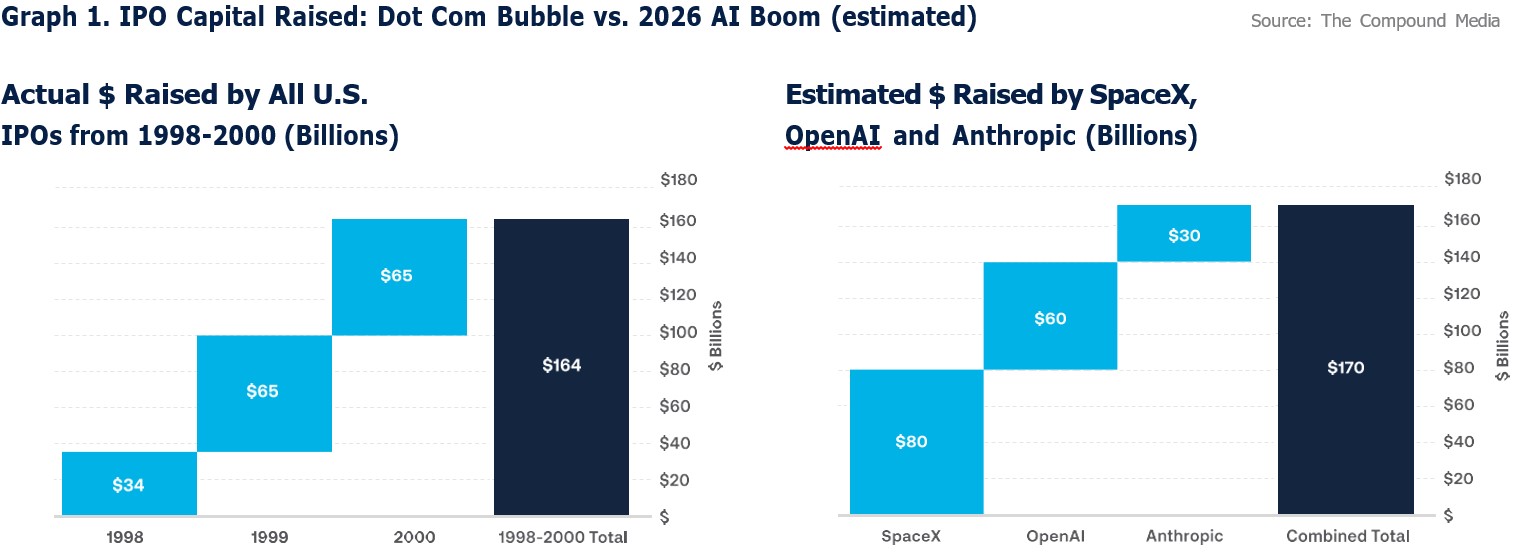
A historic IPO wave may be approaching: SpaceX, OpenAI, and Anthropic are expected to pursue public listings at valuations that could collectively reach $4–5 trillion, raising over $170 billion in primary capital.
Revenue scale is real, but so are the losses, many of these companies are already generating billions in revenue, yet AI-native firms like OpenAI face operating losses potentially reaching $14 billion in 2026, with profitability not expected until 2029–2030.
Passive indices could become automatic buyers at massive scale with roughly $12.8 trillion tracking benchmarks like the Russell 1000 and Nasdaq 100. At the same time, inclusion of mega IPOs could mechanically force index funds to absorb close to 25% of offerings like SpaceX, triggering significant portfolio rebalancing across the market.
Direct IPO access will be limited for most investors as allocations are typically controlled by underwriting institutions, though some exposure may be available through select mutual funds, private equity vehicles, and ETFs that hold pre-IPO positions in companies like SpaceX.
On August 2, 2018, Apple became the first company in history to surpass a USD 1.0 trillion market capitalization. At the time, the milestone felt almost symbolic, a valuation so large that many assumed it would remain exceptional for years. Instead, it marked the start of one of the most significant periods of wealth creation in public markets. Less than a decade later, the landscape has shifted dramatically. Fifteen companies have crossed the trillion-dollar threshold, and the upper bound of the market now approaches USD 5.0 trillion. What once defined corporate scale has increasingly become the entry ticket for global market leaders.
Artificial intelligence has accelerated this trend. Capital is concentrating on a small group of companies building the infrastructure, software, and models expected to define the next technological cycle. At the same time, some of the largest private companies in history are preparing for public listings. This naturally raises a key question: why now? To answer it, it is useful to examine how equity markets reached this point and what the next phase may look like.
Since Apple crossed the trillion-dollar mark, the S&P 500’s total market capitalization has expanded from roughly USD 21.8 trillion to USD 73.8 trillion, a 3.4x increase in less than eight years. Over the same period, the index rose from 2,827 to 7,610, delivering over 200% in total returns. Concentration at the top has intensified: Nvidia, Apple, Alphabet, Microsoft, and Amazon now represent more than USD 18.5 trillion in combined value, nearly matching the entire S&P 500 in 2018. Against this backdrop, potential IPOs from companies like SpaceX and Anthropic at or near USD 1.0 trillion no longer appear exceptional but increasingly expected.
Despite this backdrop, IPO activity has remained subdued in recent years. In 2021, abundant liquidity and post pandemic optimism drove 287 U.S. listings. That momentum faded as the Federal Reserve tightened policy and financial conditions deteriorated, leading to weaker issuance and compressed valuations from 2022 to 2024. Conditions began to recover in 2025 as artificial intelligence reignited equity markets, with 105 IPOs during the year. This reopening sets the stage for what could be the most anticipated listings in recent history, including SpaceX, Anthropic, and OpenAI. Together, they could reach a combined valuation of USD 4.0–5.0 trillion and raise more than USD 170 billion in primary capital.
SpaceX as a key driver has less to do with technology and more with market structure. Passive investing is creating mechanical demand. Changes to benchmark inclusion rules across indices such as the Russell 1000, Nasdaq 100, and potentially the S&P 500 could force index-tracking funds to become automatic buyers of mega IPOs. With roughly USD 12.8 trillion tracking these indices, passive flows alone could absorb close to 25%
of shares in offerings such as SpaceX according to Bloomberg. Every new inclusion requires rebalancing, meaning passive investors would likely sell existing holdings to fund purchases of newly listed names.
Active managers face a different constraint: speed. Allocation is discretionary, so early positioning can translate into a fundraising advantage, enabling faster scaling and access to the computing capacity required to compete in the AI race. Recent markets illustrate this dynamic. Cerebras, a wafer-scale AI processor and supercomputing company, went public in May 2026 and surged more than 60% on its first trading day as investors rushed into AI infrastructure exposure, underscoring the scarcity premium attached to these assets. This helps explain why leading private companies may be accelerating listings. Early entrants benefit from strong sentiment, passive inflows, and limited competition for capital. These advantages tend to weaken as more issuers enter the market. The bull case is that equity markets remain deep enough to absorb these offerings without disruption. The bear case is that investors fund participation by rotating out of existing mega cap technology positions, shifting exposure within AI rather than expanding total inflows. Either way, the scale of these IPOs is likely to reshape positioning well beyond the companies themselves.
Seemingly Solid Financial Positions
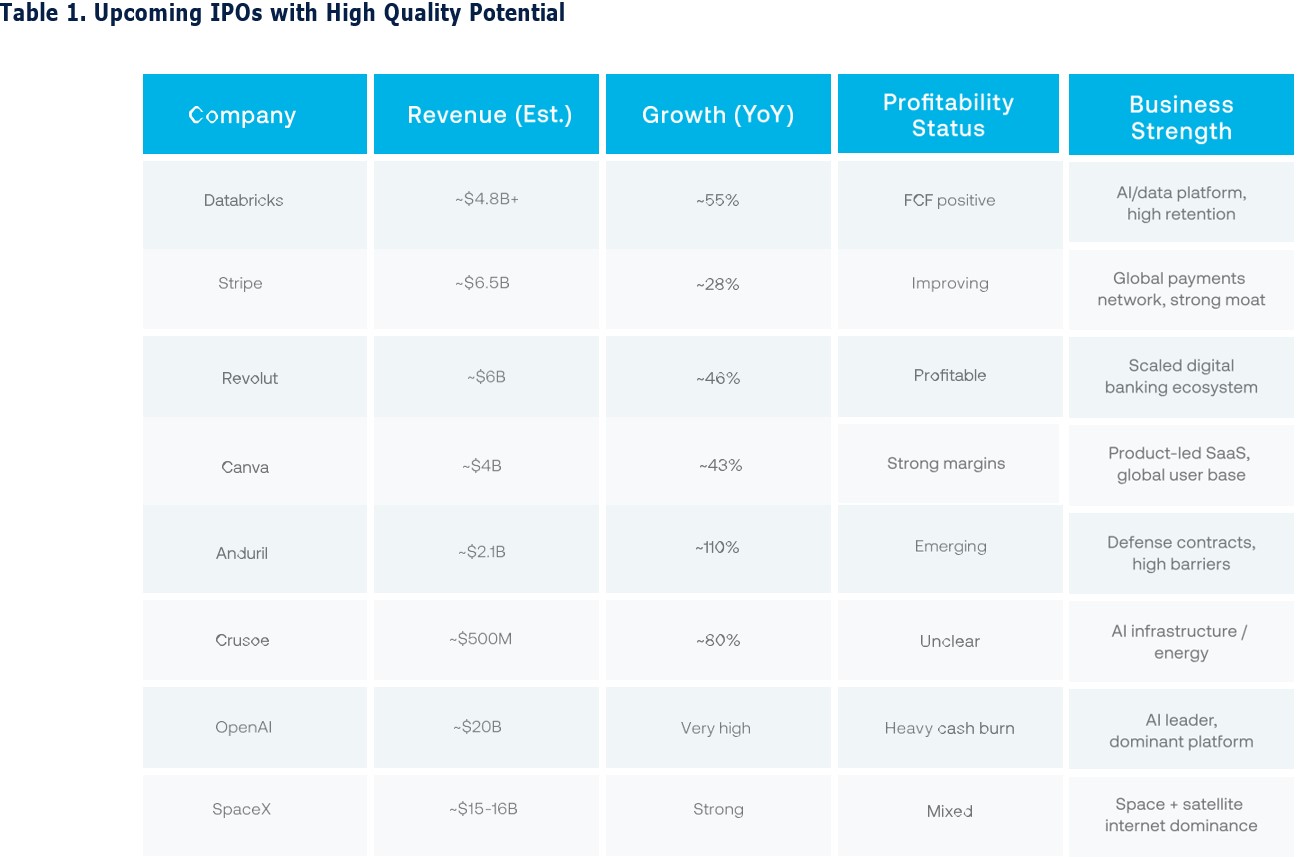
Some of the upcoming IPOs, particularly some of those outlined in Table 1, reflect a potentially high-quality group of companies distinguished by meaningful revenue scale, strong growth trajectories, and differentiated business models. At the upper end, firms such as SpaceX, OpenAI, and Anthropic could be seeing annualized revenue run rates ranging from $20-$45 billion, while others like Stripe, Revolut, Databricks, and Canva approach the $10 billion mark. Regardless of size, many of these companies are already operating at a substantial scale ahead of public market entry, combining sizable revenue bases with elevated growth rates, showcasing a potentially attractive blend of maturity and expansion potential that public market investors typically reward.
The potential for revenue growth remains a defining feature across this group, consistently exceeding traditional public market benchmarks. Anduril leads with exceptional 110% year-over-year growth, followed by Crusoe near 80% and Databricks near 55%, all benefiting from structural tailwinds tied to artificial intelligence and next-generation infrastructure. Even more mature plat-forms such as Stripe and Canva continue to deliver strong double-digit growth. OpenAI stands apart with earlier projections suggesting it could reach approximately $25–$29 billion in revenue in 2026, while management indicated a potential path toward $100 billion in revenue by 2027, highlighting the unprecedented scaling dyna-mics of generative AI.
This rapid top-line expansion, however, comes with significant margin and profitability pressures, particularly for AI-native firms. OpenAI’s gross margins declined to 33% in 2025 from 40% in 2024, falling well short of internal expectations as cloud infrastructure costs
outpaced revenue growth. The company is expected to remain in a loss-making state through at least 2028, with operating losses potentially reaching close to $14 billion in 2026 and profitability only emerging closer to 2029–2030. Over the longer term, OpenAI is targeting revenue in excess of $280 billion by 2030, but this ambition is paired with enormous projected infrastructure spending of roughly $600–$665 billion, underscoring the capital intensity required to sustain leadership in frontier AI. This insatiable hunger for capex was recently illustrated by Alphabet’s announcement that it would be raising approximately $80 billion through an equity issuance to meet capex demands. If we think about it, a company that generates $200 billion in operating cash flow per year is seemingly not generating enough to satisfy the insanely high appetite for AI, which the company is attempting to meet through projected capex of $300 billion next year.
Anthropic further illustrates both the opportunity and intensity of this AI arms race. The company’s revenue trajectory in 2026 has been extraordinarily steep, with reported annualized run rates nearing $45 billion by May, exceeding OpenAI’s estimated $33 billion run rate. While many of these figures are based on investor disclosures rather than audited results, they point to a highly competitive and rapidly evolving landscape in which scale, capital access, and infrastructure investment are critical determinants of success.
SpaceX, by contrast, highlights a different but equally compelling model of scale combined with capital intensity. The company generated $18.7 billion in revenue in 2025, up 33% year-over-year, with Starlink’s connectivity segment accounting for approximately 61% of revenue and delivering strong profitability, including $4.42 billion in operating income. However, total company results were weighed down by losses close to $5 billion, largely due to investments in adjacent initiatives such as xAI. Looking ahead, SpaceX is projected to generate close to $20 billion in revenue in 2026 from launch and Starlink combined, with Starlink representing nearly 70% of total revenue. A potential IPO valuation of up to $2 trillion reflects not only current scale but also long-term optionality tied to meaningful project development and global satellite infrastructure expansion.
Across this promising group, strong business moats underpin financial performance and strategic positioning. Stripe and OpenAI stand out as the most prominent, though for different reasons. Stripe possesses the most durable and proven moat, driven by a global payments network, deep integration, and high switching costs. OpenAI represents the most strategically significant but still evolving moat, anchored in frontier model leadership, platform dominance, and a powerful data feedback loop, though increasingly challenged by competitors like Anthropic. SpaceX offers one of the deepest industrial moats through capital intensity and regulatory barriers, while Databricks benefits from enterprise data lock-in and high switching costs. At the same time, artificial
intelligence is reshaping IPO timing across the group: companies are prioritizing scale, infrastructure, and ecosystem dominance over near-term public listings. The result is a shift toward fewer, larger, and more strategically timed IPOs, where the decision to go public is less about accessing capital and more about cementing long-term leadership in rapidly evolving markets.
Given all the hype around the upcoming IPO schedule, investors are naturally exploring different ways to get access to these potential investments. Direct IPO allocations tend to be controlled by the IPO’s underwriting institutions and allotted to a limited group of participants selected by these institutions. However, investors could potentially get exposure to some of the upcoming IPOs, like SpaceX, through Private Equity vehicles from houses such as Step Stone, certain mutual funds like the Baron Partners Fund (BPTRX) and Neuberger Quality Equity Fund (NBSRX), as well as ETFs such as the ERShares Private-Public Crossover ETF (XOVR). Although these investment vehicles do not represent a pure-play avenue for exposure, they may provide potential investors with ways to get limited access to some of these companies. It is important to note that we are not endorsing any of these products for investment, just presenting some ideas for potential consideration. Additionally, the investments held in these vehicles may not be representative of the entire group of potential IPOs mentioned above and may provide access to a limited number of companies. Lastly, these investment vehicles carry varying levels of risk and could present potential suitability challenges for some investors and are best evaluated on a case-by-case basis. Please feel free to reach out to your financial advisor with any questions.
Ultimately, the convergence of unprecedented scale in public markets, the capital intensity of artificial intelligence, and a structurally supportive IPO environment is setting the stage for a new wave of market leaders to emerge. Companies such as SpaceX, OpenAI, Anthropic, and others are entering public markets with levels of revenue, growth, and strategic importance that rival today’s largest incumbents, even as they navigate significant investment demands and competitive pressures. Whether driven by passive flows, active positioning, or the necessity to fund massive infrastructure buildouts, these listings have the potential to redefine market concentration and leadership in the years ahead—harkening back to this central question: which of these companies will ultimately enter the trillion-dollar club?
Important Disclosures
Insigneo Financial Group, LLC comprises a number of operating businesses engaged in the offering of brokerage and advisory products and services in various jurisdictions. Brokerage products and services are offered through Insigneo Securities, LLC, a broker-dealer registered with the U.S. Securities and Exchange Commission (“SEC”) and member of FINRA and SIPC. Investment advisory products and services are offered through Insigneo Advisory Services, LLC, an investment adviser registered with the SEC. Insigneo has affiliated companies in different locations, so it is important to understand which entity you are conducting business with. Please visit https://insigneo.com/legalentities/ for more information about the differences between these companies, their locations, and what that means for you.
This material should not be construed as an offer to sell or the solicitation of an offer to buy any security. It is for general information purposes only. To the extent that this material discusses general market activity, industry or sector trends or other broad-based economic or political conditions, it should not be construed as research or investment advice. To the extent that it includes references to securities, those references do not constitute a recommendation to buy, sell or hold such security. It does not constitute a recommendation or a statement of opinion, or a report of either of those things and does not, and is not intended, to consider the particular investment objectives, financial conditions, or needs of individual investors. Any target prices provide reflect our current expectations, are subject to change and may not be achieved due to a variety of risks, including changes in economic conditions, interest rates, geopolitical developments, and issuer-specific factors. The target price does not guarantee future results and should not be relied upon as a sole basis for investment decisions.
Not All Risks Are Disclosed – Past performance is not indicative of futures results. Investments involve significant risks, and it is possible to lose some or all of your principal investments and therefore may not be suitable for everyone. Always consider whether any investment is suitable for your particular circumstances and, if necessary, seek professional advice from your Investment Professional. This material may contain opinions, expressions, and estimates that represent the analysis and perspective of Insigneo Securities, LLC’s Investment Strategy department or its providers at the time of publication. These are subject to change at any time, without notice.
FOR AFFILIATES LOCATED IN CHILE
Insigneo Asesorías Financieras SPA se encuentra inscrito en Chile, en el Registro de Prestadores de Servicios Financieros de la Comisión para el Mercado Financiero. Este informe fue efectuado por área de Research & Strategy de Insigneo Securities LLC. o sus proveedores, en base a la información disponible a la fecha de emisión de este. Para evitar cualquier conflicto de interés, Insigneo Securities LLC dispone que ningún integrante del equipo de Research & Strategy tenga su remuneración asociada directa o indirectamente con una recomendación o reporte específico o con el resultado de una cartera.
Aunque los antecedentes sobre los cuales ha sido elaborado este informe fueron obtenidos de fuentes consideradas confiables, no podemos garantizar la completa exactitud e integridad de estos, no asumiendo responsabilidad alguna al respecto Insigneo Securities LLC, Insigneo Asesorías Financieras SPA ni ninguna de sus empresas relacionadas.
Este material está destinado únicamente a facilitar el debate general y no pretende ser fuente de ninguna recomendación específica para una persona concreta. Por favor, consulte con su ejecutivo de cuentas o con su asesor financiero si alguna de las recomendaciones específicas que se hacen en este documento es adecuada para usted. Este documento no constituye una oferta o solicitud de compra o venta de ningún valor en ninguna jurisdicción en la que dicha oferta o solicitud no esté autorizada o a ninguna persona a la que sea ilegal hacer dicha oferta o solicitud. Las inversiones en cuentas de corretaje y de asesoramiento de inversiones están sujetas al riesgo de mercado, incluida la pérdida de capital.
La información base del presente informe puede sufrir cambios, no teniendo Insigneo Securities LLC ni Insigneo Asesorías Financieras SPA la obligación de actualizar el presente informe ni de comunicar a sus destinatarios sobre la ocurrencia de tales cambios. Cualquier opinión, expresión, estimación y/o recomendación contenida en este informe constituyen el juicio o visión de área de Research & Strategy de Insigneo Securities LLC. o sus proveedores, a la fecha de su publicación y pueden ser modificadas sin previo aviso.
FOR AFFILIATES LOCATED IN URUGUAY
Insigneo Asesor Uruguay S.A. está inscripto en el Registro de Mercado de Valores del Banco Central del Uruguay como Asesor de Inversiones. En Uruguay, los valores están siendo ofrecidos en forma privada de acuerdo al artículo 2 de la ley 18.627 y sus modificaciones. Los valores no han sido ni serán registrados ante el Banco Central del Uruguay para oferta pública. Este material está destinado únicamente a facilitar el debate general y no pretende ser fuente de ninguna recomendación específica para una persona concreta. Por favor, consulte con su ejecutivo de cuentas o con su asesor financiero si alguna de las recomendaciones específicas que se hacen en este documento es adecuada para usted según su perfil y estrategia de inversión. Este documento no constituye un asesoramiento ni una recomendación u oferta o solicitud de compra o. Las inversiones en valores negociables están sujetas al riesgo de mercado, incluida la pérdida parcial o total del capital invertido. Cualquier opinión, expresión, estimación y/o recomendación contenida en este informe constituyen el juicio o visión de área de Research & Strategy de Insigneo Securities LLC. o sus proveedores, a la fecha de su publicación y pueden ser modificadas sin previo aviso. Rentabilidades históricas de los productos anunciados no aseguran rentabilidades futuras..
FOR AFFILIATES LOCATED IN ARGENTINA
Insigneo Argentina S.A.U. Agente Asesor Global de Inversión se encuentra registrado bajo el N° 1053 de la Comisión Nacional de Valores (CNV) e inscripto ante la Inspección General de Justicia (IGJ) bajo el N° 12.278 del Libro 90, Tomo –, de Sociedades por Acciones. Este informe fue efectuado por área de Research & Strategy de Insigneo Securities LLC. o sus proveedores, en base a la información disponible a la fecha de su emisión. Para evitar cualquier conflicto de interés, Insigneo Securities LLC dispone que ningún integrante del equipo de Research & Strategy tenga su remuneración asociada directa o indirectamente con una recomendación o reporte específico o con el resultado de una cartera. Aunque los antecedentes sobre los cuales ha sido elaborado este informe fueron obtenidos de fuentes consideradas confiables, no podemos garantizar la completa exactitud e integridad de estos, no asumiendo responsabilidad alguna al respecto Insigneo Securities LLC, Insigneo Argentina S.A.U. ni ninguna de sus empresas relacionadas. La información base del presente informe puede sufrir cambios, no teniendo Insigneo Argentina S.A.U. la obligación de actualizar el presente informe ni de comunicar a sus destinatarios sobre la ocurrencia de tales cambios.
Este material está destinado únicamente a facilitar el debate general y no pretende ser fuente de ninguna recomendación específica para una persona concreta. Por favor, consulte con su ejecutivo de cuentas o con su asesor financiero si alguna de las recomendaciones específicas que se hacen en este documento es adecuada para usted. Este documento no constituye una oferta, recomendación o solicitud de compra o venta de ningún valor negociable en ninguna jurisdicción en la que dicha oferta o solicitud no esté autorizada o a ninguna persona a la que sea ilegal hacer dicha oferta o solicitud. Las inversiones en valores negociables están sujetas al riesgo de mercado, incluida la pérdida parcial o total del capital invertido. Cualquier opinión, expresión, estimación y/o recomendación contenida en este informe constituyen el juicio o visión de área de Research & Strategy de Insigneo Securities LLC. o sus proveedores, a la fecha de su publicación y pueden ser modificadas sin previo aviso.
DM Wealth Management Group is the “doing business as entity” through which Cristina Mendez, Zoraida Diaz, and Debra Tyler, investment professionals (“IP”) of Insigneo Securities, LLC (“ISEC”) and Insigneo Advisory Services, LLC (“IAS”) conducts securities and advisory activities DM Wealth Management Group is not itself a broker dealer or an investment advisor and is not under common ownership with ISEC or IAS. Insigneo Financial Group, LLC comprises a number of operating businesses engaged in the offering of brokerage and advisory products and services in various jurisdictions. Brokerage products and services are offered through Insigneo Securities, LLC, a broker-dealer registered with the U.S. Securities and Exchange Commission (“SEC”) and member of FINRA and SIPC. Investment advisory products and services are offered through Insigneo Advisory Services, LLC, an investment adviser registered with the SEC. Insigneo has affiliated companies in different locations, so it is important to understand which entity you are conducting business with. Please visit "https://insigneo.com/legalentities" for more information about the differences between these companies, their locations, and what that means for you.
Investing involves risk, including possible loss of principal. Past performance is not indicative of future results. Please consult your Investment Professional for any recommendation regarding your specific financial situation.
Click on the following links to view ISEC Reg BI Client Relationship Summary (“Form CRS”) and IAS Form ADV Part 3 CRS.
The following content is provided by Insigneo, the firm through which DM Wealth Management’s investment professionals offer brokerage and advisory services. Visit insigneo.com to learn more.