

July 10, 2026

Stay up to date with the inisghts from our Research Team.
Hydration Break: El Super Niño
This is currently very relevant, after the meteorological community announced that yet another El Niño began last June.



Investment Strategist
El Niño is a recurring climate phenomenon that alters weather patterns globally, creating droughts in some regions and excessive rainfall in others. The current episode could intensify global warming and increase the frequency of weather-related disruptions across economies and markets.
Agricultural commodities are among the most vulne-rable areas, as major crop-producing countries face unfavorable growing conditions. Reduced supply can contribute to higher food prices, creating inflationary pressure and lowering consumer purchasing power in many countries.
Beyond agriculture, weather disruptions can affect mining operations, transportation networks, and energy generation. These interruptions may tighten supplies of key raw materials and increase production costs across several industries.
From an investment perspective, the impacts are often uneven, creating both opportunities and risks. Companies tied to agricultural inputs, water manage-ment, and certain commodities may benefit, while businesses exposed to rising food and raw-material costs could face margin pressure.
Often, the climate conversation revolves around when the Earth will experience an extreme El Niño. This is currently very relevant, after the meteorological community announced that yet another El Niño began last June. Today’s weather conditions seem to be siding with climate experts who have been warning about the consequences of global warming. Given that these consequences permeate various economic and social layers, we wanted to revisit what it means when an El Niño develops, how it can affect markets and raw material supplies, and how investors can position to navigate it.
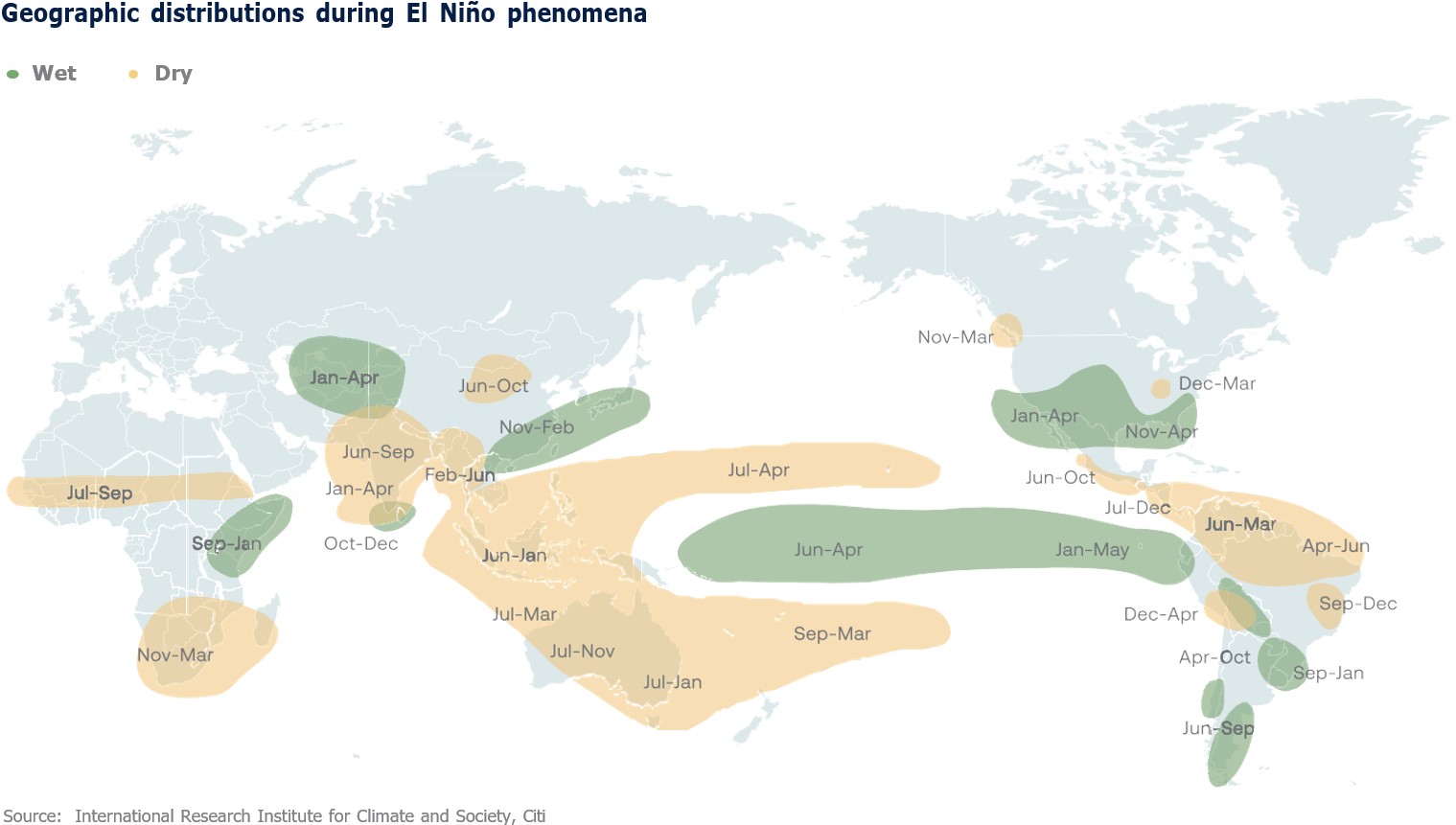
According to the National Oceanic and Atmospheric Administration (NOAA), El Niño is a natural climate phenomenon that occurs when the surface waters of the central and eastern tropical Pacific Ocean become warmer than normal, and the usual easterly trade winds weaken. This phenomenon is part of a larger climate cycle called the El Niño–Southern Oscillation (ENSO). Whenever an El Niño occurs, the trade winds that usually push warm surface water towards Asia and Australia and allow cooler water to rise near the coast of South America weaken, causing warm water to spread east across the Pacific Ocean. Additional effects of El Niño include intense heat and deficient rainfall conditions in South Asia, ASEAN countries, Australia, Central America, Colombia, and many other parts of the world. In contrast, this pheno-menon causes heavier rains in East Africa and on the western and southern coasts of South America. This map illustrates the global impact.
Translating this framework into current conditions and the outlook looks bleak. According to models developed by the University of Miami, the current El Niño could push global warming as high as 2°C. For context, the world currently sits at 1.4°C above pre-industrial levels. Furthermore, the Earth’s warming trend has worsened since 2010, with four times as many new heat records set from 2016 to 2024 versus a baseline level. The last three years are among the three hottest years ever recorded, according to Bloomberg. This hotter Earth has caused accelerated glacial melting, which in turn reduces the amount of sunlight reflected back to space. Ultimately, this energy imbalance could lead models to underpredict future warming trends, according to Phil Duffy, chief scientist of Spark Climate Solutions.
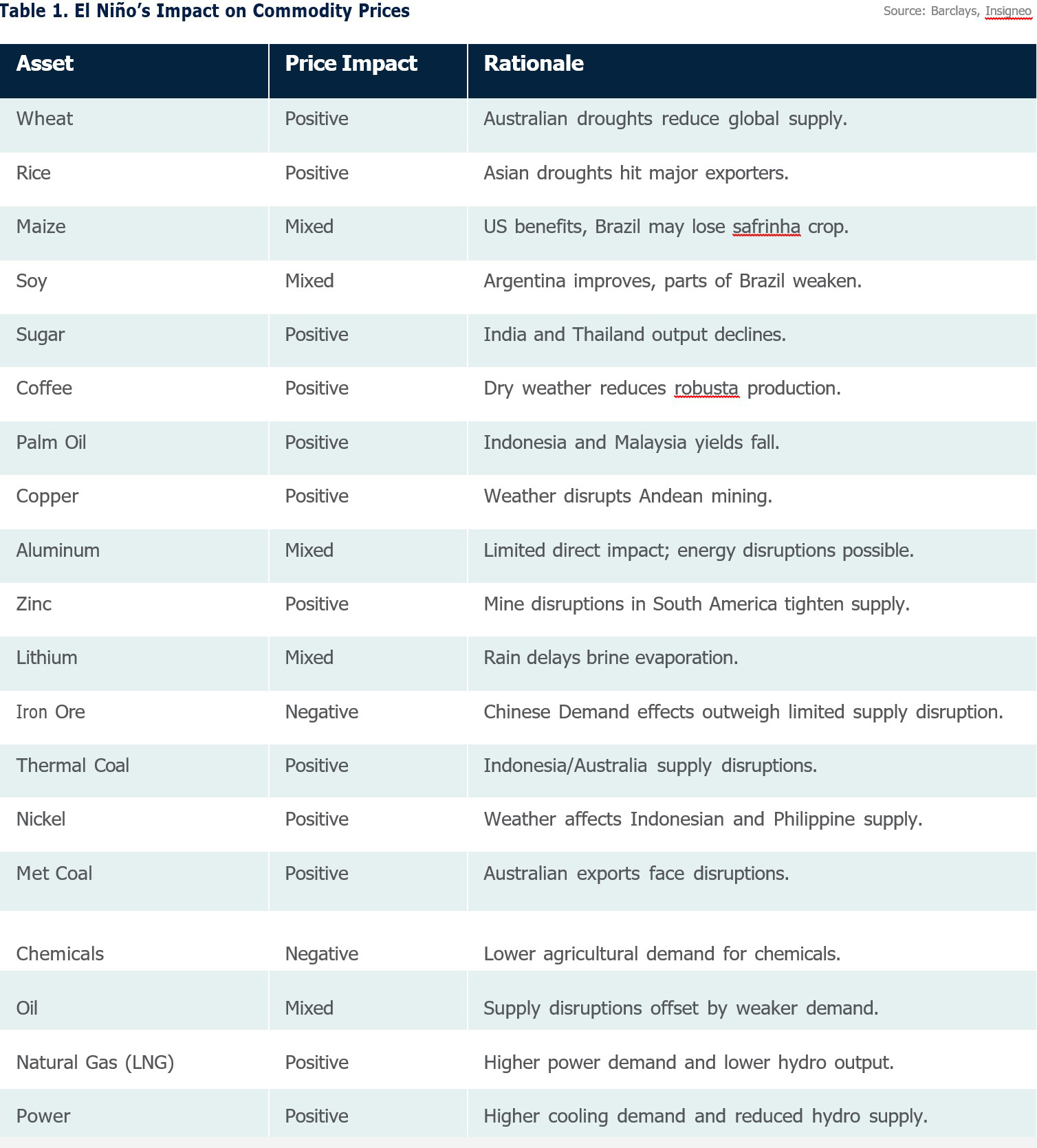
The world may be transitioning from one commodity shock to another. Just as the Strait of Hormuz conflict triggered sharp price spikes across energy markets, investors may now face the consequences of a potential Super El Niño shock. Unlike geopolitical disruptions, El Niño affects regions unevenly, producing highly diffe-rentiated impacts across commodities. The magnitude of these moves will depend on weather intensity, supply chain disruptions, inventory levels, and geographic production concentration.
While energy and industrial metals will face disruptions, food remains El Niño’s most important transmission channel. Economies highly dependent on agriculture are likely to face the greatest stress as weather-driven supply disruptions push food prices higher. In emerging markets such as the Philippines, where rice alone accounts for nearly 8.9% of the CPI basket, agricultural shocks can quickly translate into inflation. As with the Hormuz disruption, the ultimate macroeconomic conse-quence of El Niño is likely to be lower household dispo-sable income in places where food represents a signi-ficant proportion of consumption.
Agricultural commodities are particularly vulnerable as El Niño simultaneously creates droughts and excessive rain-fall globally. Palm oil illustrates this exposure well. Around 82% of global production is concentrated in Indonesia and Malaysia, two countries prone to drought during El Niño episodes. According to the Malaysian financial services firm MBSB, crude palm oil prices have historically risen between 10% and 75% during these events.
Sugar faces similar risks. India and Thailand account for roughly 30% of global sugar production, making global
supply highly sensitive to adverse weather in both coun-tries. During the 2014 Super El Niño, ICE raw sugar prices surged nearly 140% as cumulative production losses exceeded 10 million metric tons. Coffee markets are equally exposed. Brazil and Vietnam together produce more than half of the world’s coffee, and both expe-rience drought during El Niño years. In 2023, expecta-tions of a strong event pushed Robusta prices up approximately 58%, reaching multi-decade highs. Similar dynamics extend to grains such as maize, wheat, and rice, as well as oilseeds, tightening food supplies while increasing feed costs.
Higher grain prices represent a second-order effect for livestock markets, where feed represents roughly 60% to 70% of operating expenses. Livestock prices typi-cally follow a two-phase cycle during El Niño. Initially, drought forces ranchers to liquidate herds as pasture deteriorates, temporarily pushing prices lower. Once herd sizes shrink, meat supplies tighten, and prices rise sharply. The United States experienced this dynamic in 2022, when drought reduced cattle prices by roughly 25%. One year later, the national herd had fallen to its lowest level in 73 years, driving feeder cattle futures up by approximately 63%.
Industrial metals are more affected through disruptions to production and logistics, facing challenges in both dry and wet scenarios. Most mining operations rely on open pit extraction, making them especially vulnerable to heavy rainfall. At the same time, droughts reduce hydro-power generation, raising electricity costs for energy intensive mining and refining operations. In addition, floo-ding can also disrupt railways and ports, compounding supply losses. Brazil’s mining and metals industry is a good case study. While the country’s northern regions typically experience drought during El Niño, the south often faces intense rainfall. For example, Vale (VALE), one of the world’s largest metals and mining companies, operates in Minas Gerais, a region particularly exposed to wet conditions. For iron ore extraction, the company has historically reported production 15% to 20% below normal levels during rainy seasons.
Among industrial metals, copper, aluminum, lithium, zinc, and iron ore appear to be the most vulnerable. Chile and Peru account for approximately 37% of global copper production, making supply susceptible to rainfall-related disruptions in both mining and transportation. Lithium and zinc share similar exposure through their reliance on open pit mining, with Chile producing roughly 19% of global lithium and Peru accounting for about 10% of zinc output. Aluminum is exposed through a different mecha-nism. China produces more than 60% of global aluminum, and much of its smelting capacity depends on hydro-power. Drought-induced electricity shortages increase production costs, providing support for aluminum prices even without direct disruptions to mining activity.
Electricity systems generally operate according to a merit order, dispatching the lowest-cost generation first. Hydropower typically sits at the bottom of this cost curve, making it the preferred source of electricity where avai-lable. During El Niño, however, drought reduces reservoir levels and hydroelectric output, forcing utilities to rely on more expensive thermal generation fueled by natural gas or coal. Rising temperatures further amplify electricity demand through greater air conditioning use. In China, for example, a 1°C increase in temperature is estimated to raise residential power demand by approximately 14.5%.
Natural gas has traditionally been the preferred backup fuel because of its lower emissions and greater efficiency relative to coal. However, the Strait of Hormuz conflict has already tightened gas markets, providing additional support for thermal coal prices. Governments have conse-quently shifted their focus toward energy security. South Korea has delayed the retirement of 1.5 GW of coal-fired capacity, while Japan and Taiwan have expanded coal-based electricity generation. Historically, El Niño episodes have coincided with record LNG imports in countries such as India and thermal coal price increases ranging from 15% to 50% above pre-season levels. Against an already constrained global energy market, another widespread drought would likely reinforce demand for both fuels and keep energy prices elevated.
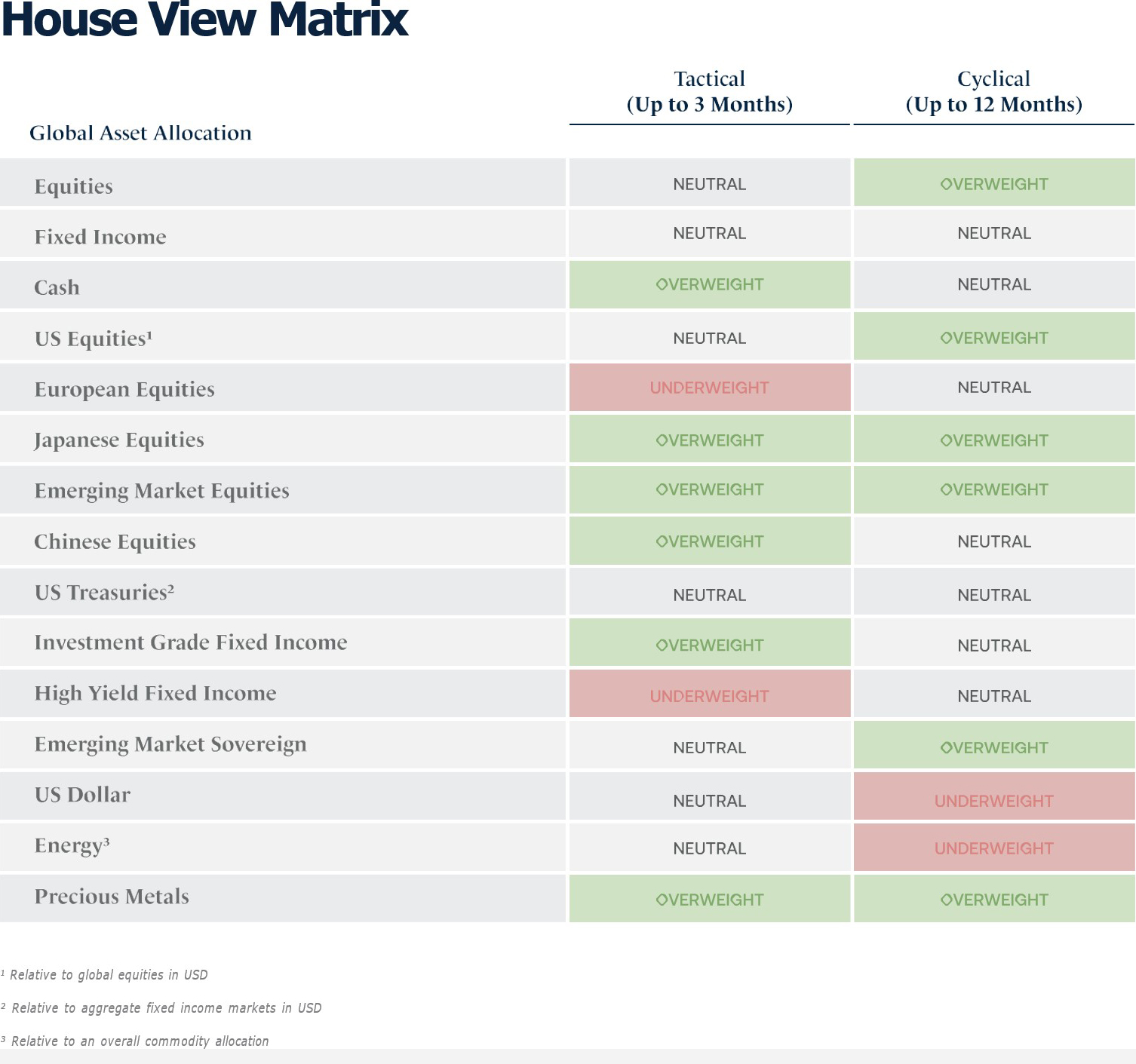
A Super El Niño is more than a weather phenomenon—it is a potential global economic and market event. By alte-ring rainfall, temperatures, and storm patterns across key agricultural and mining regions, El Niño can affect commodity production, transportation networks, energy markets, and ultimately corporate earnings. Historically, some of the largest impacts have been felt in agricul-tural commodities such as coffee, sugar, cocoa, and grains, while metals such as copper have also expe-rienced supply disruptions.
The companies most affected by El Niño are often those with significant exposure to commodity prices rather than those directly exposed to weather.
Agricultural input providers can benefit when crop prices rise because farmers often increase spending on fertili-zers, crop protection chemicals, improved seeds, and irri-gation technologies to protect yields and maximize production. Companies frequently cited as potential bene-ficiaries include Nutrien (NTR), Corteva (CTVA), CF Industries (CF), and Mosaic (MOS). At the same time, agri-cultural merchants such as Archer Daniels Midland (ADM) and Bunge Global (BG) may also benefit from increased market volatility, as regional supply dislocations can create opportunities for merchandising, trading, storage, and logistics optimization. Additionally, water-management and irrigation companies, including Lindsay Corporation (LNN), Valmont Industries (VMI), and Xylem (XYL), could see increased demand if drought conditions intensify and water efficiency becomes a higher priority. Lastly, in the mining sector, copper producers such as Freeport-McMoRan (FCX), Southern Copper (SCCO), and Antofagasta could potentially benefit from stronger copper prices if weather-related disruptions tighten supply.
On the other hand, food manufacturers often face the greatest pressure because agricultural commodities are critical inputs. Companies such as Hershey (HSY), Mondelez (MDLZ), Nestlé (NESN), General Mills (GIS), and Kraft Heinz (KHC) may encounter margin pressure if cocoa, coffee, sugar, wheat, or vegetable oil prices rise faster than they can pass costs on to consumers. At the same time, beverage companies can be particularly sensitive to coffee price volatility, resulting in Starbucks (SBUX), JDE Peet’s, and Keurig Dr Pepper (KDP) expe-riencing higher raw-material costs if coffee-producing regions suffer weather-related production shortfalls. Even Consumer Staples companies with substantial emerging-market exposure, including Unilever (UL), Procter & Gamble (PG), and Colgate-Palmolive (CL), may face slower demand growth if food inflation erodes household purchasing power in agricultural economies.
On the ETF side, although there is no dedicated “El Niño ETF,” investors interested in getting exposure to this theme could potentially do so through commodity and agribusi-ness-oriented investment vehicles. The Invesco DB Agriculture Fund (DBA) offers exposure to a basket of agri-cultural futures including corn, wheat, soybeans, sugar, and coffee. Agribusiness investors could also potentially consider the VanEck Agribusiness ETF (MOO), whose holdings often include Nutrien, Corteva, ADM, and other companies that may benefit from stronger agricultural spending. Investors looking for copper exposure may consider the Global X Copper Miners ETF (COPX), which provides exposure to copper-producing companies, or the United States Copper Index Fund (CPER).
Despite the appeal of the investment thesis, significant risks remain. First, weather forecasts are notoriously uncertain. El Niño may develop later than expected, weaken, or produce less severe disruptions than scien-tists anticipate. In such cases, commodity prices can fall despite widespread expectations of shortages. Second, supply disruptions do not automatically guarantee higher prices. Demand matters. A slowdown in China, weaker global industrial activity, or recessionary condi-tions can offset supply constraints, particularly in commodities such as copper. Third, investors should also remember that not all commodities react the same way. Some grain-producing regions may actually benefit from El Niño-related rainfall patterns, resulting in improved yields rather than shortages.
For investors, El Niño is best viewed as a potential global supply shock rather than a simple weather event. The most direct exposures are typically found in cocoa, coffee, sugar, selected grains, and copper. Potential beneficiaries include fertilizer producers, agricultural merchants, irrigation companies, and copper miners, while food manufacturers and beverage companies suffer as input costs rise. However, successful investing around El Niño requires careful attention to valuation, timing, demand conditions, and the possibility that markets have already discounted the expected weather impact.
Ultimately, El Niño is not simply an agricultural event. Through its effects on food, industrial materials, and energy markets, it represents a broad inflationary shock with important macroeconomic implications. Countries with significant agricultural production or heavy reliance on hydropower, such as Brazil and Colombia, are likely to face persistent inflationary pressures that could delay monetary easing and support higher interest rate diffe-rentials. For investors, understanding these transmission channels will be essential to identifying the sectors and commodities best positioned to benefit from a potential Super El Niño. Although El Niño can potentially turn weather forecasts into investment theses, investors should remember that markets, like the climate, rarely move in a straight line.
It is important to note that we are not endorsing any of the stocks or ETFs mentioned above for investment, just presenting ideas for potential consideration. These investments carry varying levels of risk, are not suitable for every investor, and are best evaluated on a case-by-case basis. Please consult with your financial advisor before investing.
Insigneo Financial Group, LLC comprises a number of operating businesses engaged in the offering of brokerage and advisory products and services in various jurisdictions. Brokerage products and services are offered through Insigneo Securities, LLC, a broker-dealer registered with the U.S. Securities and Exchange Commission (“SEC”) and member of FINRA and SIPC. Investment advisory products and services are offered through Insigneo Advisory Services, LLC, an investment adviser registered with the SEC. Insigneo has affiliated companies in different locations, so it is important to understand which entity you are conducting business with. Please visit https://insigneo.com/legalentities/ for more information about the differences between these companies, their locations, and what that means for you.
This material should not be construed as an offer to sell or the solicitation of an offer to buy any security. It is for general information purposes only. To the extent that this material discusses general market activity, industry or sector trends or other broad-based economic or political conditions, it should not be construed as research or investment advice. To the extent that it includes references to securities, those references do not constitute a recommendation to buy, sell or hold such security. It does not constitute a recommendation or a statement of opinion, or a report of either of those things and does not, and is not intended, to consider the particular investment objectives, financial conditions, or needs of individual investors. Any target prices provide reflect our current expectations, are subject to change and may not be achieved due to a variety of risks, including changes in economic conditions, interest rates, geopolitical developments, and issuer-specific factors. The target price does not guarantee future results and should not be relied upon as a sole basis for investment decisions.
Not All Risks Are Disclosed – Past performance is not indicative of futures results. Investments involve significant risks, and it is possible to lose some or all of your principal investments and therefore may not be suitable for everyone. Always consider whether any investment is suitable for your particular circumstances and, if necessary, seek professional advice from your Investment Professional. This material may contain opinions, expressions, and estimates that represent the analysis and perspective of Insigneo Securities, LLC’s Investment Strategy department or its providers at the time of publication. These are subject to change at any time, without notice.
FOR AFFILIATES LOCATED IN CHILE
Insigneo Asesorías Financieras SPA se encuentra inscrito en Chile, en el Registro de Prestadores de Servicios Financieros de la Comisión para el Mercado Financiero. Este informe fue efectuado por área de Research & Strategy de Insigneo Securities LLC. o sus proveedores, en base a la información disponible a la fecha de emisión de este. Para evitar cualquier conflicto de interés, Insigneo Securities LLC dispone que ningún integrante del equipo de Research & Strategy tenga su remuneración asociada directa o indirectamente con una recomendación o reporte específico o con el resultado de una cartera.
Aunque los antecedentes sobre los cuales ha sido elaborado este informe fueron obtenidos de fuentes consideradas confiables, no podemos garantizar la completa exactitud e integridad de estos, no asumiendo responsabilidad alguna al respecto Insigneo Securities LLC, Insigneo Asesorías Financieras SPA ni ninguna de sus empresas relacionadas.
Este material está destinado únicamente a facilitar el debate general y no pretende ser fuente de ninguna recomendación específica para una persona concreta. Por favor, consulte con su ejecutivo de cuentas o con su asesor financiero si alguna de las recomendaciones específicas que se hacen en este documento es adecuada para usted. Este documento no constituye una oferta o solicitud de compra o venta de ningún valor en ninguna jurisdicción en la que dicha oferta o solicitud no esté autorizada o a ninguna persona a la que sea ilegal hacer dicha oferta o solicitud. Las inversiones en cuentas de corretaje y de asesoramiento de inversiones están sujetas al riesgo de mercado, incluida la pérdida de capital.
La información base del presente informe puede sufrir cambios, no teniendo Insigneo Securities LLC ni Insigneo Asesorías Financieras SPA la obligación de actualizar el presente informe ni de comunicar a sus destinatarios sobre la ocurrencia de tales cambios. Cualquier opinión, expresión, estimación y/o recomendación contenida en este informe constituyen el juicio o visión de área de Research & Strategy de Insigneo Securities LLC. o sus proveedores, a la fecha de su publicación y pueden ser modificadas sin previo aviso.
FOR AFFILIATES LOCATED IN URUGUAY
Insigneo Asesor Uruguay S.A. está inscripto en el Registro de Mercado de Valores del Banco Central del Uruguay como Asesor de Inversiones. En Uruguay, los valores están siendo ofrecidos en forma privada de acuerdo al artículo 2 de la ley 18.627 y sus modificaciones. Los valores no han sido ni serán registrados ante el Banco Central del Uruguay para oferta pública. Este material está destinado únicamente a facilitar el debate general y no pretende ser fuente de ninguna recomendación específica para una persona concreta. Por favor, consulte con su ejecutivo de cuentas o con su asesor financiero si alguna de las recomendaciones específicas que se hacen en este documento es adecuada para usted según su perfil y estrategia de inversión. Este documento no constituye un asesoramiento ni una recomendación u oferta o solicitud de compra o. Las inversiones en valores negociables están sujetas al riesgo de mercado, incluida la pérdida parcial o total del capital invertido. Cualquier opinión, expresión, estimación y/o recomendación contenida en este informe constituyen el juicio o visión de área de Research & Strategy de Insigneo Securities LLC. o sus proveedores, a la fecha de su publicación y pueden ser modificadas sin previo aviso. Rentabilidades históricas de los productos anunciados no aseguran rentabilidades futuras.
FOR AFFILIATES LOCATED IN ARGENTINA
Insigneo Argentina S.A.U. Agente Asesor Global de Inversión se encuentra registrado bajo el N° 1053 de la Comisión Nacional de Valores (CNV) e inscripto ante la Inspección General de Justicia (IGJ) bajo el N° 12.278 del Libro 90, Tomo –, de Sociedades por Acciones. Este informe fue efectuado por área de Research & Strategy de Insigneo Securities LLC. o sus proveedores, en base a la información disponible a la fecha de su emisión. Para evitar cualquier conflicto de interés, Insigneo Securities LLC dispone que ningún integrante del equipo de Research & Strategy tenga su remuneración asociada directa o indirectamente con una recomendación o reporte específico o con el resultado de una cartera. Aunque los antecedentes sobre los cuales ha sido elaborado este informe fueron obtenidos de fuentes consideradas confiables, no podemos garantizar la completa exactitud e integridad de estos, no asumiendo responsabilidad alguna al respecto Insigneo Securities LLC, Insigneo Argentina S.A.U. ni ninguna de sus empresas relacionadas. La información base del presente informe puede sufrir cambios, no teniendo Insigneo Argentina S.A.U. la obligación de actualizar el presente informe ni de comunicar a sus destinatarios sobre la ocurrencia de tales cambios.
Este material está destinado únicamente a facilitar el debate general y no pretende ser fuente de ninguna recomendación específica para una persona concreta. Por favor, consulte con su ejecutivo de cuentas o con su asesor financiero si alguna de las recomendaciones específicas que se hacen en este documento es adecuada para usted. Este documento no constituye una oferta, recomendación o solicitud de compra o venta de ningún valor negociable en ninguna jurisdicción en la que dicha oferta o solicitud no esté autorizada o a ninguna persona a la que sea ilegal hacer dicha oferta o solicitud. Las inversiones en valores negociables están sujetas al riesgo de mercado, incluida la pérdida parcial o total del capital invertido. Cualquier opinión, expresión, estimación y/o recomendación contenida en este informe constituyen el juicio o visión de área de Research & Strategy de Insigneo Securities LLC. o sus proveedores, a la fecha de su publicación y pueden ser modificadas sin previo aviso.
DM Wealth Management Group is the “doing business as entity” through which Cristina Mendez, Zoraida Diaz, and Debra Tyler, investment professionals (“IP”) of Insigneo Securities, LLC (“ISEC”) and Insigneo Advisory Services, LLC (“IAS”) conducts securities and advisory activities DM Wealth Management Group is not itself a broker dealer or an investment advisor and is not under common ownership with ISEC or IAS. Insigneo Financial Group, LLC comprises a number of operating businesses engaged in the offering of brokerage and advisory products and services in various jurisdictions. Brokerage products and services are offered through Insigneo Securities, LLC, a broker-dealer registered with the U.S. Securities and Exchange Commission (“SEC”) and member of FINRA and SIPC. Investment advisory products and services are offered through Insigneo Advisory Services, LLC, an investment adviser registered with the SEC. Insigneo has affiliated companies in different locations, so it is important to understand which entity you are conducting business with. Please visit "https://insigneo.com/legalentities" for more information about the differences between these companies, their locations, and what that means for you.
Investing involves risk, including possible loss of principal. Past performance is not indicative of future results. Please consult your Investment Professional for any recommendation regarding your specific financial situation.
Click on the following links to view ISEC Reg BI Client Relationship Summary (“Form CRS”) and IAS Form ADV Part 3 CRS.
The following content is provided by Insigneo, the firm through which DM Wealth Management’s investment professionals offer brokerage and advisory services. Visit insigneo.com to learn more.