

July 24, 2026


Between Great Expectations and Wuthering Heights: U.S. Equity Markets Kick Off Earnings Season
When we look at the 12-month forward EPS growth forecast for the S&P 500, it stands at approximately 24%, the highest figure going into an earnings season outside of post-recession periods.

Earnings expectations are unusually high heading into Q2 2026, with S&P 500 forward EPS growth forecasts near 24% and full-year 2026 earnings growth expected at roughly 34.5%, reflecting strong guidance, rising analyst estimates, and growing optimism around AI-driven profits.
High expectations increase the risk of market disap-pointment and volatility, as investors are increasingly punishing companies that merely meet, rather than significantly exceed, forecasts. Recent declines in AI-related and semiconductor stocks suggest concerns that earnings and growth expectations may have become too optimistic.
The key debate centers on AI spending and its sustain-ability, with hyperscalers continuing to invest heavily in AI infrastructure, as investors are questioning long-term returns on massive capital expenditures. While AI growth remains intact, a moderation in capex growth could shift market leadership from AI infrastructure providers toward software and AI applications, making diversification and a focus on realistic expectations increasingly important.
“Take nothing on its looks; take everything on evidence. There’s no better rule.”
Charles Dickens, Great Expectations (1861)
Uttered by the highly logical attorney, Mr. Jaggers, in Charles Dickens’ timeless novel, Great Expectations, the quote above sheds light on the dilemma currently facing investors, as U.S. equity markets enter the second-quarter 2026 earnings season. To emphasize the value of rational thought, Mr. Jaggers stresses the importance of basing expectations on cold, hard facts. However, history has taught us that equity markets are nowhere near as rational as Mr. Jaggers.
As we go into earnings season, one fact stands above all: expectations are high. I am choosing my words care-fully here, characterizing this as a fact, not an opinion. Why is that? Well, when we look at the 12-month forward EPS growth forecast for the S&P 500, it stands at approx-imately 24%, the highest figure going into an earnings season outside of post-recession periods. This elevated level of “great expectations” has been driven by very positive company guidance and bottom-up consensus estimates that have risen approximately 4.5% since the start of the last earnings season, running counter to the typical pattern of pre-season cuts from Wall Street.
The same can be said for the index’s full-year 2026 earn-ings expectations, as they remain exceptionally high. As of July 22, the consensus estimate implies approximately 34.5% full-year EPS growth for 2026. Interestingly, analysts have steadily raised their outlook throughout the
year, with 2026 consensus EPS estimates increasing from $293 at the end of January to $325 by July 22, repre-senting a cumulative gain of 11%. Unsurprisingly, the most significant upward revisions occurred between March and May, when earnings expectations rose by roughly 6%, likely reflecting stronger-than-expected first quarter earnings results and improved confidence in the macro-economic backdrop. This dynamic does underscore the market’s increasingly constructive view of corporate profit growth relative to where forecasts stood at the beginning of the year. However, Wall Street may be over-compensating, as it does not want to get caught off guard again, as it did last quarter, when earnings expectations were exceeded by company guidance.
What could this all mean for markets? Imagine a parent who has become accustomed to having his child receive only perfect grades at school, nothing short of 100%. This conditioning could lead to another perfect score not being rewarded, as it is the norm, whereas anything short of it, say a 95% score, although great for most people, is not good enough for the parent in our example. Consequently, the child is punished. This is where certain segments of the market appear to be now. These high expectations have contributed to the disproportionately large pullbacks in stocks that have not met lofty expec-tations. Consider Samsung Electronics’ recent announce-ment. Despite reporting a 19-fold surge in quarterly profit, its shares fell as much as 10% on the day it reported, as investors questioned whether AI-related earnings could continue exceeding lofty expectations. In other words, the stock fell not because the company failed to meet the market’s great expectations, but because of the fear that it will not be able to do this again next quarter. This behavior runs counter to Mr. Jaggers principle in the quote at the beginning of this piece; it was a reaction driven by fear rather than cold, hard facts.
Reactions such as that of Samsung’s stock raise an important question: what if these lofty expectations simply cannot be met, at least not immediately? Consider the mathematics behind valuation. Most people are familiar with the valuation ratio of Price to Earnings, or P/E. Basically, how much is an investor willing to pay for a dollar of earnings. The key is that as investors, we want to focus on future earnings, after all, we invest for the future, so the “E” in the P/E formula should be based on an esti-mate or expectation of what a company should be earning a year or two down the road. But what if the expectation, or the “E” in the formula is wrong? What if it is simply too high for the time being? If the “E” is too large, then the resulting “P/E” valuation could be artificially low. Math does not lie, but if its basic components are flawed, it can play tricks on our eyes. As of this writing, the P/E for the S&P 500, based on earnings estimates for the year ahead, was close to 20.8X, higher than its 10-year average of 19X, but well below the near 30X seen at the peak of the dotcom bubble. However, some players in the market are starting to worry that earnings expectations could potentially be too high, especially for technology stocks, as evidenced by the 6% and 15% respective pullbacks off recent highs, for the Nasdaq 100 and the Philadelphia Semiconductor Index, where Great Expectations may have turned into Wuthering Heights.
The term Wuthering Heights, borrowed from Emily Bronte’s classic novel, refers to a place high atop a moun-tain, lashed by violent turbulent winds. This description could not be a better fit for the high volatility seen recently in the semiconductor sector of the market, where inves-tors, chasing expectations of earnings growth approaching 100%, propelled the sector sharply higher. In fact, the Philadelphia Semiconductor Index rose more than 100% in just two and a half months. That is a signifi-cant move for a stock, let alone an index. However, this sector’s elevated position is now being lashed by violent swings in volatility, sometimes to the tune of 6% to 9% a day. Again, that is a high degree of volatility for a stock, nearly unheard of for an index. What may have spooked investors in this space to cause such violent swings? In a nutshell, capital expenditures, otherwise known as capex.
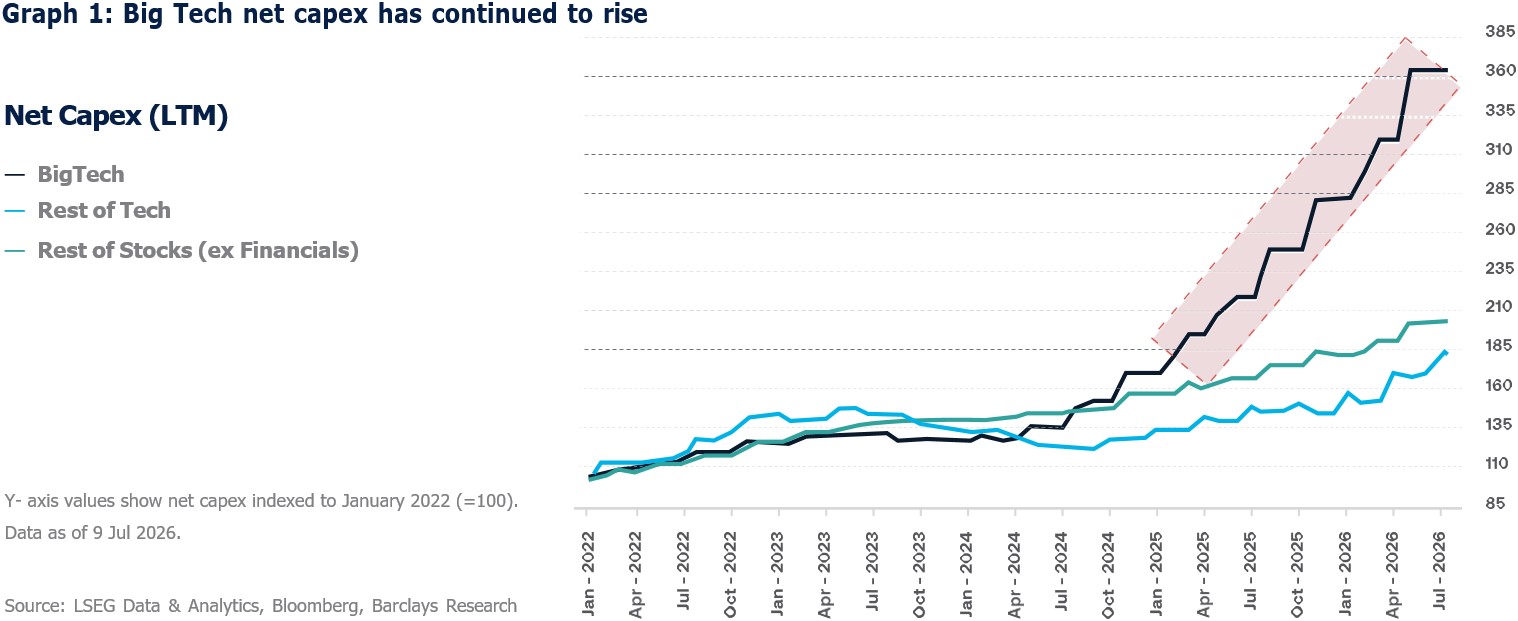
Think about it this way, in the AI race, there are two types of companies: those that spend and those that collect. On the one hand there are companies spending inordi-nate sums of money, sometimes up to $200 billion per year, to stay ahead in the race. These companies are mostly comprised of hyperscalers like Google, Amazon, Microsoft, and Meta. On the other hand, are the compa-nies receiving the spending. Here you have mostly the hardware makers, the ones making the physical products needed to run AI; companies such as Nvidia, AMD, Intel, and Micron Technologies. To get a sense of the level of spending, consider the graphs below from Barclays Research. Graph 1 highlights the nearly parabolic rise in capital expenditures over the past two years by “Big Tech”, mostly the hyperscalers, relative to other stocks in the market. Graph 2 provides additional detail, showing the main culprits behind the capex binge, as well as the nearly 75% expected growth in capex in the second quarter of this year, on a year-over-year basis.
Given the breakneck speed of capex growth, coupled with its magnitude, it is easy to understand why investors got excited about the earnings potential of the recipients of this capital. However, after many hyperscalers, traditionally known for being bastions of cash flow generation, began issuing debt to fund their appetite for capex, Wall Street began to question whether all this capex was necessary. This dynamic has become particularly acute as Wall Street increasingly demands returns, yet many of these companies have limited evidence of monetization or return on investment. If hyperscalers begin to cut their
spending in response to investors’ increasing demands for a return on AI capex, the companies that have been the recipients of these funds would also be affected.
However, as we enter this earnings season, Wall Street does not yet appear to be expecting a decline in hyper-scaler capital spending, but rather a moderation in its growth rate. After two years of AI-driven investment far exceeding expectations, Microsoft, Amazon, Alphabet, and Meta continue to signal robust demand for AI infra-structure, leading analysts to raise, rather than lower, capex forecasts. The key investor debate has shifted from whether hyperscalers will keep spending to how quickly spending growth slows, potentially from recent 50% to 100% rates to a more sustainable 10% to 20%. Concerns center on declining free cash flow, rising depreciation costs, uncertainty around AI monetization, and the risk of overcapacity if technology becomes more efficient faster than expected. A potentially slower rate of capex growth is something that investors need to monitor, this earnings season and beyond.
For semiconductors, slower hyperscaler capex growth would likely affect market segments unevenly. AI chip suppliers such as NVIDIA and AMD are most exposed, as a slower pace of infrastructure buildout could temper GPU demand growth and pressure valuation multiples, even if revenues continue rising. Memory companies such as Micron, SK Hynix, and Samsung could also see slower growth in HBM demand and weaker pricing power. Networking and optical vendors may face a more moderate impact, while semiconductor equipment makers would likely feel any slowdown later through reduced memory and foundry spending. The prevailing view is that hyper-scaler spending will remain elevated for years, though growth may moderate by 2027 or 2028. As a result, inves-tors appear to be preparing for leadership to shift gradually from AI infrastructure “picks and shovels” companies toward software, AI applications, and businesses that can
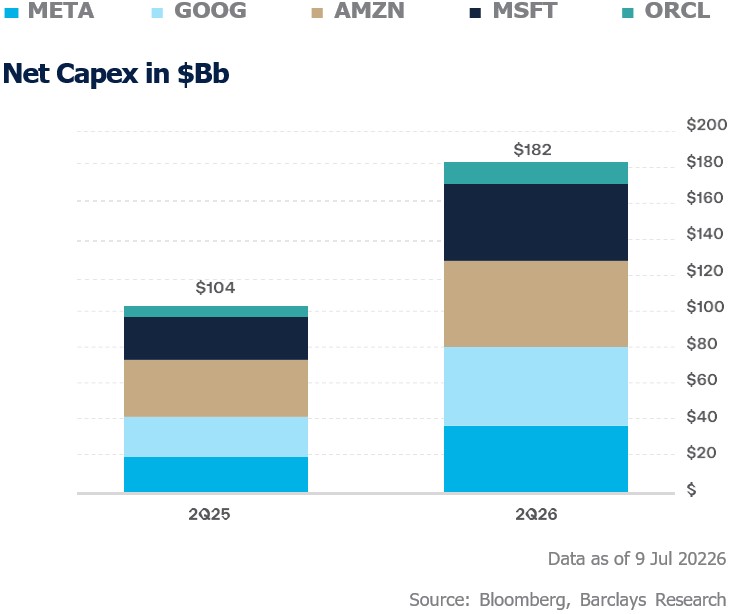 Graph 2: Capex has been driven mostly by the hyperscalers, as the net capex is expected to increase 73% in 2Q26 compared to 2Q25
monetize the large installed base of AI infrastructure. This transition will take time, and even once it occurs, the AI economy will still depend on the infrastructure supporting it. For much of the past year, we have argued that investors may be better served not by eliminating the winners of the AI rally from portfolios, but by taking some gains and diver-sifying within technology and across other sectors. We continue to believe that remains the right approach.
Perhaps the lesson for investors this earnings season lies somewhere between Great Expectations and Wuthering Heights. Markets have spent much of the past two years writing an optimistic Dickensian narrative, steadily raising earnings and AI-related growth forecasts as each quarter seemed to justify even loftier ambitions. Yet, as Emily Brontë reminds us, the higher expectations climb, the more exposed they become to turbulent winds.
Today, many of the market’s biggest winners sit atop such heights, where strong results alone may no longer be enough to satisfy increasingly demanding investors. In that environment, Mr. Jaggers’ advice may be more valu-able than ever. Investors would do well to separate evidence from emotion, focusing not just on whether expectations are high, but on whether they remain real-istic and achievable. The AI revolution is unlikely to be derailed by a moderation in capex growth, but neither are current expectations guaranteed to be realized on schedule. If Great Expectations have propelled markets upward, then occasional bouts of Wuthering Heights volatility may simply be the price of admission. The chal-lenge for investors is not to abandon the story, but to avoid becoming so captivated by the narrative that they lose sight of the facts that ultimately determine its ending.
Insigneo Financial Group, LLC comprises a number of operating businesses engaged in the offering of brokerage and advisory products and services in various jurisdictions. Brokerage products and services are offered through Insigneo Securities, LLC, a broker-dealer registered with the U.S. Securities and Exchange Commission (“SEC”) and member of FINRA and SIPC. Investment advisory products and services are offered through Insigneo Advisory Services, LLC, an investment adviser registered with the SEC. Insigneo has affiliated companies in different locations, so it is important to understand which entity you are conducting business with. Please visit https://insigneo.com/legalentities/ for more information about the differences between these companies, their locations, and what that means for you.
This material should not be construed as an offer to sell or the solicitation of an offer to buy any security. It is for general information purposes only. To the extent that this material discusses general market activity, industry or sector trends or other broad-based economic or political conditions, it should not be construed as research or investment advice. To the extent that it includes references to securities, those references do not constitute a recommendation to buy, sell or hold such security. It does not constitute a recommendation or a statement of opinion, or a report of either of those things and does not, and is not intended, to consider the particular investment objectives, financial conditions, or needs of individual investors. Any target prices provide reflect our current expectations, are subject to change and may not be achieved due to a variety of risks, including changes in economic conditions, interest rates, geopolitical developments, and issuer-specific factors. The target price does not guarantee future results and should not be relied upon as a sole basis for investment decisions.
Not All Risks Are Disclosed – Past performance is not indicative of futures results. Investments involve significant risks, and it is possible to lose some or all of your principal investments and therefore may not be suitable for everyone. Always consider whether any investment is suitable for your particular circumstances and, if necessary, seek professional advice from your Investment Professional. This material may contain opinions, expressions, and estimates that represent the analysis and perspective of Insigneo Securities, LLC’s Investment Strategy department or its providers at the time of publication. These are subject to change at any time, without notice.
FOR AFFILIATES LOCATED IN CHILE
Insigneo Asesorías Financieras SPA se encuentra inscrito en Chile, en el Registro de Prestadores de Servicios Financieros de la Comisión para el Mercado Financiero. Este informe fue efectuado por área de Research & Strategy de Insigneo Securities LLC. o sus proveedores, en base a la información disponible a la fecha de emisión de este. Para evitar cualquier conflicto de interés, Insigneo Securities LLC dispone que ningún integrante del equipo de Research & Strategy tenga su remuneración asociada directa o indirectamente con una recomendación o reporte específico o con el resultado de una cartera.
Aunque los antecedentes sobre los cuales ha sido elaborado este informe fueron obtenidos de fuentes consideradas confiables, no podemos garantizar la completa exactitud e integridad de estos, no asumiendo responsabilidad alguna al respecto Insigneo Securities LLC, Insigneo Asesorías Financieras SPA ni ninguna de sus empresas relacionadas.
Este material está destinado únicamente a facilitar el debate general y no pretende ser fuente de ninguna recomendación específica para una persona concreta. Por favor, consulte con su ejecutivo de cuentas o con su asesor financiero si alguna de las recomendaciones específicas que se hacen en este documento es adecuada para usted. Este documento no constituye una oferta o solicitud de compra o venta de ningún valor en ninguna jurisdicción en la que dicha oferta o solicitud no esté autorizada o a ninguna persona a la que sea ilegal hacer dicha oferta o solicitud. Las inversiones en cuentas de corretaje y de asesoramiento de inversiones están sujetas al riesgo de mercado, incluida la pérdida de capital.
La información base del presente informe puede sufrir cambios, no teniendo Insigneo Securities LLC ni Insigneo Asesorías Financieras SPA la obligación de actualizar el presente informe ni de comunicar a sus destinatarios sobre la ocurrencia de tales cambios. Cualquier opinión, expresión, estimación y/o recomendación contenida en este informe constituyen el juicio o visión de área de Research & Strategy de Insigneo Securities LLC. o sus proveedores, a la fecha de su publicación y pueden ser modificadas sin previo aviso.
FOR AFFILIATES LOCATED IN URUGUAY
Insigneo Asesor Uruguay S.A. está inscripto en el Registro de Mercado de Valores del Banco Central del Uruguay como Asesor de Inversiones. En Uruguay, los valores están siendo ofrecidos en forma privada de acuerdo al artículo 2 de la ley 18.627 y sus modificaciones. Los valores no han sido ni serán registrados ante el Banco Central del Uruguay para oferta pública. Este material está destinado únicamente a facilitar el debate general y no pretende ser fuente de ninguna recomendación específica para una persona concreta. Por favor, consulte con su ejecutivo de cuentas o con su asesor financiero si alguna de las recomendaciones específicas que se hacen en este documento es adecuada para usted según su perfil y estrategia de inversión. Este documento no constituye un asesoramiento ni una recomendación u oferta o solicitud de compra o. Las inversiones en valores negociables están sujetas al riesgo de mercado, incluida la pérdida parcial o total del capital invertido. Cualquier opinión, expresión, estimación y/o recomendación contenida en este informe constituyen el juicio o visión de área de Research & Strategy de Insigneo Securities LLC. o sus proveedores, a la fecha de su publicación y pueden ser modificadas sin previo aviso. Rentabilidades históricas de los productos anunciados no aseguran rentabilidades futuras.
FOR AFFILIATES LOCATED IN ARGENTINA
Insigneo Argentina S.A.U. Agente Asesor Global de Inversión se encuentra registrado bajo el N° 1053 de la Comisión Nacional de Valores (CNV) e inscripto ante la Inspección General de Justicia (IGJ) bajo el N° 12.278 del Libro 90, Tomo –, de Sociedades por Acciones. Este informe fue efectuado por área de Research & Strategy de Insigneo Securities LLC. o sus proveedores, en base a la información disponible a la fecha de su emisión. Para evitar cualquier conflicto de interés, Insigneo Securities LLC dispone que ningún integrante del equipo de Research & Strategy tenga su remuneración asociada directa o indirectamente con una recomendación o reporte específico o con el resultado de una cartera. Aunque los antecedentes sobre los cuales ha sido elaborado este informe fueron obtenidos de fuentes consideradas confiables, no podemos garantizar la completa exactitud e integridad de estos, no asumiendo responsabilidad alguna al respecto Insigneo Securities LLC, Insigneo Argentina S.A.U. ni ninguna de sus empresas relacionadas. La información base del presente informe puede sufrir cambios, no teniendo Insigneo Argentina S.A.U. la obligación de actualizar el presente informe ni de comunicar a sus destinatarios sobre la ocurrencia de tales cambios.
Este material está destinado únicamente a facilitar el debate general y no pretende ser fuente de ninguna recomendación específica para una persona concreta. Por favor, consulte con su ejecutivo de cuentas o con su asesor financiero si alguna de las recomendaciones específicas que se hacen en este documento es adecuada para usted. Este documento no constituye una oferta, recomendación o solicitud de compra o venta de ningún valor negociable en ninguna jurisdicción en la que dicha oferta o solicitud no esté autorizada o a ninguna persona a la que sea ilegal hacer dicha oferta o solicitud. Las inversiones en valores negociables están sujetas al riesgo de mercado, incluida la pérdida parcial o total del capital invertido. Cualquier opinión, expresión, estimación y/o recomendación contenida en este informe constituyen el juicio o visión de área de Research & Strategy de Insigneo Securities LLC. o sus proveedores, a la fecha de su publicación y pueden ser modificadas sin previo aviso.
DM Wealth Management Group is the “doing business as entity” through which Cristina Mendez, Zoraida Diaz, and Debra Tyler, investment professionals (“IP”) of Insigneo Securities, LLC (“ISEC”) and Insigneo Advisory Services, LLC (“IAS”) conducts securities and advisory activities DM Wealth Management Group is not itself a broker dealer or an investment advisor and is not under common ownership with ISEC or IAS. Insigneo Financial Group, LLC comprises a number of operating businesses engaged in the offering of brokerage and advisory products and services in various jurisdictions. Brokerage products and services are offered through Insigneo Securities, LLC, a broker-dealer registered with the U.S. Securities and Exchange Commission (“SEC”) and member of FINRA and SIPC. Investment advisory products and services are offered through Insigneo Advisory Services, LLC, an investment adviser registered with the SEC. Insigneo has affiliated companies in different locations, so it is important to understand which entity you are conducting business with. Please visit "https://insigneo.com/legalentities" for more information about the differences between these companies, their locations, and what that means for you.
Investing involves risk, including possible loss of principal. Past performance is not indicative of future results. Please consult your Investment Professional for any recommendation regarding your specific financial situation.
Click on the following links to view ISEC Reg BI Client Relationship Summary (“Form CRS”) and IAS Form ADV Part 3 CRS.
The following content is provided by Insigneo, the firm through which DM Wealth Management’s investment professionals offer brokerage and advisory services. Visit insigneo.com to learn more.