

July 31, 2026


Summer (Intern) Report: Are Sports Now an Investable Asset Class?
Professional sports franchises have opened to institutional capital, turning teams once treated as billionaire trophies into a fast-growing alternative asset class.


As Summer draws to a close, we wanted to wrap up our internship program by showcasing the work of our two interns, Jimena Campos and Charles Esber, students at Duquesne University and Bentley University respectively, developed under the supervision of Insigneo’s research team. With their help and insights, on this occasion, we are bringing you a fresh perspective on a timely topic, which reflects our commitment to fostering young talent as part of the Insigneo Way.
Professional sports franchises have opened to institutional capital, turning teams once treated as billionaire trophies into a fast-growing alternative asset class.
Fixed supply, media rights locked in years ahead, and franchise valuations that have outrun the S&P 500 are pulling in firms like KKR, Apollo, Blackstone, and CVC across the U.S., Europe, and Latin America.
The case is still unproven, since illiquidity, shifting rules, and the absence of a completed NFL sale mean returns rest on estimated valuations rather than realized exits, all in a market forecast to reach USD 862 billion by 2033.
For most of the last century, owning a professional sports team was a pursuit reserved for the ultra-wealthy and was rarely considered an investment option available to many. Teams were trophies, passed among wealthy families and acquired as much for status and fan loyalty as for financial returns. That era is coming to an end.
Over the past several years, major leagues in the United States, Europe, and Latin America have rewritten their ownership rules, opening the door to institutional capital for the first time. As a result, basketball, baseball, foot-ball, and soccer franchises are increasingly viewed as distinct alternative assets.
A powerful signal came in February 2026, when KKR agreed to acquire Arctos Partners for USD 1.4 billion.
For seven years, Arctos had quietly built minority stakes in dozens of teams across leagues ranging from the NBA and MLB to the English Premier League. The transaction closed in May. Its significance was not in the price paid for Arctos, but that rather than investing through a specialized manager, KKR acquired the specialist itself. The market had matured to the point where it was worth owning outright, not merely allocating capital to.
This piece examines how that transition occurred and what it means for institutional investors, the regulatory changes and economic forces driving valuations, the differences across the three regions, and the avenues through which firms such as KKR, Apollo, and Carlyle gain exposure today, along with the risks of each.
Sports teams once operated like private clubs. No law governed who could buy in, so incumbent owners selected approved buyers from their own networks, and acquisitions were often financed by a single family. In 2005, Bain Capital proposed acquiring all 30 NHL teams for a combined USD 4 billion. Today, the average NHL franchise alone is worth roughly USD 1.3 billion.
As valuations rose beyond what individual buyers could finance, leagues opened their doors to institutional capital: MLB in 2019, the NBA and NHL in 2021, and finally the NFL in August 2024. The NFL adopted strict guard-rails, including a 10% ownership cap, no voting rights, and a six-year minimum holding period, provisions crafted by owners already familiar with private equity through their own investments.
What began as an option quickly became a necessity as transaction sizes surged. The 2023 sale of the Washington Commanders for USD 6.05 billion required a syndicate of roughly 20 co-investors. The benchmark climbed higher with the USD 6.1 billion sale of the Boston Celtics in 2025 and the Los Angeles Lakers’ USD 10 billion valuation in October 2025. Together, these deals cemented institutional private equity as an essential part of modern franchise acquisitions.
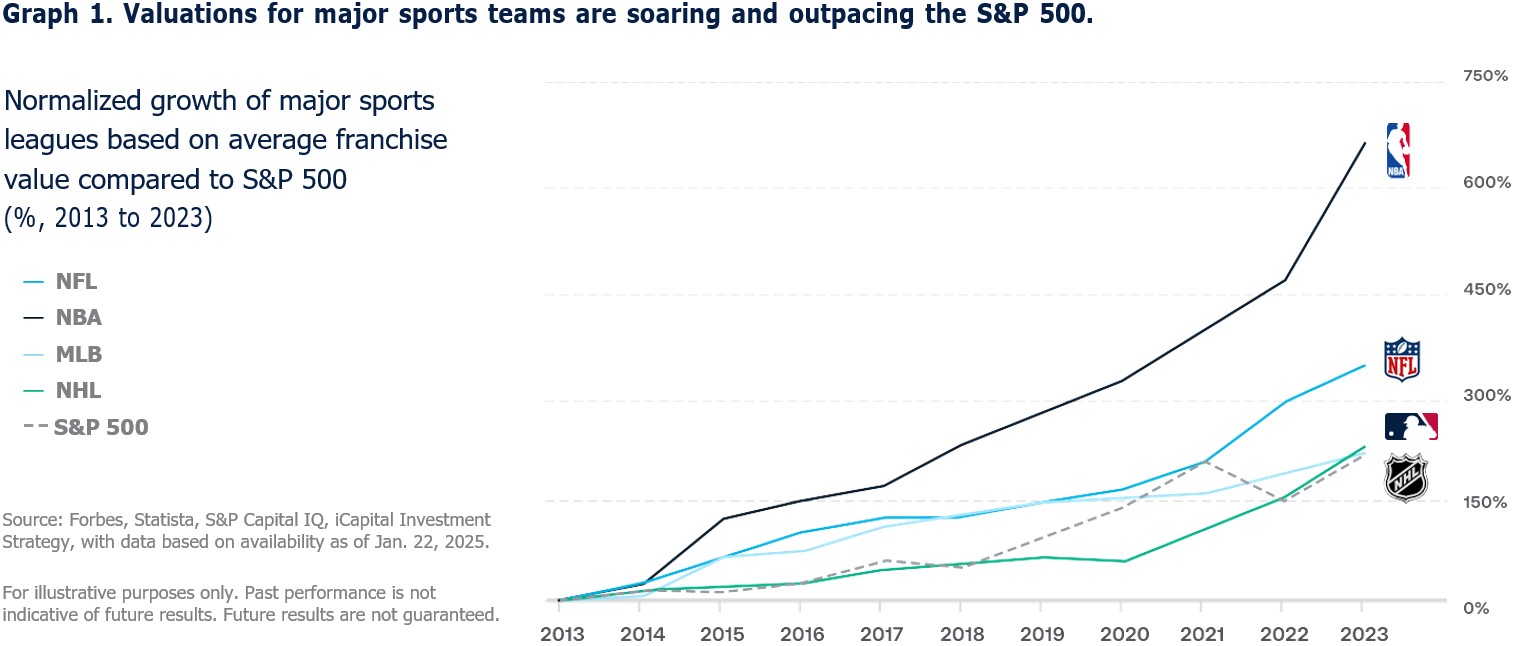
Between 2013 and 2023, the average NBA franchise gained roughly 650% in value and the average NFL franchise about 340%, against roughly 200% for the S&P 500. Baseball and hockey appreciated more modestly, but the marquee leagues clearly outperformed public equities. These figures reflect estimated valuations rather than realized sales, as most teams have not changed hands, but the trend is clear and is illustrated in Graph 1.
Franchise values have not risen simply because sports are popular. Four structural forces keep raising what investors are willing to pay.
Media rights are the engine. As streaming phases out the cable bundle, live sports are one of the few properties that still draw a large, synchronized audience, making them the most valuable content on television. Networks pay huge sums locked in for years: the NFL earns about USD 9 billion a year, the NBA close to USD 6.9 billion. That money is split evenly among teams, so even the worst team gets a guar-anteed check, and that steady income is what makes a team worth financing.
Scarcity does the rest. There are only about 150 major-league teams, and the number barely grows. When leagues admitted private equity, demand jumped but supply could not, so prices rose quickly.
The rest of the business is also growing. Tickets, premium seats, sponsorships, and merchandise are all climbing, and leagues are expanding into Mexico, Brazil, and Germany. More fans in more countries lift a team’s value.
Finally, it holds up when other things fall. Fans keep spending even in recessions, and team values move independently of the stock market. That mix of consis-tent growth and low correlation is an ideal one.
The United States created the blueprint and remains the most developed, tightly regulated version of the market. Each league is a closed system: no promotion or relegation, a fixed number of franchises, expansion only by owner vote, media rights negotiated centrally, and every transaction subject to league approval. That predictability is what allows institutional capital to enter quickly.
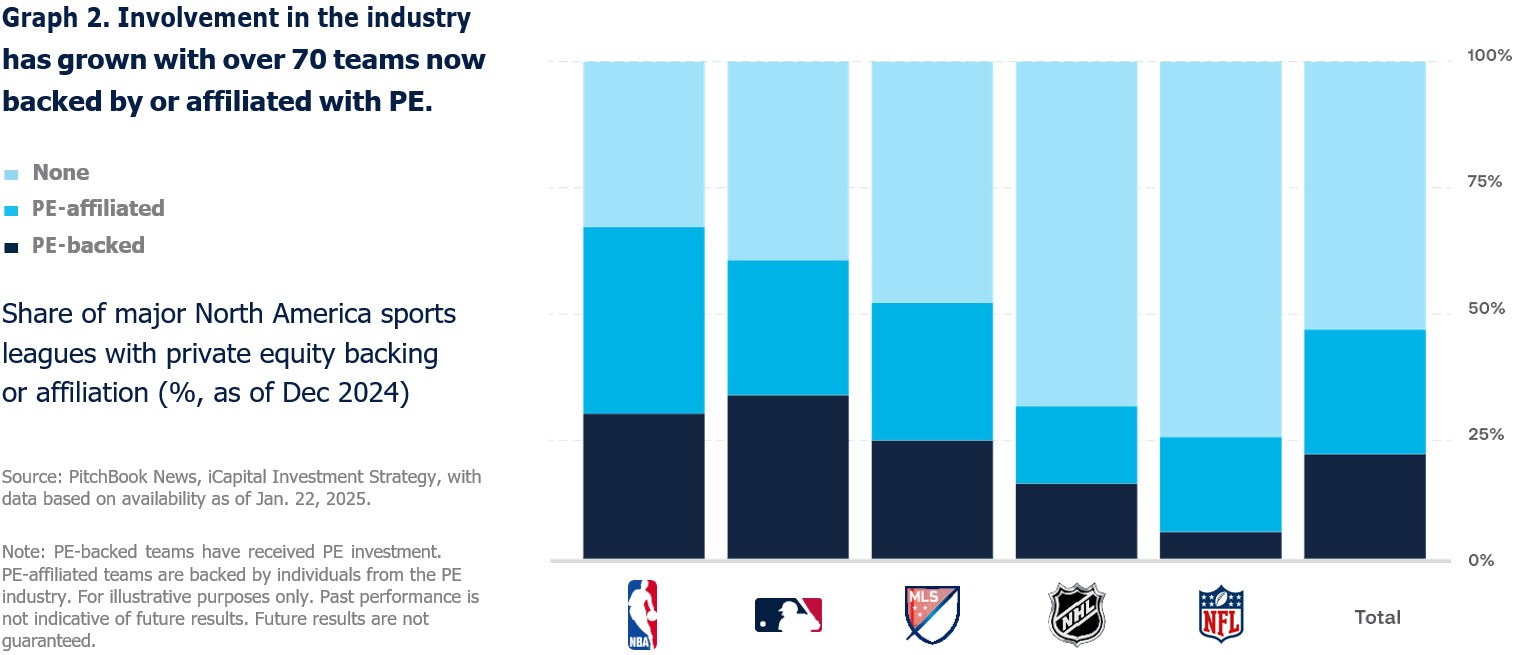
By late 2024, more than 70 North American franchises, roughly half of all teams across the five major leagues, had institutional investors or private-equity ties, according to iCapital. The NBA and MLB lead, at about 66% and 60%; the NFL, open only since 2024, has already reached roughly 25%. Debt has become nearly as important as equity. In July 2026, the New York Yankees entered talks with Apollo over a USD 2–3 billion package, structured mainly as debt, letting the Steinbrenner family keep control of a franchise valued above USD 9 billion.
Europe and Latin America differ because many clubs began as member associations rather than corporations with transferable shares, and their histories still shape how capital enters.
In European soccer, relegation can nearly halve a club’s media revenue in a season, and rights are often sold club-by-club, making a straight equity stake too volatile to price. So in December 2021, CVC Capital Partners paid roughly EUR 1.99 billion for 8.2% of LaLiga’s collective broadcast and sponsorship revenue over 50 years, a bet on the league rather than any one club. Latin America had to build the legal machinery first: Brazil’s clubs were nonprofits that could not be sold until the 2021 SAF law let them incorporate and sell up to 90% to investors, free of legacy debt, with Cruzeiro the first to convert, raising
about USD 400 million. Mexico is moving faster, since Liga MX clubs were already corporations: General Atlantic took 49% of Club América in December 2025, Apollo controls Atlético San Luis, more than a quarter of the league now has U.S. backing, and Liga MX is dropping relegation from 2026-27 and is in talks with Apollo and the NFL on a LaLiga-style media deal, timed around a 2026 World Cup expected to lift a league valuation already near USD 13 billion. Reports even emerged that FIFA was considering selling stakes in the World Cup itself, housed in a new company for the tournament’s commercial rights, a sign that even the sport’s biggest prize is now treated as an asset to be sold.
Most routes remain closed to individual investors. Buying into a team or lending to one, like the Yankees-Apollo deal, is for large institutions, and specialist funds like Arctos require millions and multi-year lockups. That leaves two doors. The first is public stocks: a few teams trade openly, including Manchester United, the Atlanta Braves, and Madison Square Garden Sports, which owns the Knicks and Rangers.
The second, newer door is prediction markets, where contracts pay out on real results and prices move like live odds. Polymarket and Kalshi are the biggest U.S. platforms, and the 2026 World Cup showed the scale: the two moved more than USD 6 billion on the tournament-winner market alone, and during the event these markets made up about 27% of legal U.S. sports betting, up from 9% at the start of the year. Kalshi’s female users grew 106%, more than double the growth among men. As millions bet in real time, outcomes trade like stocks and the teams behind them look more like assets priced daily.
The risks vary by route, but several apply universally.
The first is illiquidity. Capital often stays locked up for years, with minimum holding periods (six years in the NFL,
Source: Houlihan Lokey, “Sports Market Update – Fall 2024,” Statista, MarketResearch.com, Deloitte, iCapital Investment Strategy, with data based on availability as of Jan. 22, 2025. For illustrative purposes only. Past performance is not indicative of future results. Future results are not guaranteed.
five in the NHL) and no central marketplace. A seller must find a qualified buyer for a specific stake, who must then win league approval, so investors seeking liquidity often accept meaningful discounts.
The second is regulatory uncertainty. Rules vary across leagues and jurisdictions and keep evolving; the CVC-LaLiga deal faced legal disputes for years. Public-market investors face a version of this too: Manchester United shares can swing on governance, ownership speculation, and on-field results as much as on financials.
The third is the lack of realized performance data. Because of lockups, no investor has bought, held, and exited an NFL stake since 2024, so much reported performance rests on estimated valuations rather than realized returns. The case depends on continued growth in media rights, sponsorships, and league economics; should that slow, valuations would come under pressure.
In little more than a decade, sports have gone from closed to outside money to a market where KKR, Apollo, Blackstone, and CVC all hold positions, with CVC operating on both sides of the Atlantic under two different rulebooks.
Three forces pull capital in – fixed supply, media rights locked in years ahead, and valuations that have historically outpaced the S&P 500. The first completed sale of an NFL stake would be “game-changing” as it would finally replace an estimated valuation with a realized one. It is the marker that this market is still awaiting.
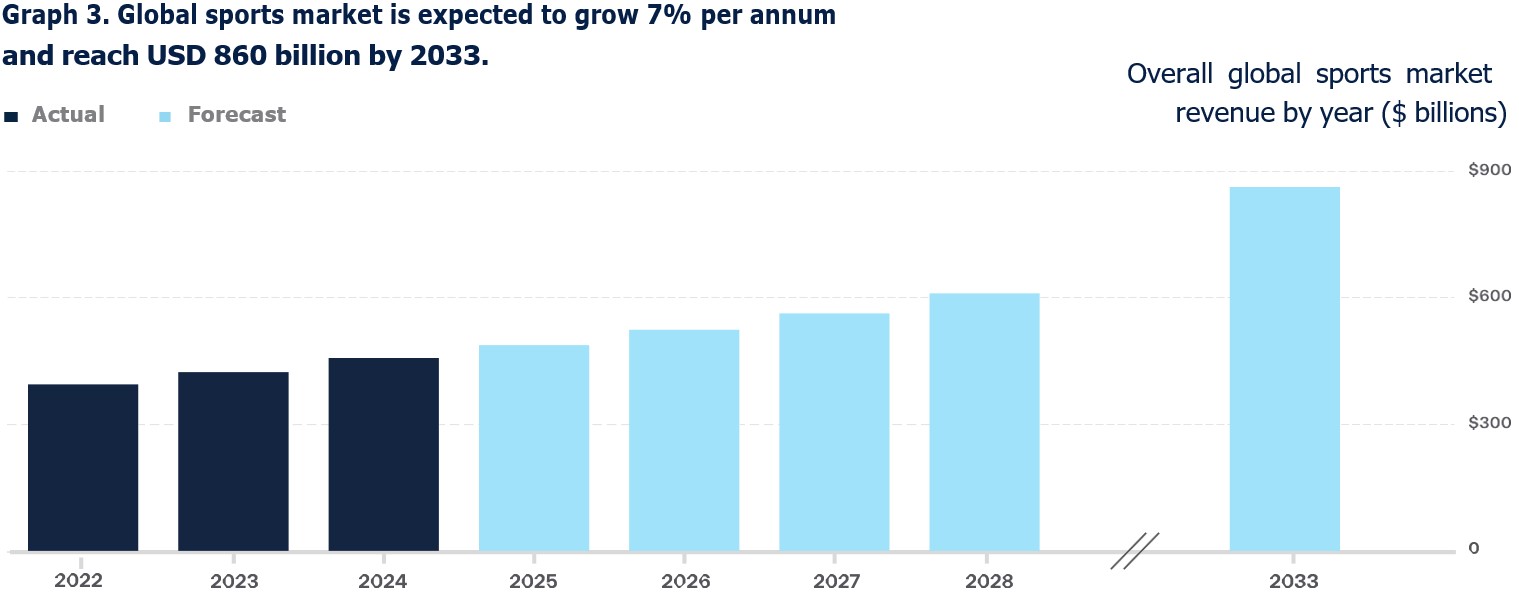
Whether the case holds depends on the business continuing to grow, and the projections point that way. The global sports market reached about USD 463 billion in 2024 and is forecast to grow roughly 7% a year to around USD 862 billion by 2033. That revenue is what services the debt and justifies the valuations throughout this piece.
Sports have crossed the line from passion projects to portfolio holdings. In little more than a decade, regulatory changes, soaring media rights, and fixed supply have turned franchises into an asset class that firms like KKR, Apollo, and CVC now pursue in earnest, and the case only grows stronger as the market heads toward USD 862 billion by 2033. Even so, the label is not fully earned.
Illiquidity, shifting rules, and the near absence of realized returns mean the thesis still rests on estimated valuations rather than proven exits. The first completed sale of an NFL stake will be the real test. Until then, sports look less like a settled asset class and more like one still in the making, promising but waiting for the numbers to confirm the story.
Insigneo Financial Group, LLC comprises a number of operating businesses engaged in the offering of brokerage and advisory products and services in various jurisdictions. Brokerage products and services are offered through Insigneo Securities, LLC, a broker-dealer registered with the U.S. Securities and Exchange Commission (“SEC”) and member of FINRA and SIPC. Investment advisory products and services are offered through Insigneo Advisory Services, LLC, an investment adviser registered with the SEC. Insigneo has affiliated companies in different locations, so it is important to understand which entity you are conducting business with. Please visit https://insigneo.com/legalentities/ for more information about the differences between these companies, their locations, and what that means for you.
This material should not be construed as an offer to sell or the solicitation of an offer to buy any security. It is for general information purposes only. To the extent that this material discusses general market activity, industry or sector trends or other broad-based economic or political conditions, it should not be construed as research or investment advice. To the extent that it includes references to securities, those references do not constitute a recommendation to buy, sell or hold such security. It does not constitute a recommendation or a statement of opinion, or a report of either of those things and does not, and is not intended, to consider the particular investment objectives, financial conditions, or needs of individual investors. Any target prices provide reflect our current expectations, are subject to change and may not be achieved due to a variety of risks, including changes in economic conditions, interest rates, geopolitical developments, and issuer-specific factors. The target price does not guarantee future results and should not be relied upon as a sole basis for investment decisions.
Not All Risks Are Disclosed – Past performance is not indicative of futures results. Investments involve significant risks, and it is possible to lose some or all of your principal investments and therefore may not be suitable for everyone. Always consider whether any investment is suitable for your particular circumstances and, if necessary, seek professional advice from your Investment Professional. This material may contain opinions, expressions, and estimates that represent the analysis and perspective of Insigneo Securities, LLC’s Investment Strategy department or its providers at the time of publication. These are subject to change at any time, without notice.
FOR AFFILIATES LOCATED IN CHILE
Insigneo Asesorías Financieras SPA se encuentra inscrito en Chile, en el Registro de Prestadores de Servicios Financieros de la Comisión para el Mercado Financiero. Este informe fue efectuado por área de Research & Strategy de Insigneo Securities LLC. o sus proveedores, en base a la información disponible a la fecha de emisión de este. Para evitar cualquier conflicto de interés, Insigneo Securities LLC dispone que ningún integrante del equipo de Research & Strategy tenga su remuneración asociada directa o indirectamente con una recomendación o reporte específico o con el resultado de una cartera.
Aunque los antecedentes sobre los cuales ha sido elaborado este informe fueron obtenidos de fuentes consideradas confiables, no podemos garantizar la completa exactitud e integridad de estos, no asumiendo responsabilidad alguna al respecto Insigneo Securities LLC, Insigneo Asesorías Financieras SPA ni ninguna de sus empresas relacionadas.
Este material está destinado únicamente a facilitar el debate general y no pretende ser fuente de ninguna recomendación específica para una persona concreta. Por favor, consulte con su ejecutivo de cuentas o con su asesor financiero si alguna de las recomendaciones específicas que se hacen en este documento es adecuada para usted. Este documento no constituye una oferta o solicitud de compra o venta de ningún valor en ninguna jurisdicción en la que dicha oferta o solicitud no esté autorizada o a ninguna persona a la que sea ilegal hacer dicha oferta o solicitud. Las inversiones en cuentas de corretaje y de asesoramiento de inversiones están sujetas al riesgo de mercado, incluida la pérdida de capital.
La información base del presente informe puede sufrir cambios, no teniendo Insigneo Securities LLC ni Insigneo Asesorías Financieras SPA la obligación de actualizar el presente informe ni de comunicar a sus destinatarios sobre la ocurrencia de tales cambios. Cualquier opinión, expresión, estimación y/o recomendación contenida en este informe constituyen el juicio o visión de área de Research & Strategy de Insigneo Securities LLC. o sus proveedores, a la fecha de su publicación y pueden ser modificadas sin previo aviso.
FOR AFFILIATES LOCATED IN URUGUAY
Insigneo Asesor Uruguay S.A. está inscripto en el Registro de Mercado de Valores del Banco Central del Uruguay como Asesor de Inversiones. En Uruguay, los valores están siendo ofrecidos en forma privada de acuerdo al artículo 2 de la ley 18.627 y sus modificaciones. Los valores no han sido ni serán registrados ante el Banco Central del Uruguay para oferta pública. Este material está destinado únicamente a facilitar el debate general y no pretende ser fuente de ninguna recomendación específica para una persona concreta. Por favor, consulte con su ejecutivo de cuentas o con su asesor financiero si alguna de las recomendaciones específicas que se hacen en este documento es adecuada para usted según su perfil y estrategia de inversión. Este documento no constituye un asesoramiento ni una recomendación u oferta o solicitud de compra o. Las inversiones en valores negociables están sujetas al riesgo de mercado, incluida la pérdida parcial o total del capital invertido. Cualquier opinión, expresión, estimación y/o recomendación contenida en este informe constituyen el juicio o visión de área de Research & Strategy de Insigneo Securities LLC. o sus proveedores, a la fecha de su publicación y pueden ser modificadas sin previo aviso. Rentabilidades históricas de los productos anunciados no aseguran rentabilidades futuras..
FOR AFFILIATES LOCATED IN ARGENTINA
Insigneo Argentina S.A.U. Agente Asesor Global de Inversión se encuentra registrado bajo el N° 1053 de la Comisión Nacional de Valores (CNV) e inscripto ante la Inspección General de Justicia (IGJ) bajo el N° 12.278 del Libro 90, Tomo –, de Sociedades por Acciones. Este informe fue efectuado por área de Research & Strategy de Insigneo Securities LLC. o sus proveedores, en base a la información disponible a la fecha de su emisión. Para evitar cualquier conflicto de interés, Insigneo Securities LLC dispone que ningún integrante del equipo de Research & Strategy tenga su remuneración asociada directa o indirectamente con una recomendación o reporte específico o con el resultado de una cartera. Aunque los antecedentes sobre los cuales ha sido elaborado este informe fueron obtenidos de fuentes consideradas confiables, no podemos garantizar la completa exactitud e integridad de estos, no asumiendo responsabilidad alguna al respecto Insigneo Securities LLC, Insigneo Argentina S.A.U. ni ninguna de sus empresas relacionadas. La información base del presente informe puede sufrir cambios, no teniendo Insigneo Argentina S.A.U. la obligación de actualizar el presente informe ni de comunicar a sus destinatarios sobre la ocurrencia de tales cambios.
Este material está destinado únicamente a facilitar el debate general y no pretende ser fuente de ninguna recomendación específica para una persona concreta. Por favor, consulte con su ejecutivo de cuentas o con su asesor financiero si alguna de las recomendaciones específicas que se hacen en este documento es adecuada para usted. Este documento no constituye una oferta, recomendación o solicitud de compra o venta de ningún valor negociable en ninguna jurisdicción en la que dicha oferta o solicitud no esté autorizada o a ninguna persona a la que sea ilegal hacer dicha oferta o solicitud. Las inversiones en valores negociables están sujetas al riesgo de mercado, incluida la pérdida parcial o total del capital invertido. Cualquier opinión, expresión, estimación y/o recomendación contenida en este informe constituyen el juicio o visión de área de Research & Strategy de Insigneo Securities LLC. o sus proveedores, a la fecha de su publicación y pueden ser modificadas sin previo aviso.
DM Wealth Management Group is the “doing business as entity” through which Cristina Mendez, Zoraida Diaz, and Debra Tyler, investment professionals (“IP”) of Insigneo Securities, LLC (“ISEC”) and Insigneo Advisory Services, LLC (“IAS”) conducts securities and advisory activities DM Wealth Management Group is not itself a broker dealer or an investment advisor and is not under common ownership with ISEC or IAS. Insigneo Financial Group, LLC comprises a number of operating businesses engaged in the offering of brokerage and advisory products and services in various jurisdictions. Brokerage products and services are offered through Insigneo Securities, LLC, a broker-dealer registered with the U.S. Securities and Exchange Commission (“SEC”) and member of FINRA and SIPC. Investment advisory products and services are offered through Insigneo Advisory Services, LLC, an investment adviser registered with the SEC. Insigneo has affiliated companies in different locations, so it is important to understand which entity you are conducting business with. Please visit "https://insigneo.com/legalentities" for more information about the differences between these companies, their locations, and what that means for you.
Investing involves risk, including possible loss of principal. Past performance is not indicative of future results. Please consult your Investment Professional for any recommendation regarding your specific financial situation.
Click on the following links to view ISEC Reg BI Client Relationship Summary (“Form CRS”) and IAS Form ADV Part 3 CRS.
The following content is provided by Insigneo, the firm through which DM Wealth Management’s investment professionals offer brokerage and advisory services. Visit insigneo.com to learn more.