

August 7, 2026

Latin America: Where Currencies, Commodities, and Earnings Converge
So far in 2026, global investors have navigated an investment landscape fraught with heightened volatility and uncertainty.


Latin American currencies have diverged meaningfully in 2026, with performance shaped by each country’s commodity exposure and the relative attractiveness of its interest-rate differential versus the U.S.
The region’s FX performance also highlights how quickly technical tailwinds can shift, as central-bank decisions, political risk, and changing commodity dynamics begin to reshape the outlook for individual currencies.
Foreign exchange movements are a major driver of earnings in Latin America, particularly for commodity-exporting economies where revenues are largely denominated in U.S. dollars, and costs are incurred in local currencies. Countries such as Brazil, Chile, and Peru are especially sensitive because of their dependence on globally traded commodities.
The biggest beneficiaries of currency depreciation are exporters in mining, agriculture, pulp and paper, and energy, while the biggest losers are domestically focused sectors such as airlines, retailers, and telecommunications companies that face significant dollar-linked costs and imports.
So far in 2026, global investors have navigated an investment landscape fraught with heightened volatility and uncertainty. However, a constant throughout the year has been the positive performance of Latin American currencies, amplified by the Iran conflict and the subsequent commodity shock. Therefore, we wanted to dive deeper into the causes of this behavior, its direct relationship to commodities, and how it could directly impact portfolio positioning for specific Latam companies.
Since Donald Trump took office in early 2025, investors have increasingly questioned whether the U.S. is losing its exceptional status as an investment destination and have looked to other geographies for diversification. That shift has renewed interest in Latin American assets, especially currencies. When looking at their year-to-date performance, two factors stand out as potentially strong drivers: an economy’s exposure to the oil sector, and the current stage of its monetary policy cycle. The data summarized in Graph 1 demonstrates this.
Graph 1 suggests that the performance of Latin American currencies throughout 2026 has been mainly driven by their oil price correlation and its policy rate differential with the U.S. Year-to-date, the two outperformers of the region are the Colombian peso (COP) and the Brazilian real (BRL). Both economies are net oil exporters and currently exhibit the largest rate differential versus the effective Federal Funds Rate. Oil’s support reflects supply shocks from the Iran war, making the timing of any reversal difficult to assess.
In Colombia, BanRep has aggressively hiked rates in 2026 amid unmoored inflation expectations, in contrast to the rest of the region, making high nominal rates attractive to carry trade investors. Additionally, optimism following Abelardo de la Espriella’s election as president led to additional support for Colombian assets, further contributing to the COP rally. Still, the rally hit its ceiling after the latest BanRep meeting, in which the central bank held rates steady and announced a plan to buy up to USD 4bn in FX reserves via put-option auctions, triggering a 2.39% one-day depreciation and reminding the market that the COP rally is sensitive to policy shifts. Going forward, those auctions should limit further COP appreciation, while investors may wait for the incoming administration’s first moves before adding exposure.
Brazil also benefits from a favorable commodity-export base, as seen throughout 2026. Combined with a still-high Selic rate at 14.00%, this has kept the Real attractive for carry trades even as the Brazilian central bank (COPOM) began easing. Zooming in on the Brazilian macroeconomic scenario, it is worth noting that even if the COPOM continues cutting rates, persistent inflation risks and unanchored inflation expectations argue for a gradual path. Furthermore, Brazilian assets face increased political
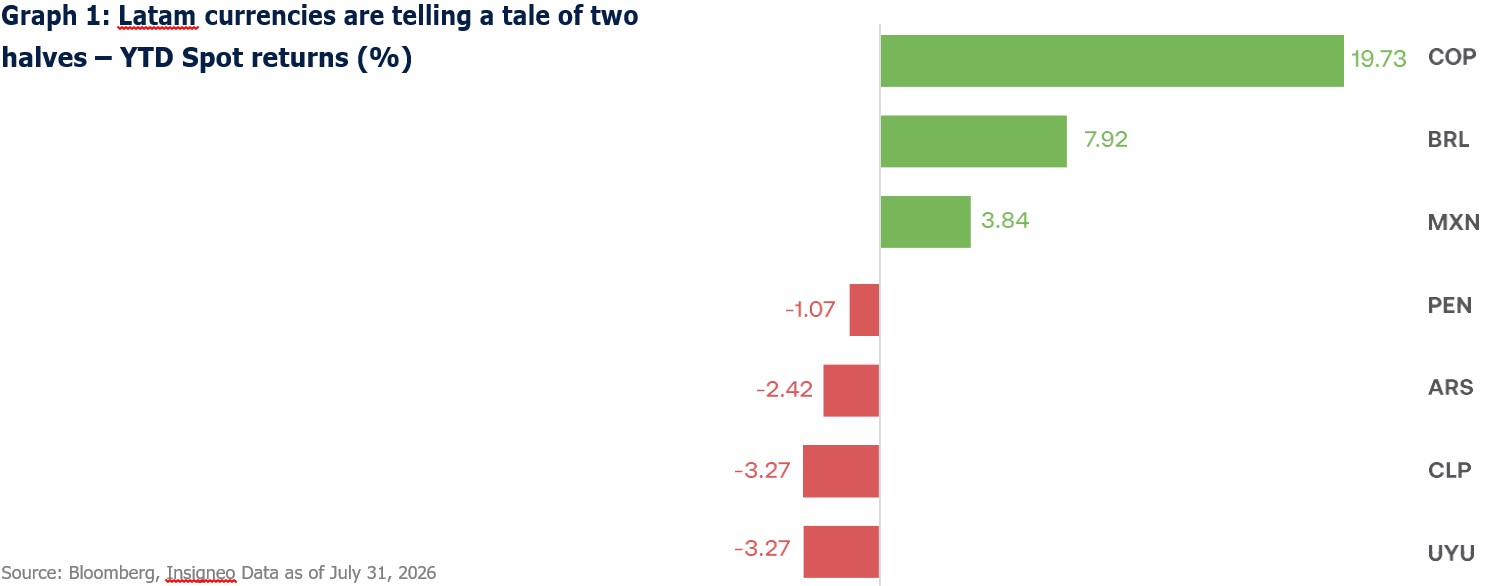
risk ahead of the October presidential election. According to the latest available polls, right-leaning candidate Flávio Bolsonaro is trailing incumbent President Lula, who launched his campaign with a speech that highlighted Brazil’s place in an unstable world, called for increased defense spending and promised to protect the country’s reserves of critical minerals and rare earths.
In Mexico, even if the carry trade looks less attractive than it did in 2024, when the monetary policy rate peaked, the rate differential between Mexico and the U.S. still positions the Mexican peso (MXN) as an attractive carry trade. This has been reflected in the MXN’s performance this year. Oil exposure also helps, even though Pemex’s increased domestic refining has reduced exports. A nominal rate differential near 260bps and the current oil tailwind both remain supportive of the currency.
At the other side of the spectrum, the Peruvian sol (PEN) and Chilean peso (CLP) are among this year’s laggards. Both economies are more tied to copper than oil, and its price volatility has weighed down their currencies. Both countries also have the smallest policy rate differentials relative to the U.S., reducing the appeal of currency exposure.
The Argentinian peso’s (ARS) narrative for 2026 has shifted. It began the year appreciating on carry trade inflows underpinned by Milei’s midterm victory, which allowed the central bank to accumulate reserves and stabilized the currency around 2Q26. However, the ARS has depreciated sharply since June as carry trades unwound and political uncertainty rose alongside President Milei’s declining approval ratings. According to local analysts, the ARS could end the year at ~1,673–1,700, ~12% weaker than current levels. That depreciation would still be consistent with the country’s crawling peg system and an inflation rate that remains above 30%.
Foreign exchange fluctuations are among the most important earnings drivers for Latin American companies because the region sits at the intersection of global commodity markets and volatile emerging-market currencies. Most commodities are priced and sold in U.S. dollars, while labor, transportation, taxes, and a significant portion of operating expenses are incurred in local currencies. This creates substantial earnings leverage to movements in the U.S. dollar. Countries with export sectors concentrated in commodities tend to be the most exposed. Chile and Peru stand out as the region’s most structurally sensitive economies due to their dependence on copper and other metals exports combined with their status as net oil importers. In Chile, for example, the Chilean peso is closely tied to copper market fundamentals, and periods of declining copper prices or weaker global demand often lead to currency depreciation and deteriorating terms of trade. Peru faces a similar dynamic through its dependence on copper, gold, and zinc exports. As one of the region’s largest exporters, Peru generates approximately USD 107.5 billion in annualized exports. In both countries, a stronger dollar and weaker domestic currency increase the local-currency value of export revenues and can bolster producer margins, although they also raise the cost of imported fuel, machinery, and other dollar-linked inputs. Mexico and Colombia display somewhat lower structural sensitivity because of more diversified economies and energy-related offsets, while Argentina remains a special case where exchange-rate policy and capital controls often affect exporter behavior as much as commodity prices themselves. Across the region, commodity composition matters enormously: Chile and Peru are vulnerable when copper prices fall, and oil prices rise simultaneously, while Colombia’s oil and coal exports provide a natural support for the peso through stronger terms of trade.
Brazil occupies a unique position within this framework as Latin America’s largest and most diversified commodity exporter. The Brazilian Real is one of the most actively traded and volatile emerging-market currencies, making exchange-rate fluctuations a major determinant of corporate earnings. Brazil’s export basket spans iron ore, soybeans, oil, pulp, agricultural products, and metals, all of which are largely priced in dollars. Consequently, BRL depreciation generally boosts local-currency revenues and profitability for exporters, while appreciation creates a translation headwind. Vale, one of the world’s largest mining companies and Brazil’s third-largest commodity exporter, generates approximately USD 41.3 billion in annualized revenue, with the vast majority of sales linked to globally priced commodities while maintaining a significant domestic cost base in Reals. Agricultural producers experience similar effects because crops such as soybeans and corn are priced in dollars globally. Even within the energy sector, exchange-rate moves can have meaningful effects; company disclosures indicate that a 5% appreciation in the BRL can materially alter revenue and the profitability metrics in certain natural gas operations. More broadly, the relationship between commodities and currencies becomes self-reinforcing through
terms-of-trade dynamics. Rising commodity prices attract capital inflows, boost export earnings, and support domestic currencies, partially offsetting exporters’ revenue windfalls. Conversely, falling commodity prices often coincide with currency weakness, amplifying earnings volatility. Mexico illustrates another important variation: because the Peso serves as a liquid proxy for emerging market risk sentiment, currency moves can significantly alter reported financial results.
At the company level, the largest beneficiaries of local-currency depreciation tend to be firms with dollar-denominated revenues and predominantly domestic cost bases. The clearest examples are found in mining, pulp and paper, and agriculture. Suzano is among the most FX-sensitive companies in Latin America, with more than 90% of revenue tied to dollar-denominated pulp exports. Management estimates that every USD 0.10 movement in the BRL/USD exchange rate affects annual EBITDA by roughly 3%, illustrating direct transmission from foreign exchange into profitability. To mitigate currency fluctuations, companies like Suzano maintain substantial hedging programs, with derivatives expected to contribute approximately R$1.5 billion in 2026 and R$3.6 billion in 2027 for this company. Other highly exposed Brazilian exporters include Klabin, Vale, SLC Agrícola, BrasilAgro, and Minerva Foods. SLC Agrícola generates effectively USD-linked revenues while roughly 55% of its cost base is denominated in BRL, creating significant operating leverage to currency movements. Minerva derives approximately 60% of its revenue from exports, making BRL fluctuations a primary earnings variable. Similar dynamics extend beyond Brazil to companies such as Grupo México, Antofagasta, and Ecopetrol, whose commodity revenues are largely linked to dollar pricing. As a result, Brazil, Peru, and Argentina rank among the world’s five most commodity-exposed equity markets, making their equity performance particularly sensitive to broad movements in the U.S. dollar and global commodity cycles.
However, foreign exchange sensitivity in Latin America extends well beyond commodity producers. A second group of companies faces more balanced or two-sided exposure, where export benefits are partially offset by imported inputs, foreign-currency debt, or operational costs tied to the dollar. Industrial firms such as WEG earn a significant share of revenue abroad and therefore see translated earnings decline when the BRL strengthens. Pemex similarly generates substantial dollar-linked revenues while maintaining a large peso-denominated cost structure. Utilities generally exhibit lower sensitivity because financing is often local currency based; nevertheless, currency movements can still affect consolidated earnings, as illustrated by Enel Americas, where FX fluctuations reduced EBITDA by approximately USD 130 million in a recent year. The most negatively exposed sectors are domestically oriented companies that earn revenues in local currency but face significant USD-linked costs. Retailers such as Walmart de México, FEMSA, Falabella, and Cencosud experience margin pressure when local currencies weaken because imported merchandise and inventory become more expensive. Airlines represent perhaps the most structurally disadvantaged group: carriers such as LATAM Airlines and Gol receive ticket revenues primarily in local currencies but face substantial dollar-denominated expenses through fuel, aircraft leases, maintenance contracts, and financing costs, causing depreciation to directly compress margins. Financial institutions including Itaú Unibanco, Bradesco, Banco do Brasil, and Credicorp are less exposed through direct transaction channels but remain highly sensitive through macroeconomic effects as exchange-rate fluctuations influence inflation, interest rates, credit quality, and loan demand.
It is easy to see how Latin America’s biggest FX winners are exporters in mining, pulp and paper, agriculture, and select energy businesses where dollar revenues meet local-currency costs, while airlines, retailers, telecommunications firms, and other domestically focused sectors bear the greatest downside from currency weakness because of their dependence on imported goods, dollar-linked expenses, or foreign-currency liabilities.
In summary, Latin American currencies have been among the region’s strongest-performing assets in 2026, supported by higher commodity prices and attractive interest rate differentials. This environment has generally favored commodity exporters, particularly in the oil, mining, agriculture, and pulp and paper industries, while creating challenges for more domestically focused sectors such as retailers and airlines. For investors, the close relationship between currencies, commodities, and corporate earnings remains a key factor in identifying opportunities and managing risks across Latin American portfolios.
Insigneo Financial Group, LLC comprises a number of operating businesses engaged in the offering of brokerage and advisory products and services in various jurisdictions. Brokerage products and services are offered through Insigneo Securities, LLC, a broker-dealer registered with the U.S. Securities and Exchange Commission (“SEC”) and member of FINRA and SIPC. Investment advisory products and services are offered through Insigneo Advisory Services, LLC, an investment adviser registered with the SEC. Insigneo has affiliated companies in different locations, so it is important to understand which entity you are conducting business with. Please visit https://insigneo.com/legalentities/ for more information about the differences between these companies, their locations, and what that means for you.
This material should not be construed as an offer to sell or the solicitation of an offer to buy any security. It is for general information purposes only. To the extent that this material discusses general market activity, industry or sector trends or other broad-based economic or political conditions, it should not be construed as research or investment advice. To the extent that it includes references to securities, those references do not constitute a recommendation to buy, sell or hold such security. It does not constitute a recommendation or a statement of opinion, or a report of either of those things and does not, and is not intended, to consider the particular investment objectives, financial conditions, or needs of individual investors. Any target prices provide reflect our current expectations, are subject to change and may not be achieved due to a variety of risks, including changes in economic conditions, interest rates, geopolitical developments, and issuer-specific factors. The target price does not guarantee future results and should not be relied upon as a sole basis for investment decisions.
Not All Risks Are Disclosed – Past performance is not indicative of futures results. Investments involve significant risks, and it is possible to lose some or all of your principal investments and therefore may not be suitable for everyone. Always consider whether any investment is suitable for your particular circumstances and, if necessary, seek professional advice from your Investment Professional. This material may contain opinions, expressions, and estimates that represent the analysis and perspective of Insigneo Securities, LLC’s Investment Strategy department or its providers at the time of publication. These are subject to change at any time, without notice.
FOR AFFILIATES LOCATED IN CHILE
Insigneo Asesorías Financieras SPA se encuentra inscrito en Chile, en el Registro de Prestadores de Servicios Financieros de la Comisión para el Mercado Financiero. Este informe fue efectuado por área de Research & Strategy de Insigneo Securities LLC. o sus proveedores, en base a la información disponible a la fecha de emisión de este. Para evitar cualquier conflicto de interés, Insigneo Securities LLC dispone que ningún integrante del equipo de Research & Strategy tenga su remuneración asociada directa o indirectamente con una recomendación o reporte específico o con el resultado de una cartera.
Aunque los antecedentes sobre los cuales ha sido elaborado este informe fueron obtenidos de fuentes consideradas confiables, no podemos garantizar la completa exactitud e integridad de estos, no asumiendo responsabilidad alguna al respecto Insigneo Securities LLC, Insigneo Asesorías Financieras SPA ni ninguna de sus empresas relacionadas.
Este material está destinado únicamente a facilitar el debate general y no pretende ser fuente de ninguna recomendación específica para una persona concreta. Por favor, consulte con su ejecutivo de cuentas o con su asesor financiero si alguna de las recomendaciones específicas que se hacen en este documento es adecuada para usted. Este documento no constituye una oferta o solicitud de compra o venta de ningún valor en ninguna jurisdicción en la que dicha oferta o solicitud no esté autorizada o a ninguna persona a la que sea ilegal hacer dicha oferta o solicitud. Las inversiones en cuentas de corretaje y de asesoramiento de inversiones están sujetas al riesgo de mercado, incluida la pérdida de capital.
La información base del presente informe puede sufrir cambios, no teniendo Insigneo Securities LLC ni Insigneo Asesorías Financieras SPA la obligación de actualizar el presente informe ni de comunicar a sus destinatarios sobre la ocurrencia de tales cambios. Cualquier opinión, expresión, estimación y/o recomendación contenida en este informe constituyen el juicio o visión de área de Research & Strategy de Insigneo Securities LLC. o sus proveedores, a la fecha de su publicación y pueden ser modificadas sin previo aviso.
FOR AFFILIATES LOCATED IN URUGUAY
Insigneo Asesor Uruguay S.A. está inscripto en el Registro de Mercado de Valores del Banco Central del Uruguay como Asesor de Inversiones. En Uruguay, los valores están siendo ofrecidos en forma privada de acuerdo al artículo 2 de la ley 18.627 y sus modificaciones. Los valores no han sido ni serán registrados ante el Banco Central del Uruguay para oferta pública. Este material está destinado únicamente a facilitar el debate general y no pretende ser fuente de ninguna recomendación específica para una persona concreta. Por favor, consulte con su ejecutivo de cuentas o con su asesor financiero si alguna de las recomendaciones específicas que se hacen en este documento es adecuada para usted según su perfil y estrategia de inversión. Este documento no constituye un asesoramiento ni una recomendación u oferta o solicitud de compra o. Las inversiones en valores negociables están sujetas al riesgo de mercado, incluida la pérdida parcial o total del capital invertido. Cualquier opinión, expresión, estimación y/o recomendación contenida en este informe constituyen el juicio o visión de área de Research & Strategy de Insigneo Securities LLC. o sus proveedores, a la fecha de su publicación y pueden ser modificadas sin previo aviso. Rentabilidades históricas de los productos anunciados no aseguran rentabilidades futuras..
FOR AFFILIATES LOCATED IN ARGENTINA
Insigneo Argentina S.A.U. Agente Asesor Global de Inversión se encuentra registrado bajo el N° 1053 de la Comisión Nacional de Valores (CNV) e inscripto ante la Inspección General de Justicia (IGJ) bajo el N° 12.278 del Libro 90, Tomo –, de Sociedades por Acciones. Este informe fue efectuado por área de Research & Strategy de Insigneo Securities LLC. o sus proveedores, en base a la información disponible a la fecha de su emisión. Para evitar cualquier conflicto de interés, Insigneo Securities LLC dispone que ningún integrante del equipo de Research & Strategy tenga su remuneración asociada directa o indirectamente con una recomendación o reporte específico o con el resultado de una cartera. Aunque los antecedentes sobre los cuales ha sido elaborado este informe fueron obtenidos de fuentes consideradas confiables, no podemos garantizar la completa exactitud e integridad de estos, no asumiendo responsabilidad alguna al respecto Insigneo Securities LLC, Insigneo Argentina S.A.U. ni ninguna de sus empresas relacionadas. La información base del presente informe puede sufrir cambios, no teniendo Insigneo Argentina S.A.U. la obligación de actualizar el presente informe ni de comunicar a sus destinatarios sobre la ocurrencia de tales cambios.
Este material está destinado únicamente a facilitar el debate general y no pretende ser fuente de ninguna recomendación específica para una persona concreta. Por favor, consulte con su ejecutivo de cuentas o con su asesor financiero si alguna de las recomendaciones específicas que se hacen en este documento es adecuada para usted. Este documento no constituye una oferta, recomendación o solicitud de compra o venta de ningún valor negociable en ninguna jurisdicción en la que dicha oferta o solicitud no esté autorizada o a ninguna persona a la que sea ilegal hacer dicha oferta o solicitud. Las inversiones en valores negociables están sujetas al riesgo de mercado, incluida la pérdida parcial o total del capital invertido. Cualquier opinión, expresión, estimación y/o recomendación contenida en este informe constituyen el juicio o visión de área de Research & Strategy de Insigneo Securities LLC. o sus proveedores, a la fecha de su publicación y pueden ser modificadas sin previo aviso.
DM Wealth Management Group is the “doing business as entity” through which Cristina Mendez, Zoraida Diaz, and Debra Tyler, investment professionals (“IP”) of Insigneo Securities, LLC (“ISEC”) and Insigneo Advisory Services, LLC (“IAS”) conducts securities and advisory activities DM Wealth Management Group is not itself a broker dealer or an investment advisor and is not under common ownership with ISEC or IAS. Insigneo Financial Group, LLC comprises a number of operating businesses engaged in the offering of brokerage and advisory products and services in various jurisdictions. Brokerage products and services are offered through Insigneo Securities, LLC, a broker-dealer registered with the U.S. Securities and Exchange Commission (“SEC”) and member of FINRA and SIPC. Investment advisory products and services are offered through Insigneo Advisory Services, LLC, an investment adviser registered with the SEC. Insigneo has affiliated companies in different locations, so it is important to understand which entity you are conducting business with. Please visit "https://insigneo.com/legalentities" for more information about the differences between these companies, their locations, and what that means for you.
Investing involves risk, including possible loss of principal. Past performance is not indicative of future results. Please consult your Investment Professional for any recommendation regarding your specific financial situation.
Click on the following links to view ISEC Reg BI Client Relationship Summary (“Form CRS”) and IAS Form ADV Part 3 CRS.
The following content is provided by Insigneo, the firm through which DM Wealth Management’s investment professionals offer brokerage and advisory services. Visit insigneo.com to learn more.