

September 4, 2026


Jackson Hole Special
The First Rule of Forward Guidance Is That You Don’t Talk About Forward Guidance.


The First Rule of Forward Guidance Is That You Don’t Talk About Forward
Chair Warsh’s Jackson Hole debut delivered a hawkish message: inflation remains above target, the U.S. economy continues to show resilience, and financial conditions are difficult to characterize as restrictive.
His reluctance to provide forward guidance may signal a return to a more data-driven policy framework, placing greater weight on realized economic outcomes than on Fed signaling.
The experience of earlier Fed regimes suggests that less policy transparency can alter how markets process information, react to economic developments, and price future policy decisions.
Recent inflation and growth trends present a nuanced backdrop for monetary policy, increasing the importance of realized economic outcomes as markets navigate a less guidance-heavy environment.
On Friday, August 28, Fed Chair Kevin Warsh made his Jackson Hole debut with a speech that markets had been waiting for precisely because he has resisted giving them what they now expect from the Fed: explicit forward guidance. In a conference focused on financial innovation, payments, and policy, Warsh stayed close to the official theme while also advancing a broader message about how the central bank should communicate. Hence, we wanted to revisit the main takeaways from his remarks, compare his approach with earlier Fed communication regimes, and consider what a less guidance-heavy Fed could mean for monetary policy expectations and asset-class reactions.
Saying that Chair Warsh’s intervention was the most anticipated item on Friday’s Jackson Hole agenda is not an exaggeration. After two Federal Open Market Committee (FOMC) meetings at the helm, Warsh’s refusal to provide forward guidance and his instruction that markets should “play the ball and not the referee” left investors scanning his speech for any clue about the central bank’s next move. One notable omission was any update on the task forces and their progress. Instead, market participants and attendees received a fuller assessment of the economy and a clearer sense of Warsh’s communication philosophy.
Throughout the speech, Warsh reinforced the FOMC’s commitment to the PCE target, stating that 2% was a “firm, fixed target”, and that “the responsibility for 65 months of sustained, elevated inflation sits squarely with the central bank”. At the same time, he was explicit that underlying inflation trends had not improved meaning-fully, even if summer CPI and PCE readings were encour-aging. For Warsh, the FOMC must be confident not only that inflation is moving toward its objective, but that it is doing so “at sufficient speed.”
Adding to the hawkish tone of the speech were Warsh’s comments on the state of the U.S. economy. The Fed Chair said he was impressed by the economy’s overall performance, which appeared to have strengthened, underpinned by resilience from both Main Street and Wall Street. To that extent, Warsh contrasted the rapid growth in business capital expenditures with profits from S&P 500 firms, noting that expectations for both are running quite high.
Regarding financial conditions, Warsh gave the final hawkish statement by affirming that he would be “hard pressed to describe broad financial conditions as restric-tive.” To that extent, he highlighted the resiliency of real consumer spending and the positive side of the Fed’s mandate – the strength observed in the labor market.
A constant element in Warsh’s remarks was his distancing from forward guidance, even though he dedicated a full section of his speech to it. He argued that the period when forward guidance was necessary for the FOMC has passed. In his view, guidance can bind policymakers to earlier interest-rate commitments and reduce their freedom to make the right decision as conditions change. That logic also explains his reluctance to send explicit signals to financial markets. Rather than having markets search for direction from the Fed, Warsh argued that the Fed needs clear, unfiltered signals from markets, with investors assuming agency and drawing conclusions from their own expectations. He warned that too much guid-ance can create a hall-of-mirrors problem, leaving both policymakers and market participants less prepared for unexpected turns and more exposed to policy mistakes.
In all, the market interpreted Warsh’s inflation rhetoric as hawkish. The Treasury curve initially flattened as short-end yields rose sharply and investors priced in a higher prob-ability of a rate hike at several of the upcoming meetings. At the time of the speech, longer-end yields declined, which could be read as a sign that markets believed a more hawkish Fed would help restrain future inflation. Since then, however, the long end has resumed its bearish trend, likely influenced by external dynamics and higher term-premium pricing, and now looks more consistent with the broader message of a more hawkish Fed stance.
Given that the current Warsh Fed has been compared with the Fed from the Greenspan era, we wanted to take a deeper dive into the similarities between the two periods and how financial assets and markets fared during the Greenspan regime.
While markets have grown used to receiving forward guidance from the Fed Chair over the past two decades, that was not always the case. To borrow from Fight Club, the novel later made famous by the 1999 movie, it seems Kevin Warsh may have joined a new kind of forward guid-ance club, one whose first rule is simple: don’t give forward guidance.
Since the Bernanke era, and arguably beginning in the final years of Alan Greenspan’s tenure, investors have become accustomed to receiving regular hints about how the Fed sees growth, inflation, labor markets, and the likely path of monetary policy. Markets learned to dissect every statement, speech, press conference, and dot plot for clues about where rates might be headed next. But if a Warsh-led Fed embraces a more traditional philosophy, that era of abundant guidance may be coming to an end, at least for a while.
Since its creation in 1913, the Federal Reserve has been led by some of the most influential policymakers in American economic history. Yet explicit communication about future policy is surprisingly recent. It was only in February 2000 that the Fed added a formal “balance of risks” section to its post-meeting statements. A more meaningful shift came in August 2003, when the Greenspan Fed signaled that policy accommodation could remain in place for a “consid-erable period,” marking one of the earliest forms of modern forward guidance. What started as a response to concerns about disinflation eventually became a core policy tool. Under Bernanke, especially after the Global Financial Crisis, forward guidance became a pillar of monetary policy. Yellen refined it through a strongly data-dependent frame-work, while Powell expanded it further through unprece-dented transparency and outcome-based guidance.
Alan Greenspan, who chaired the Federal Reserve between 1987 and 2006, famously said: “If I seem unduly clear to you, you must have misunderstood what I said.” Whether entirely serious or not, the quote perfectly captured his communication style. Greenspan intentionally spoke in a dense, nuanced, and often difficult-to-decode way. The goal was to prevent markets from overreacting and pricing in policy moves before the FOMC had even decided. After all, if the Fed Chair openly says the economy is running too hot and rate hikes are likely around the corner, investors immediately sell bonds, yields rise, finan-cial conditions tighten, and part of the policy work gets done before the Fed even votes. The downside was that markets became borderline obsessive/paranoid in their search for clues. The most famous example was the so-called “briefcase indicator.” Traders convinced them-selves that Greenspan’s briefcase size contained valuable information about future policy decisions. If he showed up carrying an unusually large briefcase, markets assumed he had spent the night reviewing data and preparing argu-ments for a change in interest rates. If the briefcase looked thin, markets assumed policy was likely to remain unchanged. It was almost certainly nonsense, but in a world with very little guidance, even the Chairman’s luggage became a market signal.
If history serves as a guide, what happened during this non-guidance time?
We often hear that the old days were better. Yet before 1994, markets did not even receive the federal funds rate target directly from the Fed. Investors had to infer monetary policy from open market operations, operating with far less information than they do today. Research by Gürkaynak, Sack, and Swanson showed that Fed communication itself became a major driver of asset prices during the 2000s. So, how did different asset classes behave in such an environment?
Fixed income was the asset class most affected by this lack of transparency. Without explicit guidance, investors relied on economic data, speeches, and policy actions to decipher the Fed’s reaction function. The most famous example was the 1994 Bond Massacre. Seeking to contain inflation pressures, the Fed raised the federal funds rate from 3.0% to 6.0% in just one year. The 10-year Treasury yield surged from roughly 5.2% to above 8.0%, generating double-digit losses in long-duration bond portfolios and spilling over into mortgages, emerging markets, and lever-aged fixed-income strategies. While we do not expect rates to double over the next year, the latest Jackson Hole meeting offered a glimpse of a more old-school Fed. With little guidance provided, markets interpreted Warsh’s speech as relatively hawkish, increasing the probability of a rate hike this month. In a less transparent regime, Treasury investors should expect greater volatility and larger policy surprises than those experienced under Bernanke, Yellen, or Powell.
Equities behaved differently as well. Investors were far more focused on growth, productivity, and earnings than on the future path of interest rates. From a corpo-rate finance perspective, a company’s value depends on its ability to generate future cash flows, which are then discounted back to the present using interest rates. All else equal, higher rates reduce the present value of those cash flows and therefore lower valuations. The difference is that, today, markets constantly adjust valuations based on what they think the Fed will do in the future. In a world with little to no forward guidance, investors will likely spend less time interpreting Fed speeches and more time analyzing actual economic and corporate fundamentals. As Warsh noted in Jackson Hole, trends matter. Inflation trends, earnings revisions, productivity growth, and realized policy changes become more important than anticipated rate paths. The result could be a market that reacts later, but more abruptly, as investors respond to policy actions rather than pricing them in months ahead. It could also favor sectors with long-duration cash flows, like technology, as the market narrative shifts away from rate path expectations and back toward innovation, growth prospects, and earnings generation.
For commodities, the story is similar. Prices would likely be driven more by global growth, supply-demand dynamics, geopolitical developments, and manufacturing cycles, and less by day-to-day changes in Fed expectations. The same applies to currencies, where relative growth, inflation differentials, and actual rate moves may regain importance over anticipated policy paths. If history is any guide, the biggest change may not be in returns, but in how markets process information. Investors could move away from asking, “What does the Fed think about the economy?” and back toward the more fundamental question: “What is the economy actually doing?”
With that in mind, what should we expect from the next Fed meeting?
If there is one takeaway from the latest Warsh remarks, it is that, for him, trends matter most. So, ahead of the upcoming September Fed meeting, we evaluated trends in the most recent Summary of Economic Projections (SEP) to read the economic tea leaves.
On inflation, the SEP seemed aligned with Warsh’s take-away: in June, it showed no meaningful improvement; rather, the June projections displayed an increase in the FOMC’s expected PCE by the end of 2026, with the fore-cast skewing higher than the March data. However, long-term trends still point to inflation nearing its target in 2027 and finally converging in 2028, according to the mean of participants from both the March and June observations.
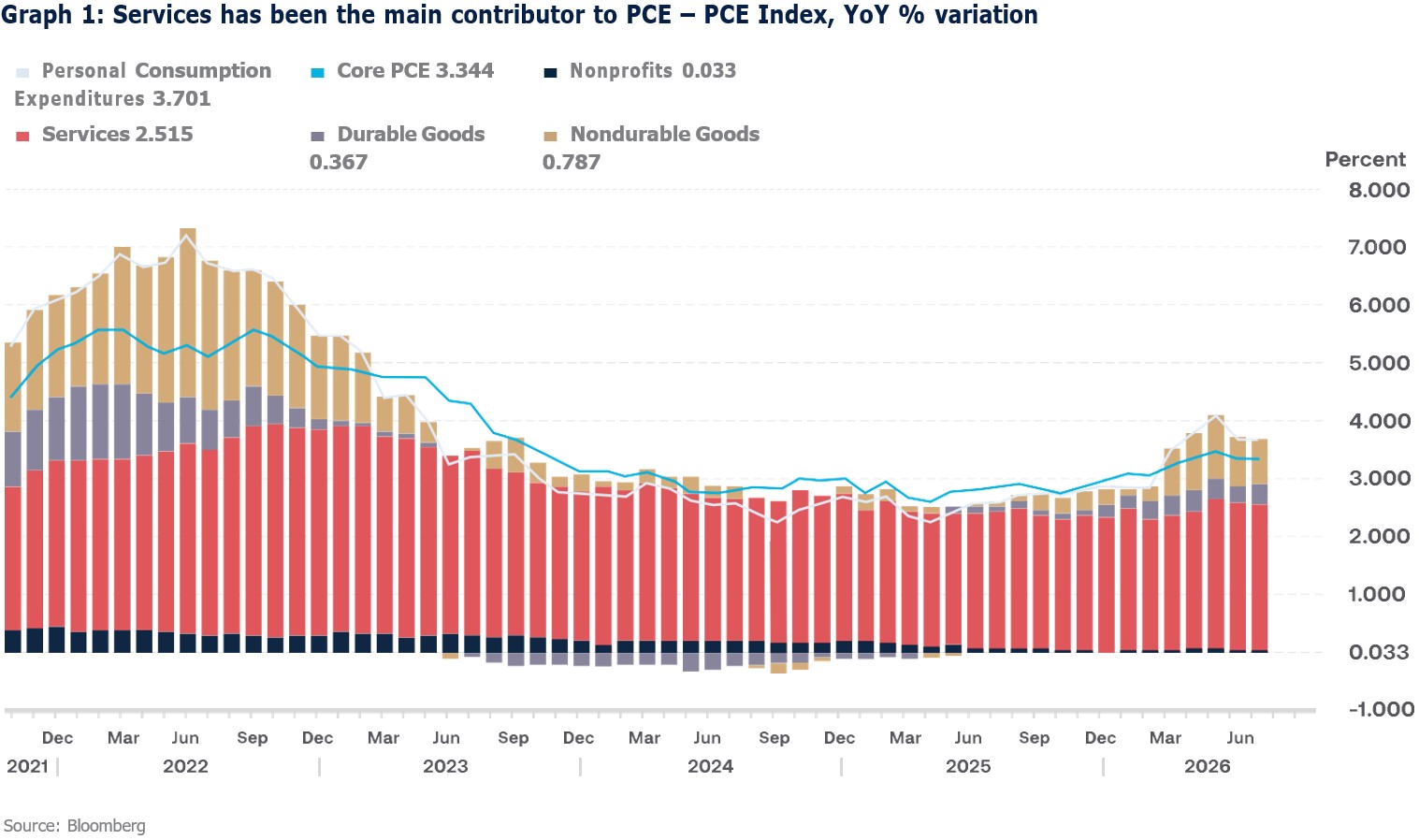
Because the SEP projections are already somewhat dated, we contrasted them with the latest PCE figures to better understand the inflation trend and gauge what it implies for monetary policy. The July PCE data showed inflation remains sticky, with both headline and core PCE still well above the 2% target and services inflation continuing to drive the annual increase, as shown in Graph 1. This trend has dominated since 2021, with services increasingly shaping inflation dynamics as the contribution from nondurable goods has diminished.
The message here is twofold. Inflation remains above target, and even if annual PCE variation is muted, the data do not yet suggest a clean return to 2%. At the same time, the relative stability of core PCE could support keeping rates unchanged at the upcoming Fed meeting.
We did the same exercise for GDP, and the trend we inferred from the SEP points to a slight economic decelera-tion in 2026, with most FOMC participants expecting growth between 2.0% and 2.3% (versus 2.2% and 2.5% in March). Still, long-term projections point to growth stabi-lizing around 2% in both 2027 and 2028.
Contrasting those forecasts with the Q2 GDP reading helps explain why Chair Warsh said he was impressed with the U.S. economy. Personal consumption expenditures have remained resilient since 2021, partially offsetting the drags from net exports and changes in private inventories, as shown in Graph 2. At the same time, recent volatility in net exports suggests trade-related factors have played an outsized role in headline GDP growth, particularly because
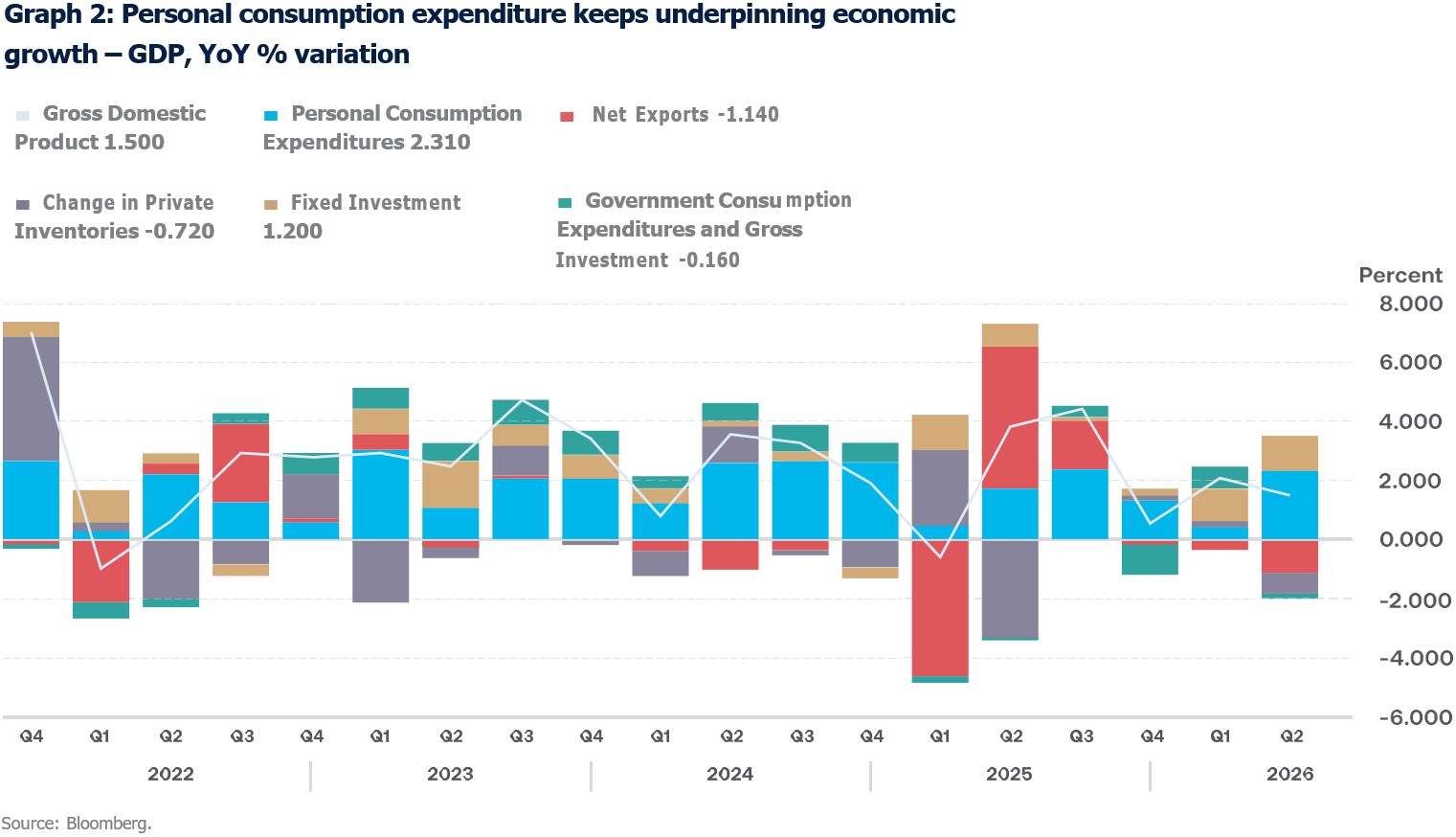
of tariff implementation and front-loaded inventory purchases. Fixed investment, by contrast, contributed strongly in both Q1 and Q2, pointing to continued business spending, especially from the fixed non-residential compo-nent tied to the AI expansion cycle. Even so, growth could cool in 2H26 as the Q2 boost from the World Cup and tax refunds fades. For monetary policy, that cooling would argue for rate stability and could support rate cuts if the deceleration became recessionary.
In sum, the first rule of Warsh’s tenure may be that the Fed no longer does the market’s interpretive work for it. His Jackson Hole remarks suggested a central bank that remains focused on above-target inflation, still sees resilience in the U.S. economy, and is increasingly reluctant to pre-commit on the policy path. That combination leaves investors with fewer explicit signals but not necessarily less information. The burden shifts back to the data: inflation trends, labor-market resilience, growth composition, financial conditions, and the SEP’s evolving message. For markets, the result could be a regime with less handholding, more sensitivity to realized economic outcomes, and sharper reactions when the Fed finally acts. If the Powell-era market learned to listen to the referee, the Warshera market may have to play the ball.
Important Disclosures
Insigneo” and “Insigneo Wealth” are brand names used by Insigneo Financial Group, LLC and its affiliates. Brokerage products and services are offered through Insigneo Securities, LLC, a broker-dealer, registered with the U.S. Securities and Exchange Commission (“SEC”) and a member of FINRA and SIPC. Investment advisory products and services are offered through Insigneo Advisory Services, LLC, an SEC-registered investment adviser. Because we operate through various affiliates in different locations, please visit https:// insigneo.com/legalentities/ to understand which entity you are working with and what that means for you. This material should not be construed as an offer to sell or the solicitation of an offer to buy a security. It is for general information purposes only. To the extent that this material discusses general market activity, industry or sector trends or other broad-based economic or political conditions, it should not be construed as research investment advice. To the extent that it includes references to securities, those references do not constitute a recommendation to buy, sell or hold such security. It does not constitute a recommendation or a statement of opinion, or a report of either of those things and does not, and is not intended, to consider the particular investment objectives, financial conditions, or needs of the individual investors.
Not All Risks Are Disclosed – Past performance is not indicative of futures results. Investment involves significant risk, and it is possible to lose some or all of your principal investments and therefore may not be suitable for everyone. Always consider whether any investment is suitable for your particular circumstances and, if necessary, seek professional advice from your Investment Professional. This material may contain opinions, expressions an estimated that represent the analysis and perspective of Insigneo Securities, LLC’s Investment Strategy Department or its providers at the time of publication. These are subject to change at any time without notice.
FOR AFFILIATES LOCATED IN CHILE – PARA AFILIADAS LOCALIZADAS EN CHILE
Insigneo Asesorías Financieras SPA se encuentra inscrito en Chile, en el Registro de Prestadores de Servicios Financieros de la Comisión para el Mercado Financiero. Este informe fue efectuado por área de Research & Strategy de Insigneo Securities LLC. o sus proveedores, en base a la información disponible a la fecha de emisión de este. Para evitar cualquier conflicto de interés, Insigneo Securities LLC dispone que ningún integrante del equipo de Research & Strategy tenga su remuneración asociada directa o indirectamente con una recomendación o reporte específico o con el resultado de una cartera. Aunque los antecedentes sobre los cuales ha sido elaborado este informe fueron obtenidos de fuentes consideradas confiables, no podemos garantizar la completa exactitud e integridad de estos, no asumiendo responsabilidad alguna al respecto Insigneo Securities LLC, Insigneo Asesorías Financieras SPA ni ninguna de sus empresas relacionadas. Este material está destinado únicamente a facilitar el debate general y no pretende ser fuente de ninguna recomendación específica para una persona concreta. Por favor, consulte con su ejecutivo de cuentas o con su asesor financiero si alguna de las recomendaciones específicas que se hacen en este documento es adecuada para usted. Este documento no constituye una oferta o solicitud de compra o venta de ningún valor en ninguna jurisdicción en la que dicha oferta o solicitud no esté autorizada o a ninguna persona a la que sea ilegal hacer dicha oferta o solicitud. Las inversiones en cuentas de corretaje y de asesoramiento de inversiones están sujetas al riesgo de mercado, incluida la pérdida de capital. La información base del presente informe puede sufrir cambios, no teniendo Insigneo Securities LLC ni Insigneo Asesorías Financieras SPA la obligación de actualizar el presente informe ni de comunicar a sus destinatarios sobre la ocurrencia de tales cambios. Cualquier opinión, expresión, estimación y/o recomendación contenida en este informe constituyen el juicio o visión de área de Research & Strategy de Insigneo Securities LLC. o sus proveedores, a la fecha de su publicación y pueden ser modificadas sin previo aviso.
FOR AFFILIATES LOCATED IN URUGUAY- PARA AFILIADAS LOCALIZADAS EN URUGUAY
Insigneo Asesor Uruguay S.A. está inscripto en el Registro de Mercado de Valores del Banco Central del Uruguay como Asesor de Inversiones. En Uruguay, los valores están siendo ofrecidos en forma privada de acuerdo al artículo 2 de la ley 18.627 y sus modificaciones. Los valores no han sido ni serán registrados ante el Banco Central del Uruguay para oferta pública. Este material está destinado únicamente a facilitar el debate general y no pretende ser fuente de ninguna recomendación específica para una persona concreta. Por favor, consulte con su ejecutivo de cuentas o con su asesor financiero si alguna de las recomendaciones específicas que se hacen en este documento es adecuada para usted según su perfil y estrategia de inversión. Este documento no constituye un asesoramiento ni una recomendación u oferta o solicitud de compra o. Las inversiones en valores negociables están sujetas al riesgo de mercado, incluida la pérdida parcial o total del capital invertido. Cualquier opinión, expresión, estimación y/o recomendación contenida en este informe constituyen el juicio o visión de área de Research & Strategy de Insigneo Securities LLC. o sus proveedores, a la fecha de su publicación y pueden ser modificadas sin previo aviso. Rentabilidades históricas de los productos anunciados no aseguran rentabilidades futuras.
FOR AFFILIATES LOCATED IN ARGENTINA – PARA AFILIADAS LOCALIZADAS EN ARGENTINA
Insigneo Argentina S.A.U. Agente Asesor Global de Inversión se encuentra registrado bajo el N° 1053 de la Comisión Nacional de Valores (CNV) e inscripto ante la Inspección General de Justicia (IGJ) bajo el N° 12.278 del Libro 90, Tomo –, de Sociedades por Acciones. Este informe fue efectuado por área de Research & Strategy de Insigneo Securities LLC. o sus proveedores, en base a la información disponible a la fecha de su emisión. Para evitar cualquier conflicto de interés, Insigneo Securities LLC dispone que ningún integrante del equipo de Research & Strategy tenga su remuneración asociada directa o indirectamente con una recomendación o reporte específico o con el resultado de una cartera. Aunque los antecedentes sobre los cuales ha sido elaborado este informe fueron obtenidos de fuentes consideradas confiables, no podemos garantizar la completa exactitud e integridad de estos, no asumiendo responsabilidad alguna al respecto Insigneo Securities LLC, Insigneo Argentina S.A.U. ni ninguna de sus empresas relacionadas. La información base del presente informe puede sufrir cambios, no teniendo Insigneo Argentina S.A.U. la obligación de actualizar el presente informe ni de comunicar a sus destinatarios sobre la ocurrencia de tales cambios. Este material está destinado únicamente a facilitar el debate general y no pretende ser fuente de ninguna recomendación específica para una persona concreta. Por favor, consulte con su ejecutivo de cuentas o con su asesor financiero si alguna de las recomendaciones específicas que se hacen en este documento es adecuada para usted. Este documento no constituye una oferta, recomendación o solicitud de compra o venta de ningún valor negociable en ninguna jurisdicción en la que dicha oferta o solicitud no esté autorizada o a ninguna persona a la que sea ilegal hacer dicha oferta o solicitud. Las inversiones en valores negociables están sujetas al riesgo de mercado, incluida la pérdida parcial o total del capital invertido. Cualquier opinión, expresión, estimación y/o recomendación contenida en este informe constituyen el juicio o visión de área de Research & Strategy de Insigneo Securities LLC. o sus proveedores, a la fecha de su publicación y pueden ser modificadas sin previo aviso.
FOR AFFILIATES LOCATED IN COLOMBIA – PARA AFILIADAS LOCALIZADAS EN COLOMBIA
Oficina De Representación en Colombia
La Oficina de Representación fue autorizada por la Superintendencia Financiera de Colombia el 5 de febrero de 2021, para promover o publicitar en Colombia, o a sus residentes, los productos y servicios del mercado de valores ofrecidos por Insigneo Securities, LLC e Insigneo Advisory Services, LLC. La información contenida en este informe ha sido obtenida de fuentes consideradas confiables; no obstante, no se garantiza su exactitud ni integridad, no asumiendo responsabilidad alguna Insigneo Securities, LLC e Insigneo Advisory Services, LLC ni sus entidades relacionadas. Este material tiene fines exclusivamente informativos y no constituye una recomendación personalizada. Las inversiones están sujetas a riesgos de mercado, incluida la posible pérdida de capital, por lo que se recomienda consultar con su asesor financiero. La información, opiniones y estimaciones aquí contenidas corresponden a la fecha de publicación, pueden ser modificadas sin previo aviso y no existe obligación de actualización por parte de las entidades mencionadas.
DM Wealth Management Group is the “doing business as entity” through which Cristina Mendez, Zoraida Diaz, and Debra Tyler, investment professionals (“IP”) of Insigneo Securities, LLC (“ISEC”) and Insigneo Advisory Services, LLC (“IAS”) conducts securities and advisory activities DM Wealth Management Group is not itself a broker dealer or an investment advisor and is not under common ownership with ISEC or IAS. Insigneo Financial Group, LLC comprises a number of operating businesses engaged in the offering of brokerage and advisory products and services in various jurisdictions. Brokerage products and services are offered through Insigneo Securities, LLC, a broker-dealer registered with the U.S. Securities and Exchange Commission (“SEC”) and member of FINRA and SIPC. Investment advisory products and services are offered through Insigneo Advisory Services, LLC, an investment adviser registered with the SEC. Insigneo has affiliated companies in different locations, so it is important to understand which entity you are conducting business with. Please visit "https://insigneo.com/legalentities" for more information about the differences between these companies, their locations, and what that means for you.
Investing involves risk, including possible loss of principal. Past performance is not indicative of future results. Please consult your Investment Professional for any recommendation regarding your specific financial situation.
Click on the following links to view ISEC Reg BI Client Relationship Summary (“Form CRS”) and IAS Form ADV Part 3 CRS.
The following content is provided by Insigneo, the firm through which DM Wealth Management’s investment professionals offer brokerage and advisory services. Visit insigneo.com to learn more.