

October 9, 2026


Navigating a Higher-for-Longer Fixed Income Market
The rise in long-term Treasury yields appears to reflect more than changes in the economy’s neutral rate.

In a market where duration risk remains elevated, the current environment continues to support an empha-sis on quality, a laddered portfolio approach, and ex-posure to the short and middle parts of the curve.
Recent research challenges the idea that long-term in-terest rates are driven primarily by economic funda-mentals, suggesting that market expectations and pol-icy signals may play a larger role than traditionally assumed.
The rise in long-term Treasury yields appears to reflect more than changes in the economy’s neutral rate, rais-ing important questions about how investors should interpret today’s higher-rate environment.
Although current Treasury yields are among the most attractive available in more than a decade, the addition-al compensation from moving significantly further out on the maturity spectrum may not adequately offset the added duration risk.
If expectations, policy signals, and term-premium dy-namics can keep yields elevated for extended periods, a higher-for-longer environment may persist even without a meaningful change in the economy’s equilibrium rate.
2026 has been a volatile year for fixed income. Amid lin-gering fiscal worries, a war that continues to fuel inflation, and a Federal Reserve that seems more willing to pursue a more restrictive monetary policy, Treasury yields have widened sharply in recent months.
As investors look for explanations for the sharp increase in rates across the Treasury curve, the lack of forward guidance from a Fed increasingly reluctant to steer a market that had become dependent on it has added to the uncertainty. Against this backdrop, we review recent moves at the long end of the curve through the lens of current research on the neutral rate of interest and draw our own conclusions for fixed income investors.
The neutral rate of interest, usually denoted r*, is the real short-term interest rate consistent with an economy op-erating at full employment and stable inflation — in other words, the rate that is neither stimulative nor restrictive. Because it is unobservable, economists must estimate it from macroeconomic data. When the actual policy rate is below r*, monetary policy is accommodative; when it is above r*, policy is restrictive. The neutral rate of interest is particularly relevant in the current macroeconomic back-drop, given the debate over whether monetary policy re-mains restrictive and the “higher for longer” debate in the rates market, which is also influenced by discussions of the term premium.
Standard economic theory suggests that persistent changes in r* should be reflected primarily in long-term rates. By contrast, news that attracts financial markets’ attention but provides no meaningful information about r* should not have a lasting influence on those rates.
A recent column by Paul Beaudry, Paolo Cavallino, and Tim Willems1 challenges this conventional view. The authors find that most of the observed rise in long-term interest rates after the Covid crisis is largely explained by narrow three-day windows around nonfarm payroll releases and by speeches by prominent Federal Reserve policymakers. Remarkably, these windows cover only 24% of trading days in the paper’s data sample, from August 1, 2020, to September 3, 2026. The paper’s under-lying thesis is that market participants closely monitor both events because of their direct influence on short-term monetary policy; however, they are not assumed to affect r* directly.
Beaudry, Cavallino, and Willems also examine why long-term real rates may have only a weak relationship with r*. Their argument centers on retirement savings: when rates at the long end of the curve rise, those savings compound faster. Households may then conclude that they do not need to save as aggressively to reach their retirement goals and can spend more today. This feedback mecha-nism could make policy mistakes harder to detect because perceptions of where rates belong can begin to shape economic behavior, helping long-term yields remain elevated for extended periods.
Another recent paper, by Christensen and Rudebusch (2026)2, examines whether worsening fiscal prospects or AI breakthroughs could explain the rise in r*, which is usually considered a primary driver of long-term rates. The authors test whether relevant fiscal or AI-related news led investors to revise their estimates of r* upward. They find no substantial evidence that either category of events explains the increase in long-term rates: fiscal-policy events account for less than 20% of the rise, while AI-related event windows make a negative contribution. They also find that changes in long-term rates within narrow windows around FOMC meetings do not account for any of the observed increase over the period.
So, after reviewing these two recent research papers, two things stand out:
These findings shift the focus from economic fundamen-tals alone to the expectations and narratives that influ-ence long-term yields. To examine that distinction more closely, it is useful to consider the relationship between r* and another key market variable: the term premium. In plain language, the term premium is the extra compensa-tion investors demand for holding a long-term bond instead of rolling over a series of short-term bonds over the same horizon. It can be decomposed into two
Christensen, J. H. E., & Rudebusch, G. D. (2026, August 18). Can Fiscal, AI, or Monetary News Explain the Rise in r*?. FRBSF. https://www.frbsf.org/wp-content/uploads/wp2026-19.pdf
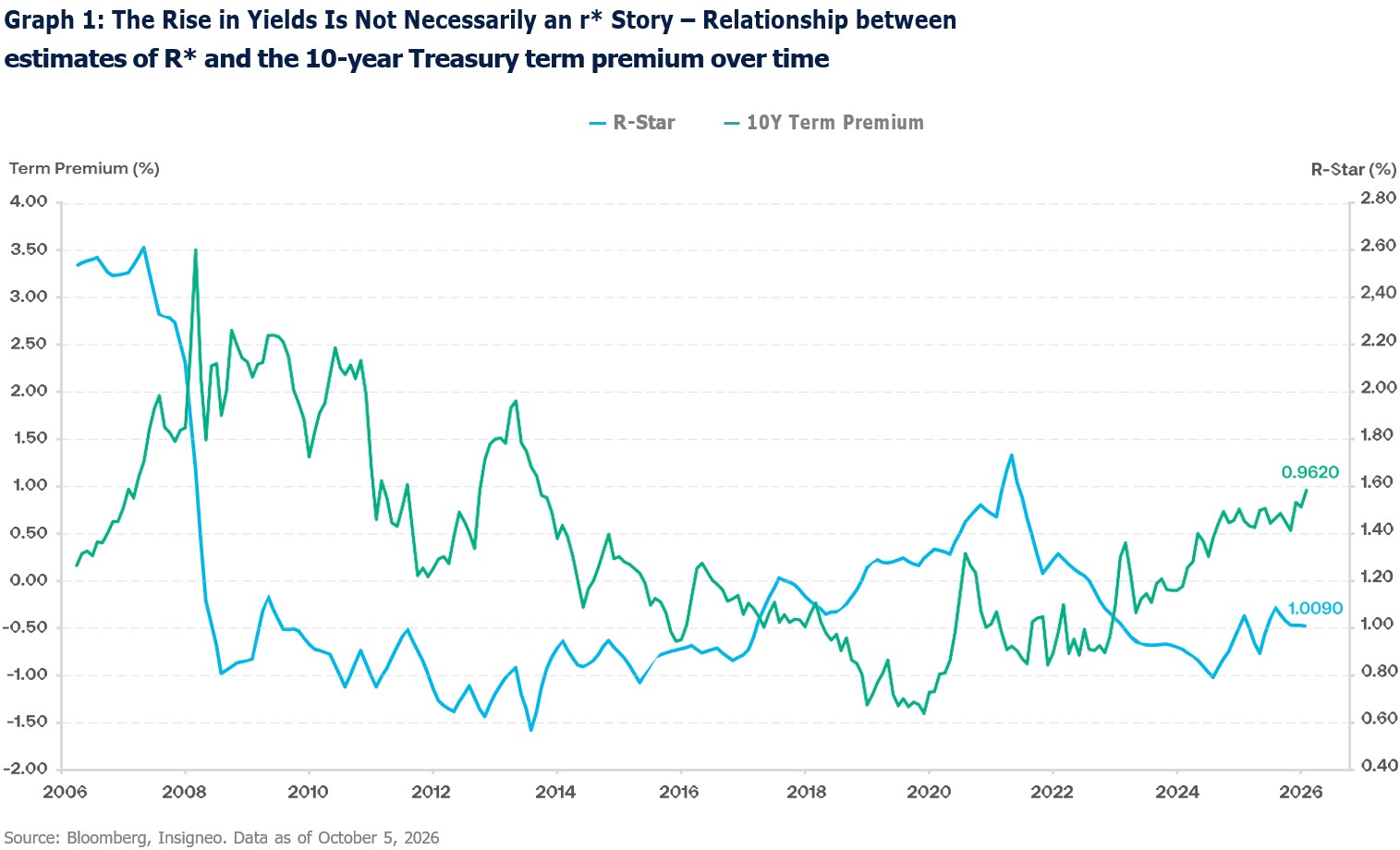
components: expected future short rates and the addi-tional yield above that expectation, widely known as the term premium. The term premium is also unobservable and must be estimated using models, with the Adrian-Crump-Moench model, published by the New York Fed, being the most widely used.
When comparing the term premium and r* over the last 20 years, as shown in Graph 1, a few things stand out. First, the relationship between r* and the term premium was inverse pre-GFC, then changed and trended lower together throughout the QE period. Central bank asset purchases deeply suppressed yields at the long end of the curve; as a result, the term premium turned negative for most of the decade. After 2022, when the Fed embarked on a tightening cycle, both r* and the term premium repriced sharply to their current levels.
From current levels of both r* and the term premium, we can infer that if we decompose the 10-year yield by subtracting the term premium, the short-term expected rate would be ~4.32%. This level is above the longer-run rate forecast in the Fed’s latest dot plot, suggesting the market may be pricing in a higher policy rate path. The observed increase in the term premium also leads us to believe that market participants are requiring higher compensation to hold duration in their portfolios because of higher inflation expectations, a challenging fiscal outlook with persistently wide US budget deficits, and sustained longer-dated debt supply stemming from the AI capex boom as hyperscaler credit competes with Treasuries for capital. In the September Minutes published on October 7, several FOMC members said the scale of the AI buildout continued to surprise, confirming the thesis that AI investment is boosting productive capacity and capital demand and, in turn, supports a structurally higher r*.
Historically, periods of rising term premiums have been more challenging for longer-duration securities because investors demand greater compensation for uncertainty around inflation, fiscal conditions, and the future path of policy rates. If recent research is correct that long-term rates are influenced as much by expectations and market narratives as by observable fundamentals, the long end of the curve could remain vulnerable to further volatility. That vulnerability may persist even if economic growth moderates or estimates of the term premium and r* begin to normalize.
For investors, the distinction between yield and risk-adjusted yield may become increasingly important. Although current Treasury yields are among the most attractive available in more than a decade, the additional compensation from moving significantly further out on the maturity spectrum may not adequately offset the added duration risk. We therefore continue to base our fixed income framework on three theses: favor quality, maintain a laddered portfolio approach, and concen-trate exposure in the short and middle parts of the curve.
Higher yields have improved prospective fixed income returns, but credit spreads remain relatively compressed by historical standards. With little evidence that investors are being meaningfully compensated for assuming addi-tional credit risk, an emphasis on higher-quality issuers remains prudent. A laddered portfolio, meanwhile, reduces the need to make a binary call on the direction of rates and creates a systematic reinvestment mechanism. Finally, investors can capture much of today’s yield without assuming the full volatility associated with longer-dated bonds. Given the continuing uncertainty around inflation, fiscal dynamics, term premium, and the eventual destina-tion of monetary policy, the risk-reward tradeoff in the front and mid ends of the curve appears more balanced.
Ultimately, investors may be asking the wrong question. Rather than focusing exclusively on the precise level of r*, it may be more important to recognize that long-term rates appear to be influenced by a broader set of forces than conventional theory suggests. If expectations, policy signals, and term-premium dynamics can keep yields elevated for extended periods, then a higher-for-longer environment may persist even without a meaningful change in the economy’s equilibrium rate. For investors, that reality reinforces a simple lesson: a disciplined invest-ment process often outweighs trying to predict the next move in interest rates.
Insigneo” and “Insigneo Wealth” are brand names used by Insigneo Financial Group, LLC and its affiliates. Brokerage products and services are offered through Insigneo Securities, LLC, a broker-dealer, registered with the U.S. Securities and Exchange Commission (“SEC”) and a member of FINRA and SIPC. Investment advisory products and services are offered through Insigneo Advisory Services, LLC, an SEC-registered investment adviser. Because we operate through various affiliates in different locations, please visit https:// insigneo.com/legalentities/ to understand which entity you are working with and what that means for you. This material should not be construed as an offer to sell or the solicitation of an offer to buy a security. It is for general information purposes only. To the extent that this material discusses general market activity, industry or sector trends or other broad-based economic or political conditions, it should not be construed as research investment advice. To the extent that it includes references to securities, those references do not constitute a recommendation to buy, sell or hold such security. It does not constitute a recommendation or a statement of opinion, or a report of either of those things and does not, and is not intended, to consider the particular investment objectives, financial conditions, or needs of the individual investors.
Not All Risks Are Disclosed – Past performance is not indicative of futures results. Investment involves significant risk, and it is possible to lose some or all of your principal investments and therefore may not be suitable for everyone. Always consider whether any investment is suitable for your particular circumstances and, if necessary, seek professional advice from your Investment Professional. This material may contain opinions, expressions an estimated that represent the analysis and perspective of Insigneo Securities, LLC’s Investment Strategy Department or its providers at the time of publication. These are subject to change at any time without notice.
FOR AFFILIATES LOCATED IN CHILE – PARA AFILIADAS LOCALIZADAS EN CHILE
Insigneo Asesorías Financieras SPA se encuentra inscrito en Chile, en el Registro de Prestadores de Servicios Financieros de la Comisión para el Mercado Financiero. Este informe fue efectuado por área de Research & Strategy de Insigneo Securities LLC. o sus proveedores, en base a la información disponible a la fecha de emisión de este. Para evitar cualquier conflicto de interés, Insigneo Securities LLC dispone que ningún integrante del equipo de Research & Strategy tenga su remuneración asociada directa o indirectamente con una recomendación o reporte específico o con el resultado de una cartera. Aunque los antecedentes sobre los cuales ha sido elaborado este informe fueron obtenidos de fuentes consideradas confiables, no podemos garantizar la completa exactitud e integridad de estos, no asumiendo responsabilidad alguna al respecto Insigneo Securities LLC, Insigneo Asesorías Financieras SPA ni ninguna de sus empresas relacionadas. Este material está destinado únicamente a facilitar el debate general y no pretende ser fuente de ninguna recomendación específica para una persona concreta. Por favor, consulte con su ejecutivo de cuentas o con su asesor financiero si alguna de las recomendaciones específicas que se hacen en este documento es adecuada para usted. Este documento no constituye una oferta o solicitud de compra o venta de ningún valor en ninguna jurisdicción en la que dicha oferta o solicitud no esté autorizada o a ninguna persona a la que sea ilegal hacer dicha oferta o solicitud. Las inversiones en cuentas de corretaje y de asesoramiento de inversiones están sujetas al riesgo de mercado, incluida la pérdida de capital. La información base del presente informe puede sufrir cambios, no teniendo Insigneo Securities LLC ni Insigneo Asesorías Financieras SPA la obligación de actualizar el presente informe ni de comunicar a sus destinatarios sobre la ocurrencia de tales cambios. Cualquier opinión, expresión, estimación y/o recomendación contenida en este informe constituyen el juicio o visión de área de Research & Strategy de Insigneo Securities LLC. o sus proveedores, a la fecha de su publicación y pueden ser modificadas sin previo aviso.
FOR AFFILIATES LOCATED IN URUGUAY- PARA AFILIADAS LOCALIZADAS EN URUGUAY
Insigneo Asesor Uruguay S.A. está inscripto en el Registro de Mercado de Valores del Banco Central del Uruguay como Asesor de Inversiones. En Uruguay, los valores están siendo ofrecidos en forma privada de acuerdo al artículo 2 de la ley 18.627 y sus modificaciones. Los valores no han sido ni serán registrados ante el Banco Central del Uruguay para oferta pública. Este material está destinado únicamente a facilitar el debate general y no pretende ser fuente de ninguna recomendación específica para una persona concreta. Por favor, consulte con su ejecutivo de cuentas o con su asesor financiero si alguna de las recomendaciones específicas que se hacen en este documento es adecuada para usted según su perfil y estrategia de inversión. Este documento no constituye un asesoramiento ni una recomendación u oferta o solicitud de compra o. Las inversiones en valores negociables están sujetas al riesgo de mercado, incluida la pérdida parcial o total del capital invertido. Cualquier opinión, expresión, estimación y/o recomendación contenida en este informe constituyen el juicio o visión de área de Research & Strategy de Insigneo Securities LLC. o sus proveedores, a la fecha de su publicación y pueden ser modificadas sin previo aviso. Rentabilidades históricas de los productos anunciados no aseguran rentabilidades futuras.
FOR AFFILIATES LOCATED IN ARGENTINA – PARA AFILIADAS LOCALIZADAS EN ARGENTINA
Insigneo Argentina S.A.U. Agente Asesor Global de Inversión se encuentra registrado bajo el N° 1053 de la Comisión Nacional de Valores (CNV) e inscripto ante la Inspección General de Justicia (IGJ) bajo el N° 12.278 del Libro 90, Tomo –, de Sociedades por Acciones. Este informe fue efectuado por área de Research & Strategy de Insigneo Securities LLC. o sus proveedores, en base a la información disponible a la fecha de su emisión. Para evitar cualquier conflicto de interés, Insigneo Securities LLC dispone que ningún integrante del equipo de Research & Strategy tenga su remuneración asociada directa o indirectamente con una recomendación o reporte específico o con el resultado de una cartera. Aunque los antecedentes sobre los cuales ha sido elaborado este informe fueron obtenidos de fuentes consideradas confiables, no podemos garantizar la completa exactitud e integridad de estos, no asumiendo responsabilidad alguna al respecto Insigneo Securities LLC, Insigneo Argentina S.A.U. ni ninguna de sus empresas relacionadas. La información base del presente informe puede sufrir cambios, no teniendo Insigneo Argentina S.A.U. la obligación de actualizar el presente informe ni de comunicar a sus destinatarios sobre la ocurrencia de tales cambios. Este material está destinado únicamente a facilitar el debate general y no pretende ser fuente de ninguna recomendación específica para una persona concreta. Por favor, consulte con su ejecutivo de cuentas o con su asesor financiero si alguna de las recomendaciones específicas que se hacen en este documento es adecuada para usted. Este documento no constituye una oferta, recomendación o solicitud de compra o venta de ningún valor negociable en ninguna jurisdicción en la que dicha oferta o solicitud no esté autorizada o a ninguna persona a la que sea ilegal hacer dicha oferta o solicitud. Las inversiones en valores negociables están sujetas al riesgo de mercado, incluida la pérdida parcial o total del capital invertido. Cualquier opinión, expresión, estimación y/o recomendación contenida en este informe constituyen el juicio o visión de área de Research & Strategy de Insigneo Securities LLC. o sus proveedores, a la fecha de su publicación y pueden ser modificadas sin previo aviso.
FOR AFFILIATES LOCATED IN COLOMBIA – PARA AFILIADAS LOCALIZADAS EN COLOMBIA
Oficina De Representación en Colombia
La Oficina de Representación fue autorizada por la Superintendencia Financiera de Colombia el 5 de febrero de 2021, para promover o publicitar en Colombia, o a sus residentes, los productos y servicios del mercado de valores ofrecidos por Insigneo Securities, LLC e Insigneo Advisory Services, LLC. La información contenida en este informe ha sido obtenida de fuentes consideradas confiables; no obstante, no se garantiza su exactitud ni integridad, no asumiendo responsabilidad alguna Insigneo Securities, LLC e Insigneo Advisory Services, LLC ni sus entidades relacionadas. Este material tiene fines exclusivamente informativos y no constituye una recomendación personalizada. Las inversiones están sujetas a riesgos de mercado, incluida la posible pérdida de capital, por lo que se recomienda consultar con su asesor financiero. La información, opiniones y estimaciones aquí contenidas corresponden a la fecha de publicación, pueden ser modificadas sin previo aviso y no existe obligación de actualización por parte de las entidades mencionadas.
DM Wealth Management Group is the “doing business as entity” through which Cristina Mendez, Zoraida Diaz, and Debra Tyler, investment professionals (“IP”) of Insigneo Securities, LLC (“ISEC”) and Insigneo Advisory Services, LLC (“IAS”) conducts securities and advisory activities DM Wealth Management Group is not itself a broker dealer or an investment advisor and is not under common ownership with ISEC or IAS. Insigneo Financial Group, LLC comprises a number of operating businesses engaged in the offering of brokerage and advisory products and services in various jurisdictions. Brokerage products and services are offered through Insigneo Securities, LLC, a broker-dealer registered with the U.S. Securities and Exchange Commission (“SEC”) and member of FINRA and SIPC. Investment advisory products and services are offered through Insigneo Advisory Services, LLC, an investment adviser registered with the SEC. Insigneo has affiliated companies in different locations, so it is important to understand which entity you are conducting business with. Please visit "https://insigneo.com/legalentities" for more information about the differences between these companies, their locations, and what that means for you.
Investing involves risk, including possible loss of principal. Past performance is not indicative of future results. Please consult your Investment Professional for any recommendation regarding your specific financial situation.
Click on the following links to view ISEC Reg BI Client Relationship Summary (“Form CRS”) and IAS Form ADV Part 3 CRS.
The following content is provided by Insigneo, the firm through which DM Wealth Management’s investment professionals offer brokerage and advisory services. Visit insigneo.com to learn more.