

October 16, 2026


Brazil’s Coiled Spring – Part 1: Why a Favorable Electoral Outcome Could Unlock Further Equity Upside
This report is the first installment in a two-part series examining Brazil’s equity and fixed income markets in the context of the country’s electoral landscape.

Brazil’s Coiled Spring – Part 1:
The opportunity lies in expectations, not perfection – With the Ibovespa trading at roughly 9.6x forward earn-ings versus a historical average near 11.5x, investors are already being compensated for many of the risks. If fis-cal credibility improves and earnings continue growing, the combination of earnings growth and multiple ex-pansion could be powerful.
This report is the first installment in a two-part series ex-amining Brazil’s equity and fixed income markets in the context of the country’s electoral landscape. The second installment will be published in the week following the second-round election results.
A re-rating story, not a growth story – Brazil does not need exceptional GDP growth to generate attractive re-turns. A reduction in fiscal and political risk premiums alone could potentially drive meaningful valuation ex-pansion from today’s discounted levels.
Lower interest rates matter more than higher commod-ity prices – Nearly half of the Ibovespa is tied to domes-tically oriented sectors such as financials and utilities, making the path of the Selic rate potentially more im-portant than the price of iron ore or oil.
For much of the past decade, investing in Brazil has required two qualities that are often in short supply on Wall Street: patience and a strong stomach. The country’s ability to test investors’ conviction has become almost legendary. Yet beneath the bouts of political drama, fiscal anxiety, currency volatility, and persistently high interest rates lies one of the most compelling collections of assets in the emerging world. Few countries can match Brazil’s combination of abundant natural resources, globally competitive companies, a sophisticated financial system, and one of the largest domestic consumer markets outside the developed world. Despite these advantages, Brazilian equities have spent years trading at valuations that imply far more pessimism than the underlying funda-mentals would seem to justify.
Today, that disconnect may finally be creating an unusu-ally attractive opportunity. Valuations remain depressed, corporate earnings are improving, monetary policy is beginning to move in a more supportive direction, and the political backdrop may be shifting toward a more market-friendly and fiscally disciplined framework. At the same time, global investment themes ranging from electrifica-tion and energy infrastructure to artificial intelligence, resource security, and agricultural demand are increas-ingly intersecting with areas where Brazil possesses genuine competitive advantages.
This is not a call for a new economic miracle, nor is it a forecast that Brazil will relive the extraordinary commodity boom that powered markets between 2003 and 2011.
Investors do not need another China, another super cycle, or another decade of exceptionally strong growth for the story to work. In fact, the opportunity may be consider-ably simpler. If fiscal credibility improves modestly and corporate earnings continue their current trajectory, Brazil’s unusually large risk premium could begin to compress. For a market that still trades as though disap-pointment is the most likely outcome, merely becoming less disappointing could be enough to generate substan-tial upside.
At its core, the investment thesis is straightforward. Markets are simultaneously forecasting an earnings recovery while continuing to apply a significant discount to Brazilian assets because of concerns about fiscal sustainability and political execution. Should the political backdrop evolve in a way that provides greater confi-dence in fiscal discipline, that discount could narrow. In such a scenario, investors would benefit not only from earnings growth but also from a higher valuation multiple being applied to those earnings.
At first glance, Brazil may not appear to be fertile ground for a major equity rally. Consensus forecasts call for GDP growth of approximately 1.9% in 2026 and 1.5% in 2027. Inflation remains above the Central Bank’s target, public debt remains elevated, and real interest rates are among the highest in the world. Yet equity markets rarely move in response to the absolute level of economic activity. More often, they respond to changes in expectations. The crucial question is not whether Brazil’s current macro-economic environment is strong, but whether future conditions are likely to prove better than those already reflected in asset prices.
That is where valuations become particularly important. The Ibovespa currently trades at roughly 12.4x trailing earn-ings and 9.6x forward earnings. Although valuations have recovered from the depressed levels seen during the 2022-2023 tightening cycle, they remain below historical norms. The trailing multiple sits below the ten-year average of 13.4x, while the forward multiple remains roughly 17% below the 2010-2021 average of 11.5x. As seen on Chart 1,
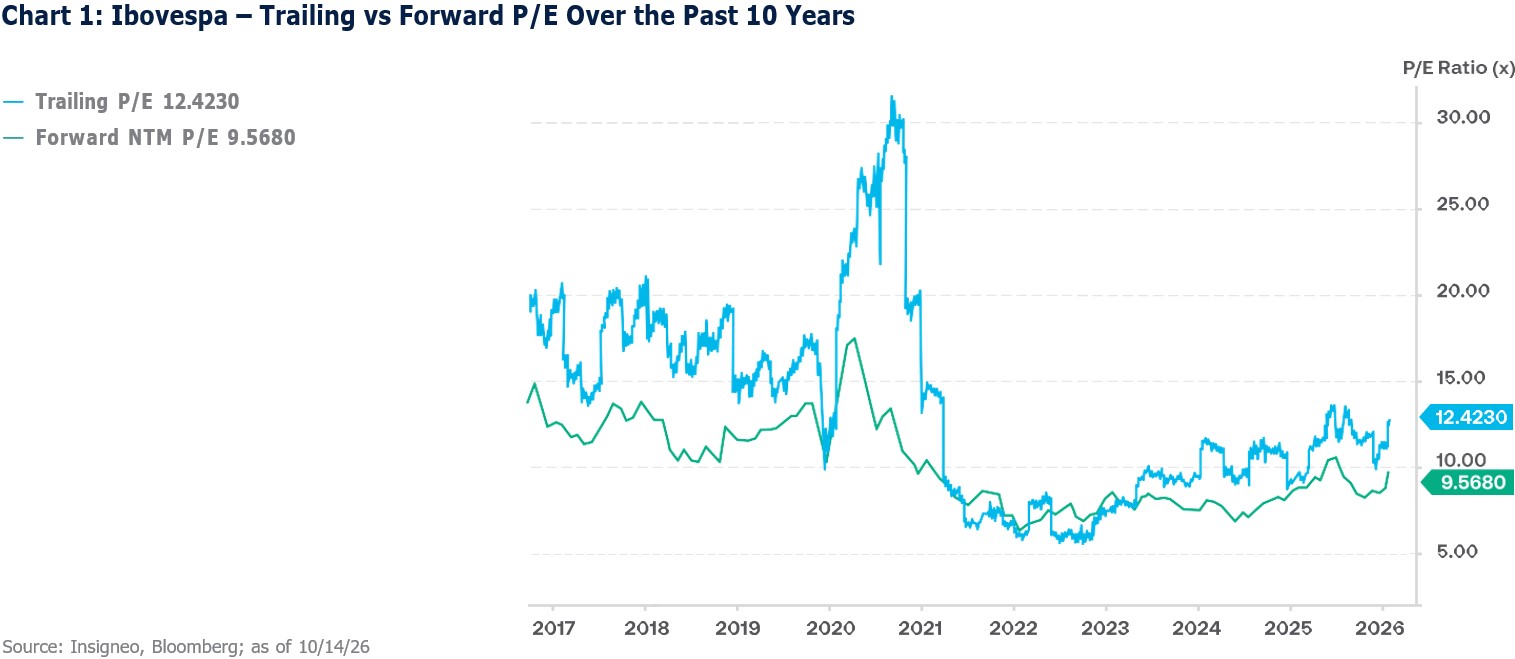
perhaps more telling is the wide gap between the trailing and forward multiples. The market is already anticipating earnings growth, yet despite that expectation, investors continue to assign a substantial risk premium to Brazilian assets. In other words, earnings expectations are improving faster than investor confidence.
Historically, some of the strongest periods of equity performance have occurred when those two variables improve simultaneously. Companies deliver better earn-ings than expected and investors become increasingly comfortable paying a higher multiple for those earnings. Brazil may be approaching precisely that type of inflec-tion point.
The upcoming election has become central to that discussion, not because of its potential impact on short-term economic growth, but because of its implications for the risk premium embedded throughout Brazilian finan-cial markets. Following the first-round election results, Brazilian equities rallied, the real strengthened, and inter-est-rate expectations declined. Investors interpreted the results as increasing the likelihood of a more fiscally disci-plined administration and, consequently, a more sustain-able debt trajectory.
Whether those expectations ultimately prove correct remains to be seen. What matters today is that market participants clearly believe the current fiscal risk premium may be too high. With Brazil’s debt-to-GDP ratio hovering around 83% and long-term government bond yields remaining elevated, even modest progress on fiscal consolidation could have an outsized impact on financial assets. A credible improvement in fiscal policy could trigger a virtuous cycle of lower sovereign risk premiums, declining long-term interest rates, currency apprecia-tion, further monetary easing, and, ultimately, higher equity valuations.
This dynamic is particularly important because much of Brazil’s equity market is more sensitive to interest rates than commodity prices. International investors often view Brazil primarily through the lens of Petrobras and Vale, but nearly half of the Ibovespa consists of sectors driven predominantly by domestic economic conditions. Financials account for roughly 29% of the index and utilities approxi-mately 19%. For these businesses, the path of the Selic rate matters far more than the price of oil or iron ore. The recent decline in the Selic from 15.0% to 13.75%, combined with expectations for further easing, therefore has broader implications than many investors appreciate. Lower rates stimulate credit creation, reduce financing costs, support housing activity, improve consumer spending, and increase capital markets activity. Some Wall Street sell-side esti-mates suggest that every 100-basis-point decline in rates could lift aggregate Ibovespa earnings by roughly 85 basis points. It is therefore not surprising that some of the stron-gest performers following the first-round election results were domestic banks, real estate companies, consum-er-related businesses, and small-cap stocks rather than commodity exporters.
Among these domestically focused sectors, Financials may offer the most direct exposure to a favorable political and monetary backdrop. Several of Brazil’s leading banks continue to trade at attractive valuations despite strong profitability and healthy earnings expectations. Banco do Brasil trades near 5.6x forward earnings, Bradesco around 7.6x, and Itaú roughly 10x. While some of these individual institutions carry differing, and sometimes high levels of political and operational risk, these are not distressed businesses. They are franchises operating in an environment constrained by elevated rates and persistent uncertainty. Consensus expectations for earnings growth in the country’s Financial sector ranging from the low to high teens create the possibility that investors could benefit simultaneously from earnings expansion and multiple re-rating, a combination that has historically produced some of the strongest equity returns.
Naturally, comparisons are often drawn to Brazil’s last great period of outperformance. The boom of 2003-2011 was fueled by a rare convergence of positive forces: China’s rapid industrialization, soaring commodity prices, declining inflation, falling interest rates, fiscal improve-ment, and significant currency appreciation. During that period, Brazil’s economy grew at roughly 4.7% annually while corporate earnings expanded at more than 20% per year. Today’s environment looks very different. Growth expectations are lower, debt burdens are higher, and China’s economy is maturing rather than accelerating. However, the key lesson from that period is not the specific catalyst but the mechanism. The strongest returns ultimately came because earnings grew faster than investors expected and confidence improved at the same time. A similar, albeit smaller, dynamic could emerge again if current earnings forecasts prove too conservative and fiscal concerns begin to moderate. The scale may be different, but the underlying driver of equity outperfor-mance could be remarkably similar.
Moreover, while another China-driven commodity super cycle appears unlikely, a new collection of structural tail-winds may provide support over the coming decade. Massive investment in artificial intelligence infrastructure, electrification, power-grid expansion, industrial reshoring, resource security, and food security is driving what could become a prolonged increase in global capital expendi-ture. No single theme is likely to replicate China’s property boom, but together they may create a powerful backdrop for real assets and infrastructure investment. Importantly, Brazil is unusually well positioned to benefit from these trends. It remains one of the world’s leading exporters of agricultural products, a major producer of iron ore and copper, and a country endowed with abundant renewable energy resources. Unlike the previous cycle, the potential beneficiaries are likely to be more diverse. Traditional players such as Vale and Petrobras remain important, but companies like Embraer, WEG, and TOTVS could also emerge as beneficiaries of industrial modernization, electrification, and technology-related investment.
The Brazilian real adds another dimension to the opportunity. The currency’s nearly 5% appreciation immediately following the first-round election results reflected growing optimism among investors. However, several Wall Street sell-side scenarios suggest that credible fiscal consolidation could push USD/BRL toward the 4.50-4.80 range from approximately 5.0 today, implying an additional 5-10% appreciation. A stronger currency would reinforce many of the positive dynamics already underway by lowering imported inflation, creating room for additional rate cuts, supporting domestic demand, and attracting incremental capital inflows. For foreign investors, the benefits could be particularly meaningful, as many of Brazil’s strongest equity periods have coin-cided with currency appreciation that enhanced returns in U.S. dollar terms.
That said, the bullish case is not without risks. The most important remains execution. Markets have already begun to price in the possibility of greater fiscal discipline, and sentiment could reverse if political promises fail to trans-late into credible policy action. Stabilizing debt dynamics will require difficult choices, while Brazil’s rigid budget structure makes fiscal reform challenging. Inflation is another key variable. If inflation expectations remain elevated, the Central Bank may be forced to keep interest rates restrictive for longer than investors currently expect, limiting valuation expansion in rate-sensitive sectors.
External risks also matter. Brazil remains exposed to global growth, commodity prices, and Chinese demand. A sharper-than-expected slowdown in China, weaker commodity markets, or a global recession would likely weigh on earnings expectations for some of the country’s largest companies. Likewise, part of the bullish scenario assumes a stronger Brazilian real. If fiscal reforms disappoint or global risk appetite deteriorates, currency weak-ness could offset a portion of potential returns.
Yet these risks appear to be widely understood and largely reflected in current valuations. Investors are not paying premium multiples for a perfect macroeconomic outcome. They are being offered exposure to a market where expectations remain subdued, and a substantial risk premium remains embedded in asset prices.
Ultimately, the most compelling aspect of the Brazilian equity market investment story is that it does not require perfection. Brazil does not need another China, another commodity super cycle, or even exceptional economic growth. The market already appears to understand the risks: elevated debt, fiscal uncertainty, inflation, political execution, and sensitivity to global growth. Those concerns are precisely why valuations remain depressed. Instead, the opportunity rests on a far simpler proposition. At roughly 9.6x forward earnings, the market continues to price Brazil as though its challenges are permanent. If fiscal credibility improves, risk premiums decline, earnings continue to grow, and the country captures even a portion of the opportunities emerging around energy infrastructure, artificial intelligence, electrification, agriculture, and critical resources, the combination of earnings growth and valuation expansion could be powerful.
Viewed through that lens, Brazil’s equity market upside is fundamentally a re-rating story. Investors are not being asked to believe in a miracle. They merely need to believe that the future may be somewhat better than what current prices imply. In a market where expecta-tions remain subdued and risk premiums remain elevated, that may be all that is required to generate compelling returns over the coming years. If confidence returns even modestly, the next chapter for Brazilian equities could be written not by explosive growth, but by the gradual reali-zation that the pessimism was overdone.
Insigneo” and “Insigneo Wealth” are brand names used by Insigneo Financial Group, LLC and its affiliates. Brokerage products and services are offered through Insigneo Securities, LLC, a broker-dealer, registered with the U.S. Securities and Exchange Commission (“SEC”) and a member of FINRA and SIPC. Investment advisory products and services are offered through Insigneo Advisory Services, LLC, an SEC-registered investment adviser. Because we operate through various affiliates in different locations, please visit https:// insigneo.com/legalentities/ to understand which entity you are working with and what that means for you. This material should not be construed as an offer to sell or the solicitation of an offer to buy a security. It is for general information purposes only. To the extent that this material discusses general market activity, industry or sector trends or other broad-based economic or political conditions, it should not be construed as research investment advice. To the extent that it includes references to securities, those references do not constitute a recommendation to buy, sell or hold such security. It does not constitute a recommendation or a statement of opinion, or a report of either of those things and does not, and is not intended, to consider the particular investment objectives, financial conditions, or needs of the individual investors.
Not All Risks Are Disclosed – Past performance is not indicative of futures results. Investment involves significant risk, and it is possible to lose some or all of your principal investments and therefore may not be suitable for everyone. Always consider whether any investment is suitable for your particular circumstances and, if necessary, seek professional advice from your Investment Professional. This material may contain opinions, expressions an estimated that represent the analysis and perspective of Insigneo Securities, LLC’s Investment Strategy Department or its providers at the time of publication. These are subject to change at any time without notice.
FOR AFFILIATES LOCATED IN CHILE – PARA AFILIADAS LOCALIZADAS EN CHILE
Insigneo Asesorías Financieras SPA se encuentra inscrito en Chile, en el Registro de Prestadores de Servicios Financieros de la Comisión para el Mercado Financiero. Este informe fue efectuado por área de Research & Strategy de Insigneo Securities LLC. o sus proveedores, en base a la información disponible a la fecha de emisión de este. Para evitar cualquier conflicto de interés, Insigneo Securities LLC dispone que ningún integrante del equipo de Research & Strategy tenga su remuneración asociada directa o indirectamente con una recomendación o reporte específico o con el resultado de una cartera. Aunque los antecedentes sobre los cuales ha sido elaborado este informe fueron obtenidos de fuentes consideradas confiables, no podemos garantizar la completa exactitud e integridad de estos, no asumiendo responsabilidad alguna al respecto Insigneo Securities LLC, Insigneo Asesorías Financieras SPA ni ninguna de sus empresas relacionadas. Este material está destinado únicamente a facilitar el debate general y no pretende ser fuente de ninguna recomendación específica para una persona concreta. Por favor, consulte con su ejecutivo de cuentas o con su asesor financiero si alguna de las recomendaciones específicas que se hacen en este documento es adecuada para usted. Este documento no constituye una oferta o solicitud de compra o venta de ningún valor en ninguna jurisdicción en la que dicha oferta o solicitud no esté autorizada o a ninguna persona a la que sea ilegal hacer dicha oferta o solicitud. Las inversiones en cuentas de corretaje y de asesoramiento de inversiones están sujetas al riesgo de mercado, incluida la pérdida de capital. La información base del presente informe puede sufrir cambios, no teniendo Insigneo Securities LLC ni Insigneo Asesorías Financieras SPA la obligación de actualizar el presente informe ni de comunicar a sus destinatarios sobre la ocurrencia de tales cambios. Cualquier opinión, expresión, estimación y/o recomendación contenida en este informe constituyen el juicio o visión de área de Research & Strategy de Insigneo Securities LLC. o sus proveedores, a la fecha de su publicación y pueden ser modificadas sin previo aviso.
FOR AFFILIATES LOCATED IN URUGUAY- PARA AFILIADAS LOCALIZADAS EN URUGUAY
Insigneo Asesor Uruguay S.A. está inscripto en el Registro de Mercado de Valores del Banco Central del Uruguay como Asesor de Inversiones. En Uruguay, los valores están siendo ofrecidos en forma privada de acuerdo al artículo 2 de la ley 18.627 y sus modificaciones. Los valores no han sido ni serán registrados ante el Banco Central del Uruguay para oferta pública. Este material está destinado únicamente a facilitar el debate general y no pretende ser fuente de ninguna recomendación específica para una persona concreta. Por favor, consulte con su ejecutivo de cuentas o con su asesor financiero si alguna de las recomendaciones específicas que se hacen en este documento es adecuada para usted según su perfil y estrategia de inversión. Este documento no constituye un asesoramiento ni una recomendación u oferta o solicitud de compra o. Las inversiones en valores negociables están sujetas al riesgo de mercado, incluida la pérdida parcial o total del capital invertido. Cualquier opinión, expresión, estimación y/o recomendación contenida en este informe constituyen el juicio o visión de área de Research & Strategy de Insigneo Securities LLC. o sus proveedores, a la fecha de su publicación y pueden ser modificadas sin previo aviso. Rentabilidades históricas de los productos anunciados no aseguran rentabilidades futuras.
FOR AFFILIATES LOCATED IN ARGENTINA – PARA AFILIADAS LOCALIZADAS EN ARGENTINA
Insigneo Argentina S.A.U. Agente Asesor Global de Inversión se encuentra registrado bajo el N° 1053 de la Comisión Nacional de Valores (CNV) e inscripto ante la Inspección General de Justicia (IGJ) bajo el N° 12.278 del Libro 90, Tomo –, de Sociedades por Acciones. Este informe fue efectuado por área de Research & Strategy de Insigneo Securities LLC. o sus proveedores, en base a la información disponible a la fecha de su emisión. Para evitar cualquier conflicto de interés, Insigneo Securities LLC dispone que ningún integrante del equipo de Research & Strategy tenga su remuneración asociada directa o indirectamente con una recomendación o reporte específico o con el resultado de una cartera. Aunque los antecedentes sobre los cuales ha sido elaborado este informe fueron obtenidos de fuentes consideradas confiables, no podemos garantizar la completa exactitud e integridad de estos, no asumiendo responsabilidad alguna al respecto Insigneo Securities LLC, Insigneo Argentina S.A.U. ni ninguna de sus empresas relacionadas. La información base del presente informe puede sufrir cambios, no teniendo Insigneo Argentina S.A.U. la obligación de actualizar el presente informe ni de comunicar a sus destinatarios sobre la ocurrencia de tales cambios. Este material está destinado únicamente a facilitar el debate general y no pretende ser fuente de ninguna recomendación específica para una persona concreta. Por favor, consulte con su ejecutivo de cuentas o con su asesor financiero si alguna de las recomendaciones específicas que se hacen en este documento es adecuada para usted. Este documento no constituye una oferta, recomendación o solicitud de compra o venta de ningún valor negociable en ninguna jurisdicción en la que dicha oferta o solicitud no esté autorizada o a ninguna persona a la que sea ilegal hacer dicha oferta o solicitud. Las inversiones en valores negociables están sujetas al riesgo de mercado, incluida la pérdida parcial o total del capital invertido. Cualquier opinión, expresión, estimación y/o recomendación contenida en este informe constituyen el juicio o visión de área de Research & Strategy de Insigneo Securities LLC. o sus proveedores, a la fecha de su publicación y pueden ser modificadas sin previo aviso.
FOR AFFILIATES LOCATED IN COLOMBIA – PARA AFILIADAS LOCALIZADAS EN COLOMBIA
Oficina De Representación en Colombia
La Oficina de Representación fue autorizada por la Superintendencia Financiera de Colombia el 5 de febrero de 2021, para promover o publicitar en Colombia, o a sus residentes, los productos y servicios del mercado de valores ofrecidos por Insigneo Securities, LLC e Insigneo Advisory Services, LLC. La información contenida en este informe ha sido obtenida de fuentes consideradas confiables; no obstante, no se garantiza su exactitud ni integridad, no asumiendo responsabilidad alguna Insigneo Securities, LLC e Insigneo Advisory Services, LLC ni sus entidades relacionadas. Este material tiene fines exclusivamente informativos y no constituye una recomendación personalizada. Las inversiones están sujetas a riesgos de mercado, incluida la posible pérdida de capital, por lo que se recomienda consultar con su asesor financiero. La información, opiniones y estimaciones aquí contenidas corresponden a la fecha de publicación, pueden ser modificadas sin previo aviso y no existe obligación de actualización por parte de las entidades mencionadas.
DM Wealth Management Group is the “doing business as entity” through which Cristina Mendez, Zoraida Diaz, and Debra Tyler, investment professionals (“IP”) of Insigneo Securities, LLC (“ISEC”) and Insigneo Advisory Services, LLC (“IAS”) conducts securities and advisory activities DM Wealth Management Group is not itself a broker dealer or an investment advisor and is not under common ownership with ISEC or IAS. Insigneo Financial Group, LLC comprises a number of operating businesses engaged in the offering of brokerage and advisory products and services in various jurisdictions. Brokerage products and services are offered through Insigneo Securities, LLC, a broker-dealer registered with the U.S. Securities and Exchange Commission (“SEC”) and member of FINRA and SIPC. Investment advisory products and services are offered through Insigneo Advisory Services, LLC, an investment adviser registered with the SEC. Insigneo has affiliated companies in different locations, so it is important to understand which entity you are conducting business with. Please visit "https://insigneo.com/legalentities" for more information about the differences between these companies, their locations, and what that means for you.
Investing involves risk, including possible loss of principal. Past performance is not indicative of future results. Please consult your Investment Professional for any recommendation regarding your specific financial situation.
Click on the following links to view ISEC Reg BI Client Relationship Summary (“Form CRS”) and IAS Form ADV Part 3 CRS.
The following content is provided by Insigneo, the firm through which DM Wealth Management’s investment professionals offer brokerage and advisory services. Visit insigneo.com to learn more.