

October 30, 2026

Brazil After the Ballot: Fiscal Credibility Takes Center Stage
Lula’s unexpected reelection defied market expectations, but a divided Congress will constrain his governing mandate and ability to advance major policy changes.


 Brazil After the Ballot: Fiscal Credibility Takes Center Stage
Lula’s unexpected reelection defied market expectations, but a divided Congress will constrain his governing mandate and ability to advance major policy changes.
Fiscal credibility remains the central macroeconomic challenge, leaving investors focused on whether the new administration can present a convincing path to-ward debt stabilization.
Brazilian assets sold off broadly after the election, and a durable recovery will depend on prudent fiscal signals, while credit performance should remain differentiated in favor of exporters and companies with strong fundamentals.`
In what could be one of 2026’s biggest political surprises, incumbent president Luiz Inácio Lula da Silva was reelected for a fourth presidential term in Brazil, Latin America’s largest economy and, in practical terms, one of the few countries in the region with a left-leaning presidency.
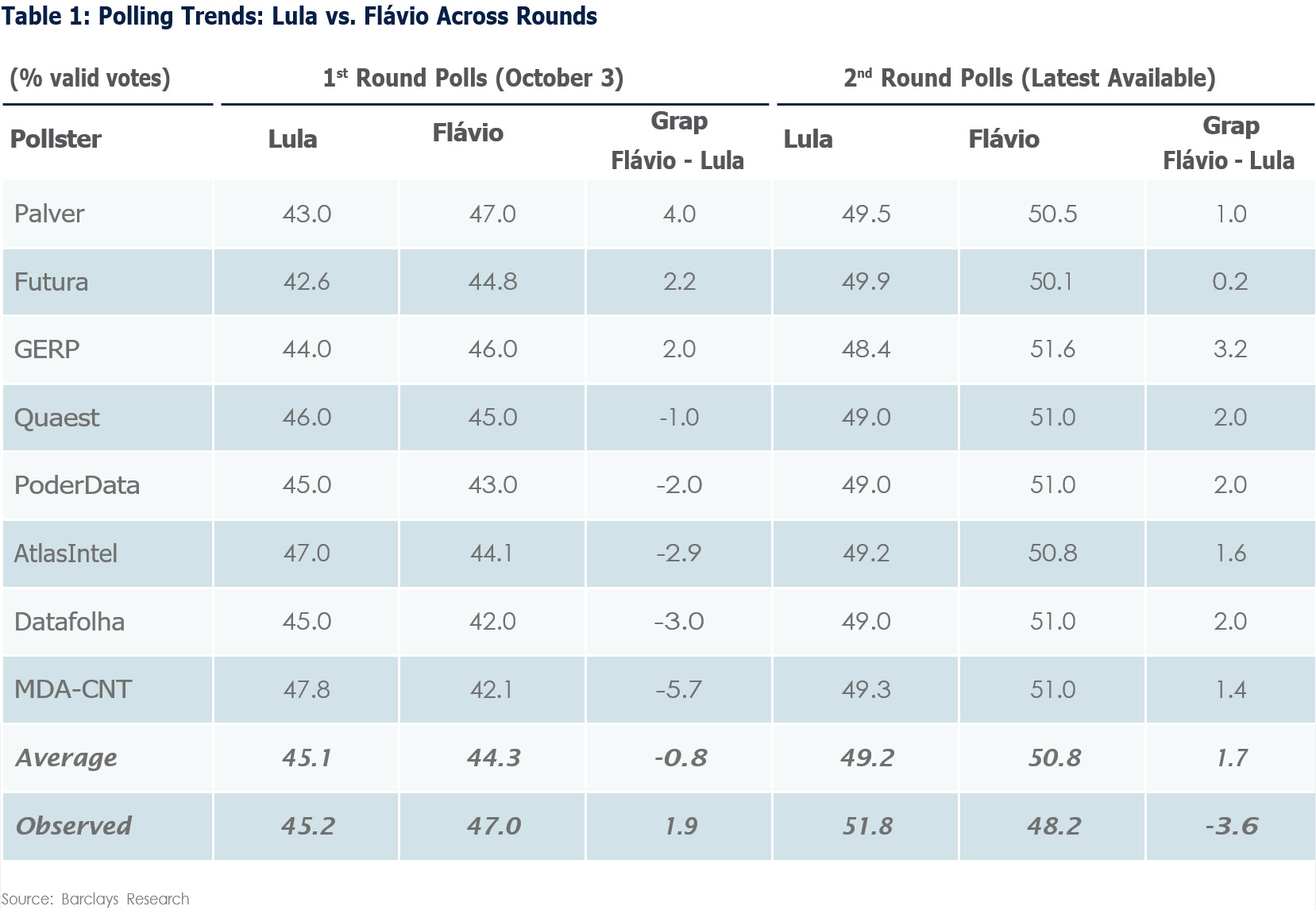
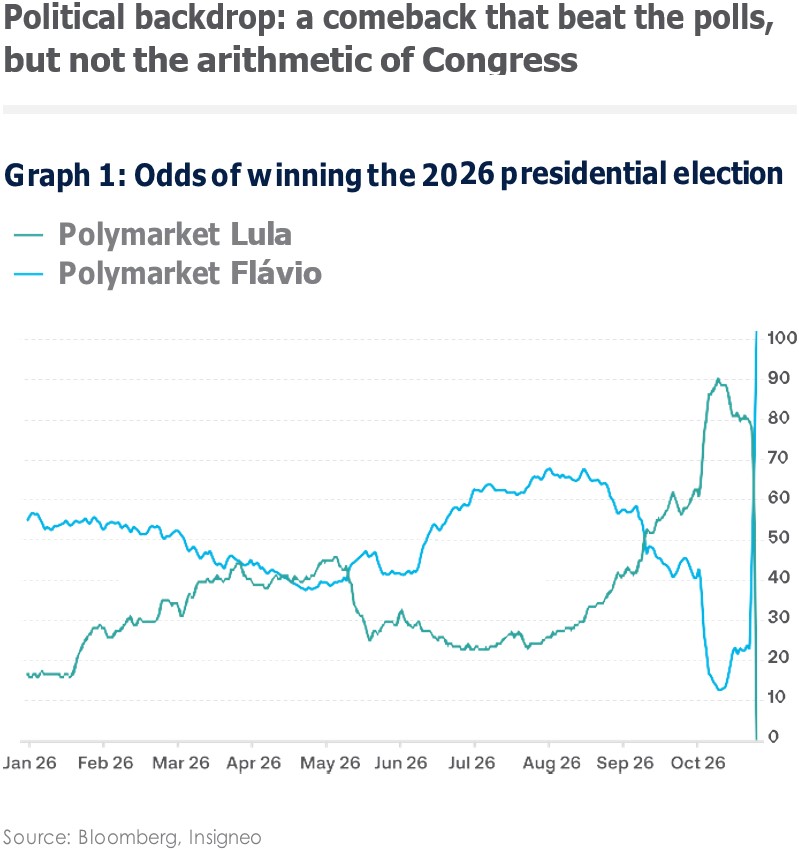
Lula’s re-election, with 51.8% of valid votes and a 3.6-point margin (roughly 4.4mn votes), reversed the first-round outcome and defied both the polls, which had Flávio Bolsonaro ahead by about 1.7 points, and prediction markets, where his implied probability of victory rose to nearly 90% in the days before the runoff (see Graph 1 and Table 1). It is the first time since the end of the military dictatorship that a candidate who trailed in the first round has won the runoff. Higher turnout explained much of the miss: abstention fell to 19.2% from 21.1%, unusual in a runoff, and blank and null votes dropped to 4.2mn from 6.0mn. As a result, Lula added more than 10mn votes between rounds.
Flávio Bolsonaro initially challenged the election outcome, alleging irregularities and signaling his inten-tion to pursue legal avenues to overturn Lula’s victory. The challenge quickly lost momentum, however, as electoral authorities dismissed his claims and Lula’s
4.4mn-vote margin left little room for a credible dispute. Bolsonaro ultimately accepted the result and refrained from further legal action, although he continued to ques-tion several decisions taken by electoral authorities during the campaign.
Attention has since shifted from Flávio Bolsonaro’s elec-toral challenge to his legal troubles. Brazil’s Supreme Court ordered him to surrender his passports as part of ongoing corruption and money-laundering investiga-tions. Rather than comply, Bolsonaro left the country and traveled to Miami with his family, further intensifying political tensions in an election aftermath that, as of this writing, remains fluid.
Beyond the immediate electoral and legal tensions, governability is the more material constraint for markets. Bolsonaro’s Liberal Party (PL) is the largest in both cham-bers, with 121 of 513 House seats and more than a third of the Senate, enough to open investigative commissions on its own. Right and center-right parties control about 57% of the House and 63% of the Senate, largely at the expense of the center, leaving Lula to begin his fourth term with only about a quarter of the House and a fifth of the Senate firmly aligned. Constitutional amendments,
which require two-thirds majorities, will therefore depend on fragmented centrist parties that are likely to demand cabinet posts and budget influence in exchange. Since Lula cannot run again in 2030, his political capital will also be limited.
The market expects continuity rather than reform, with at most modest spending restraint and a continued central role for state-owned enterprises. Against that policy backdrop, fiscal dynamics remain the primary focus for investors, particularly given Brazil’s chal-lenging starting position. Gross public debt is around 77% of GDP and stabilizing it would require primary surpluses of at least 2.0% of GDP, against an estimated deficit of about 0.5% this year. The campaign has made the task harder: measures and promises exceed BRL100bn (0.7% of GDP), including more than BRL40bn in 2027 that was not included in the budget draft. Without a
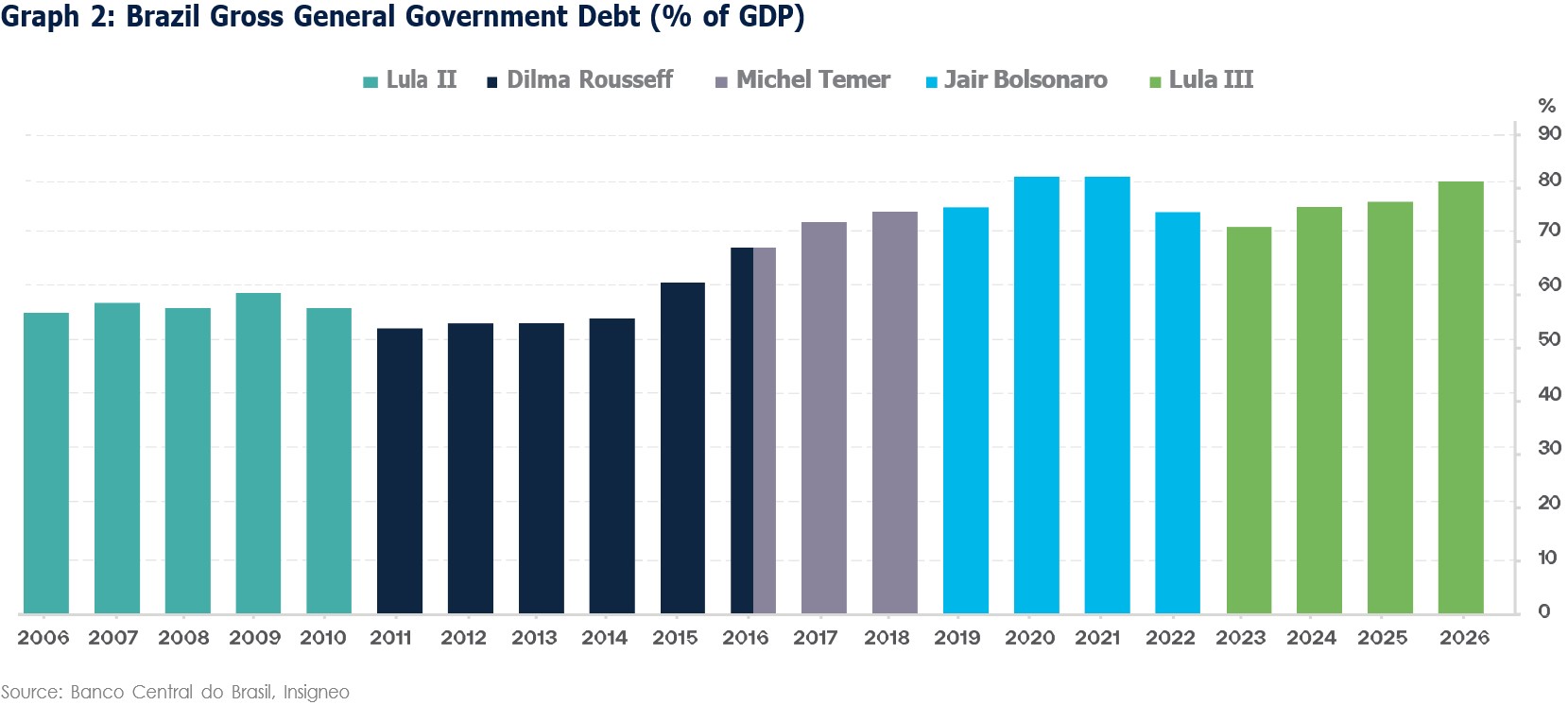
credible, detailed medium-term fiscal adjustment framework from either candidate, investors currently have limited visibility into the trajectory of public finances.
The central issue is not only Brazil’s elevated debt burden, but also the gradual loss of credibility in the fiscal frame-work introduced in 2023 to replace the spending cap. The original targets of a 0.5% primary surplus in 2025 and 1.0% in 2026 have already been softened, while spending exclu-sions and reliance on the tolerance band have weakened the framework’s effectiveness as a fiscal anchor. Against this backdrop, gross public debt reached 77% of GDP in 2025 and interest expenses remain close to 8% of GDP. With nearly 90% of federal expenditures classified as mandatory or earmarked, the scope for meaningful expen-diture restraint is limited.
The expansion of social programs, subsidized lending schemes, and other spending commitments under Lula’s administration has further complicated fiscal consolidation. With limited room for expenditure cuts, achieving a meaningful improvement in fiscal accounts will require politically difficult policy choices. Economists therefore estimate that Brazil needs sustained primary surpluses of around 2% of GDP to stabilize debt dynamics. The near-term test will be whether the administration signals a credible willingness to make those choices. Investors will closely monitor the appointment of the next Finance Minister, with BCB Governor Gabriel Galípolo and senators Camilo Santana and Renan Filho among the leading candidates, as well as the approval of the 2027 budget for signs of a credible commitment to fiscal discipline and debt stabilization.
Not everything points to the downside. A conservative Congress could act as a guardrail, Lula has a history of respecting markets when pressed, and Brazil’s external position, with ample reserves and a credible
inflation-targeting framework, provides a cushion. Even so, markets are currently pricing in continuity, which implies a higher fiscal risk premium, higher-for-longer rates, and a weaker real. Any recovery will depend on how convincing the government’s fiscal signals prove to be.
With the macroeconomic and political framework set, let us assess the elections’ aftermath from a market perspective.
Higher Rates, Higher Stakes
The initial market reaction to the runoff elections was negative across the board. The USD-denominated sovereign curve widened by an average of 16bps during Monday’s session, with the sharpest moves concentrated at the longer end of the curve. The BRL-denominated curve also widened sharply across all its references, with an average move of roughly 200bps during Monday’s session. The widening briefly exceeded 300bps before the Treasury intervened with bond purchases.
On the currency front, the BRL is still up roughly 3% YTD as of this writing, even after the sharp depreciation it underwent after the elections. The FX market seemed to regain its footing after Flávio accepted the electoral results, and the currency reverted some of the losses observed in the aftermath of the election.
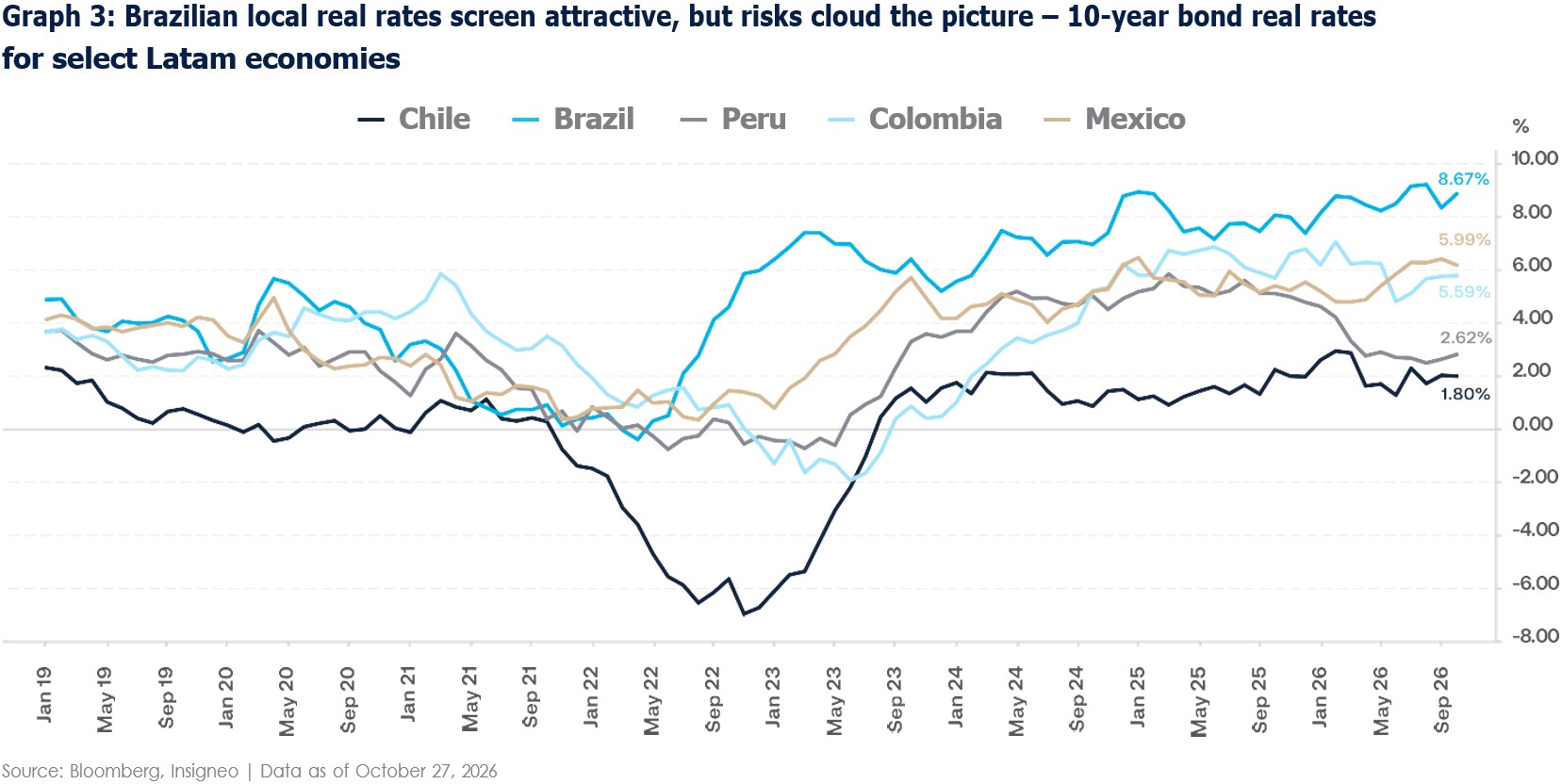
On the domestic fixed income front, Brazil’s real rates are the highest in the region and have been since July 2022, as shown in Graph 3. This occurred as inflation hit its highest level since 2003, and the Central Bank was nearing the end of a hiking cycle that left the Selic rate at 13.75%. Although inflation has receded from its 2022 highs, upside risks remain. El Niño’s potential effects on food prices and crops could add inflationary pressure, particularly after food and beverages contributed 1pp to the September IPCA print. Meanwhile, oil has risen roughly 80% YoY, but direct government fuel subsidies, federal tax cuts, and Petrobras’s policy of not passing short-term international oil-price volatility through to domestic consumers have limited energy’s contribution to headline inflation. Even if energy prices have not driven the inflationary spike, the measures cushioning their effect continue to add to Brazil’s fiscal challenges.
For local rates, the implication is straightforward: markets are pricing policy continuity against an already chal-lenging fiscal backdrop. Unless the incoming Lula admin-istration delivers a prudent and credible fiscal message, financing costs could remain elevated, further weak-ening debt dynamics and keeping the outlook for the domestic curve daunting.
Brazil’s USD-denominated debt had penciled in a Bolsonaro victory before the runoff, and the subsequent unwind of that electoral discount has produced a gener-alized widening in yields. Rising Eurobond supply could add another headwind, as market analysts expect annual sovereign issuance to reach USD10–15bn, likely weighing on sovereign credit. The shift in risk perception is already visible in the 5-year CDS, which spiked above 150bps from its October 6 low of 107.9bps. From here, the outlook remains binary: credible fiscal consolidation could compress spreads, while policy continuity accompanied by fiscal largesse would place further pressure on both bonds and the CDS.
On credit, as we have stated previously, the story is more nuanced and should be analyzed issuer by issuer. The key distinction is whether a company’s operating profile and balance sheet allow it to absorb the political, currency, and rates backdrop. The current FX deprecia-tion environment better suits issuers with mainly USD-denominated revenue and BRL-denominated costs, such as Suzano, Gerdau, and, to a more limited extent, Petrobras. Commodity exporters such as Vale could also benefit, while a Lula victory is expected to support state-backed sectors, as we noted on our Q4 quarterly call. In contrast, persistent fiscal challenges and a higher-for-longer environment could continue to pressure issuers already facing tougher financial conditions, such as CSN. Ultimately, companies with solid fundamentals, strong balance sheets, and the capacity to continue generating operating and free cash flow should be better posi-tioned to weather the political storm.
In sum, the Brazilian election caught markets by surprise, and its aftermath is still being processed across asset classes. Looking ahead, the main dividing line between further pressure and a recovery in Brazilian assets will be the credibility of fiscal consolidation under a more pragmatic left-leaning administration. A convincing commitment to debt stabilization could create room for rates and sovereign spreads to retrace part of the post-election move; without it, elevated financing costs, a weaker BRL, and continued dispersion across corpo-rate issuers are likely to remain defining features of the investment landscape.
Important Disclosures
Insigneo” and “Insigneo Wealth” are brand names used by Insigneo Financial Group, LLC and its affiliates. Brokerage products and services are offered through Insigneo Securities, LLC, a broker-dealer, registered with the U.S. Securities and Exchange Commission (“SEC”) and a member of FINRA and SIPC. Investment advisory products and services are offered through Insigneo Advisory Services, LLC, an SEC-registered investment adviser. Because we operate through various affiliates in different locations, please visit https:// insigneo.com/legalentities/ to understand which entity you are working with and what that means for you. This material should not be construed as an offer to sell or the solicitation of an offer to buy a security. It is for general information purposes only. To the extent that this material discusses general market activity, industry or sector trends or other broad-based economic or political conditions, it should not be construed as research investment advice. To the extent that it includes references to securities, those references do not constitute a recommendation to buy, sell or hold such security. It does not constitute a recommendation or a statement of opinion, or a report of either of those things and does not, and is not intended, to consider the particular investment objectives, financial conditions, or needs of the individual investors.
Not All Risks Are Disclosed – Past performance is not indicative of futures results. Investment involves significant risk, and it is possible to lose some or all of your principal investments and therefore may not be suitable for everyone. Always consider whether any investment is suitable for your particular circumstances and, if necessary, seek professional advice from your Investment Professional. This material may contain opinions, expressions an estimated that represent the analysis and perspective of Insigneo Securities, LLC’s Investment Strategy Department or its providers at the time of publication. These are subject to change at any time without notice.
FOR AFFILIATES LOCATED IN CHILE – PARA AFILIADAS LOCALIZADAS EN CHILE
Insigneo Asesorías Financieras SPA se encuentra inscrito en Chile, en el Registro de Prestadores de Servicios Financieros de la Comisión para el Mercado Financiero. Este informe fue efectuado por área de Research & Strategy de Insigneo Securities LLC. o sus proveedores, en base a la información disponible a la fecha de emisión de este. Para evitar cualquier conflicto de interés, Insigneo Securities LLC dispone que ningún integrante del equipo de Research & Strategy tenga su remuneración asociada directa o indirectamente con una recomendación o reporte específico o con el resultado de una cartera. Aunque los antecedentes sobre los cuales ha sido elaborado este informe fueron obtenidos de fuentes consideradas confiables, no podemos garantizar la completa exactitud e integridad de estos, no asumiendo responsabilidad alguna al respecto Insigneo Securities LLC, Insigneo Asesorías Financieras SPA ni ninguna de sus empresas relacionadas. Este material está destinado únicamente a facilitar el debate general y no pretende ser fuente de ninguna recomendación específica para una persona concreta. Por favor, consulte con su ejecutivo de cuentas o con su asesor financiero si alguna de las recomendaciones específicas que se hacen en este documento es adecuada para usted. Este documento no constituye una oferta o solicitud de compra o venta de ningún valor en ninguna jurisdicción en la que dicha oferta o solicitud no esté autorizada o a ninguna persona a la que sea ilegal hacer dicha oferta o solicitud. Las inversiones en cuentas de corretaje y de asesoramiento de inversiones están sujetas al riesgo de mercado, incluida la pérdida de capital. La información base del presente informe puede sufrir cambios, no teniendo Insigneo Securities LLC ni Insigneo Asesorías Financieras SPA la obligación de actualizar el presente informe ni de comunicar a sus destinatarios sobre la ocurrencia de tales cambios. Cualquier opinión, expresión, estimación y/o recomendación contenida en este informe constituyen el juicio o visión de área de Research & Strategy de Insigneo Securities LLC. o sus proveedores, a la fecha de su publicación y pueden ser modificadas sin previo aviso.
FOR AFFILIATES LOCATED IN URUGUAY- PARA AFILIADAS LOCALIZADAS EN URUGUAY
Insigneo Asesor Uruguay S.A. está inscripto en el Registro de Mercado de Valores del Banco Central del Uruguay como Asesor de Inversiones. En Uruguay, los valores están siendo ofrecidos en forma privada de acuerdo al artículo 2 de la ley 18.627 y sus modificaciones. Los valores no han sido ni serán registrados ante el Banco Central del Uruguay para oferta pública. Este material está destinado únicamente a facilitar el debate general y no pretende ser fuente de ninguna
recomendación específica para una persona concreta. Por favor, consulte con su ejecutivo de cuentas o con su asesor financiero si alguna de las recomendaciones específicas que se hacen en este documento es adecuada para usted según su perfil y estrategia de inversión. Este documento no constituye un asesoramiento ni una recomendación u oferta o solicitud de compra o. Las inversiones en valores negociables están sujetas al riesgo de mercado, incluida la pérdida parcial o total del capital invertido. Cualquier opinión, expresión, estimación y/o recomendación contenida en este informe constituyen el juicio o visión de área de Research & Strategy de Insigneo Securities LLC. o sus proveedores, a la fecha de su publicación y pueden ser modificadas sin previo aviso. Rentabilidades históricas de los productos anunciados no aseguran rentabilidades futuras.
FOR AFFILIATES LOCATED IN ARGENTINA – PARA AFILIADAS LOCALIZADAS EN ARGENTINA
Insigneo Argentina S.A.U. Agente Asesor Global de Inversión se encuentra registrado bajo el N° 1053 de la Comisión Nacional de Valores (CNV) e inscripto ante la Inspección General de Justicia (IGJ) bajo el N° 12.278 del Libro 90, Tomo –, de Sociedades por Acciones. Este informe fue efectuado por área de Research & Strategy de Insigneo Securities LLC. o sus proveedores, en base a la información disponible a la fecha de su emisión. Para evitar cualquier conflicto de interés, Insigneo Securities LLC dispone que ningún integrante del equipo de Research & Strategy tenga su remuneración asociada directa o indirectamente con una recomendación o reporte específico o con el resultado de una cartera. Aunque los antecedentes sobre los cuales ha sido elaborado este informe fueron obtenidos de fuentes consideradas confiables, no podemos garantizar la completa exactitud e integridad de estos, no asumiendo responsabilidad alguna al respecto Insigneo Securities LLC, Insigneo Argentina S.A.U. ni ninguna de sus empresas relacionadas. La información base del presente informe puede sufrir cambios, no teniendo Insigneo Argentina S.A.U. la obligación de actualizar el presente informe ni de comunicar a sus destinatarios sobre la ocurrencia de tales cambios. Este material está destinado únicamente a facilitar el debate general y no pretende ser fuente de ninguna recomendación específica para una persona concreta. Por favor, consulte con su ejecutivo de cuentas o con su asesor financiero si alguna de las recomendaciones específicas que se hacen en este documento es adecuada para usted. Este documento no constituye una oferta, recomendación o solicitud de compra o venta de ningún valor negociable en ninguna jurisdicción en la que dicha oferta o solicitud no esté autorizada o a ninguna persona a la que sea ilegal hacer dicha oferta o solicitud. Las inversiones en valores negociables están sujetas al riesgo de mercado, incluida la pérdida parcial o total del capital invertido. Cualquier opinión, expresión, estimación y/o recomendación contenida en este informe constituyen el juicio o visión de área de Research & Strategy de Insigneo Securities LLC. o sus proveedores, a la fecha de su publicación y pueden ser modificadas sin previo aviso.
FOR AFFILIATES LOCATED IN COLOMBIA – PARA AFILIADAS LOCALIZADAS EN COLOMBIA
Oficina De Representación en Colombia
La Oficina de Representación fue autorizada por la Superintendencia Financiera de Colombia el 5 de febrero de 2021, para promover o publicitar en Colombia, o a sus residentes, los productos y servicios del mercado de valores ofrecidos por Insigneo Securities, LLC e Insigneo Advisory Services, LLC. La información contenida en este informe ha sido obtenida de fuentes consideradas confiables; no obstante, no se garantiza su exactitud ni integridad, no asumiendo responsabilidad alguna Insigneo Securities, LLC e Insigneo Advisory Services, LLC ni sus entidades relacionadas. Este material tiene fines exclusivamente informativos y no constituye una recomendación personalizada. Las inversiones están sujetas a riesgos de mercado, incluida la posible pérdida de capital, por lo que se recomienda consultar con su asesor financiero. La información, opiniones y estimaciones aquí contenidas corresponden a la fecha de publicación, pueden ser modificadas sin previo aviso y no existe obligación de actualización por parte de las entidades mencionadas.
DM Wealth Management Group is the “doing business as entity” through which Cristina Mendez, Zoraida Diaz, and Debra Tyler, investment professionals (“IP”) of Insigneo Securities, LLC (“ISEC”) and Insigneo Advisory Services, LLC (“IAS”) conducts securities and advisory activities DM Wealth Management Group is not itself a broker dealer or an investment advisor and is not under common ownership with ISEC or IAS. Insigneo Financial Group, LLC comprises a number of operating businesses engaged in the offering of brokerage and advisory products and services in various jurisdictions. Brokerage products and services are offered through Insigneo Securities, LLC, a broker-dealer registered with the U.S. Securities and Exchange Commission (“SEC”) and member of FINRA and SIPC. Investment advisory products and services are offered through Insigneo Advisory Services, LLC, an investment adviser registered with the SEC. Insigneo has affiliated companies in different locations, so it is important to understand which entity you are conducting business with. Please visit "https://insigneo.com/legalentities" for more information about the differences between these companies, their locations, and what that means for you.
Investing involves risk, including possible loss of principal. Past performance is not indicative of future results. Please consult your Investment Professional for any recommendation regarding your specific financial situation.
Click on the following links to view ISEC Reg BI Client Relationship Summary (“Form CRS”) and IAS Form ADV Part 3 CRS.
The following content is provided by Insigneo, the firm through which DM Wealth Management’s investment professionals offer brokerage and advisory services. Visit insigneo.com to learn more.