

November 6, 2026

Data Centers: Bottleneck or Backbone
The global data center industry is undergoing the largest expansion cycle in its history, driven by the infrastructure demands of artificial intelligence.


AI is driving the largest data center expansion cycle in history, requiring unprecedented investment in computing capacity, power infrastructure, and cooling systems.
Technology companies are investing heavily to secure future capacity. Amazon, Microsoft, Alphabet, and Meta are expected to spend more than USD 700 billion in capital expenditures in 2026, much of it directed toward AI infrastructure.
Power availability is emerging as the industry’s key constraint. While capital remains abundant, access to electricity, grid connections, and supporting energy infrastructure is increasingly shaping where and how fast new data centers can be developed.
The investment opportunity spans far beyond data center operators. Beneficiaries include semiconductor manufacturers, networking providers, power and cooling equipment companies, REITs, infrastructure assets, private credit, and commodities linked to the physical buildout.
The global data center industry is undergoing the largest expansion cycle in its history, driven by the infrastructure demands of artificial intelligence. Unlike earlier cloud-computing investment waves, which focused primarily on storage and general-purpose computing, AI workloads require higher power densities, more advanced cooling systems, and larger campuses. As a result, the constraints on future growth are shifting from capital availability to physical infrastructure, particularly power networks and grid connectivity.
Data Center Buildout: Capacity Growth, Supply Pipeline and Geographic Concentration
The scale of industry investment reflects this shift. Consensus estimates suggest that Amazon, Microsoft, Alphabet, and Meta will invest approximately USD 715 billion in aggregate capital expenditures in 2026, nearly four times their combined 2023 spending. A significant share is being directed toward AI infrastructure, including data center construction, accelerated computing hard-ware, networking equipment, and supporting power assets. These commitments underscore expectations for sustained growth in AI workloads and the strategic importance of securing computing capacity.
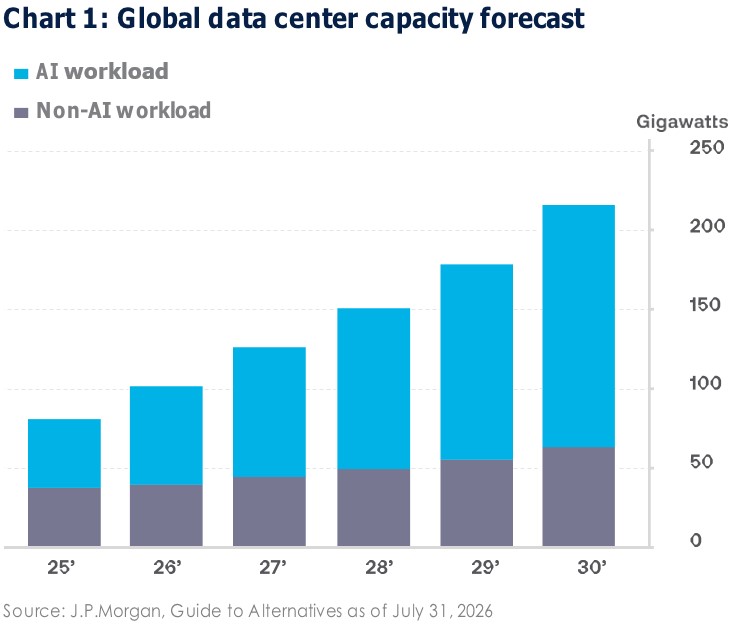
The industry relies on two primary deployment models: hyperscaler self-build, in which cloud providers develop and operate their own campuses, and colocation, in which third-party operators build facilities and lease capacity to customers. Hyperscalers account for nearly 80% of global self-built critical IT power capacity. Yet approximately 40% of North American hyperscale capacity is leased from third-party providers, highlighting the role of colocation operators in accelerating deployment and meeting incremental demand. Reflecting this trend, the colocation segment is expected to add approximately 57 GW globally through 2030, including nearly 40 GW in North America.
North America remains at the center of the global buildout. The region operates approximately 50 GW of installed capacity, with another 66 GW under construction, a pipeline capable of more than doubling its current footprint. If delivered as planned, total capacity could exceed 113 GW by 2028. This expansion is accompanied by a sharp increase in U.S. data center electricity demand, projected to rise from 31 GW in 2025 to 66 GW by 2027.
Even with this extensive development, supply may fall short of projected demand. Existing facilities and projects under construction or announced represent roughly 275 GW of global capacity, compared with estimated needs approaching 380 GW by 2030. This potential gap of more than 100 GW suggests that substantial additional infrastructure must be financed, permitted, and built. The industry’s central challenge, therefore, is not generating demand but delivering new capacity quickly enough to meet it.
Development is also concentrated in a limited number of strategic markets. In the United States, Texas (26 GW) and Virginia (13 GW) lead the pipeline, while Ohio, Louisiana, and Georgia each account for approximately 6–7 GW of planned capacity. Roughly 80% of future U.S. data center load growth is expected to occur within the PJM (Pennsylvania-New Jersey-Maryland Interconnection) and ERCOT (Electric Reliability Council of Texas) regions, underscoring the industry’s dependence on a small number of power-rich markets. In Europe, approximately 62% of capacity remains concentrated in the FLAP (Frankfurt, London, Amsterdam, Paris) markets, although power constraints and lengthy interconnection queues are redirecting investment toward Spain, Portugal, and the Nordic region. In Asia-Pacific, Singapore’s limited power availability is shifting development toward Malaysia, where the pipeline exceeds 3.6 GW.
The data center buildout remains overwhelmingly U.S.-centric, hyperscalerled, and power-intensive. Although capacity is expanding at an unprecedented pace, projected AI demand suggests that new supply will be absorbed rapidly. Sustaining the next phase of growth will therefore require not just capital, but sufficient power, land, and supporting infrastructure.
Abundant capital has enabled an unprecedented expansion of data center capacity, but energy infrastructure is becoming the industry’s primary constraint. AI work-loads are driving electricity demand beyond the pace at which utilities can expand generation, transmission, and distribution networks, intensifying pressure on grid connections and available supply. Securing reliable electricity at scale is thus becoming a defining requirement for new development.
The challenge is evident in the disconnect between planned data center construction and power infrastructure deployment. More than 200 GW of data center capacity is in various stages of planning, yet expected utility-scale generation additions are falling short of projected AI-related demand. Industry estimates suggest that the U.S. could add approximately 65 GW of generation capacity over the next five years, compared with roughly 90 GW of incremental demand associated with AI and data centers—a potential short-fall of 25 GW. Meanwhile, interconnection queues have lengthened across major markets, with some projects requiring more than four years to secure grid access. Supply-chain bottlenecks add further delays: lead times for large power transformers can exceed 200 weeks, while utility-scale gas turbines often take more than three years to deliver. Access to power has consequently become a major execution risk, shaping both project timelines and site selection.
Developers are responding by diversifying their power procurement strategies. Long-term power purchase agreements (PPAs) remain central to renewable energy procurement, but AI workloads demand reliability that intermittent generation alone cannot consistently provide. Developers are therefore combining renewables with dispatchable generation and storage, including natural gas, nuclear power, and battery systems. Current market expectations suggest that natural gas could meet approximately 80% of incremental AI-related power demand, reflecting its ability to provide dependable baseload generation and shorter deployment timelines than alternative technologies.
The need for reliable energy has also accelerated the adoption of behind-the-meter generation. Operators are increasingly pairing data centers with dedicated power assets to bypass interconnection bottlenecks and reduce grid-related delays. Recent market estimates suggest that behind-the-meter capacity could reach approximately 108 GW by 2030, compared with roughly 307 GW supplied through traditional grid infra-structure. This trend signals a broader move toward power-first development, in which energy availability dictates site selection, project economics, and deployment timelines.
Nuclear power is emerging as a strategic component of long-term procurement. Hyperscalers have signed a growing number of long-term agreements to secure carbon-free baseload generation for large AI campuses. However, lengthy development timelines for new reactors and small modular reactor technologies mean that near-term growth is expected to rely primarily on natural gas generation, battery storage, and life extensions for existing nuclear facilities, rather than large-scale new nuclear builds.
Exposure to the data center buildout extends well beyond traditional equities, spanning listed stocks, data center REITs, cloud infrastructure providers, semiconductor companies, private infrastructure vehicles, private credit, commodities, and a growing universe of data center-backed debt securities.
Within equities, opportunities span the entire value chain, from the coatings that protect physical infrastructure to the hyperscalers driving AI demand. The following sections examine the main companies at each stage and the investment considerations associated with them.
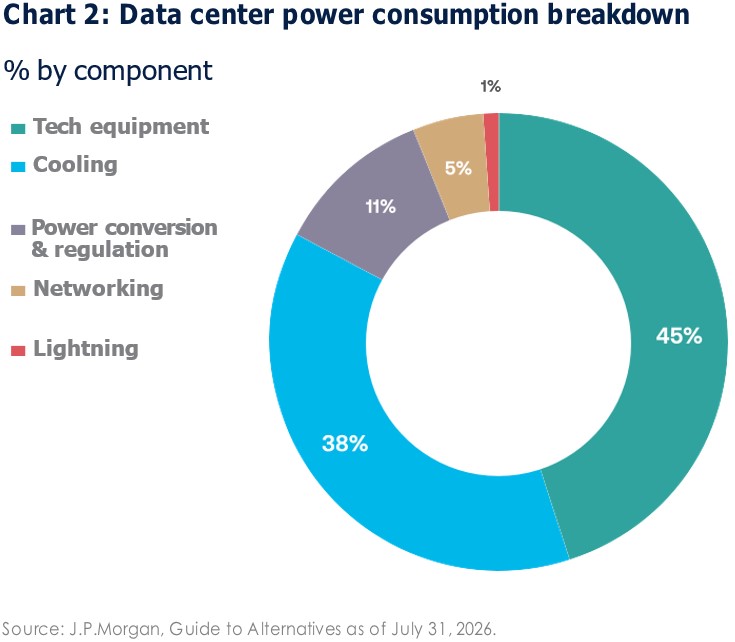
Beyond power supply, rising computational density is reshaping facility design. As AI clusters become more power-intensive, traditional air-cooled architectures are proving inadequate for next-generation workloads. Liquid-cooling systems are therefore becoming the preferred solution, with their share of the data center cooling market expected to rise from roughly 8% today to more than 30% by 2028. These technologies improve efficiency and support higher rack densities, but they also increase infrastructure complexity and the importance of water management. That consideration is particularly relevant given that approximately 39% of U.S. data center capacity is located in water-stressed regions.
Taken together, these trends suggest that the next phase of AI infrastructure growth will depend on the industry’s ability to expand its supporting energy ecosystem. Power, not capital, is becoming the defining bottleneck as AI workloads expand.
Hyperscalers and semiconductor companies sit at the center of the data center investment cycle. Amazon (AMZN), Microsoft (MSFT), Alphabet (GOOGL), and Meta (META) are driving unprecedented demand for AI infra-structure, with combined capital expenditures projected to reach USD 1.1 trillion in 2027. Much of this spending is directed toward expanding data center capacity and acquiring AI accelerators.
At the foundation of this buildout are chipmakers such as Nvidia (NVDA), AMD (AMD), and Broadcom (AVGO), which provide the compute layer powering AI workloads. While demand initially centered on training clusters built around high-end GPUs, the industry is increasingly shifting toward inference, broadening opportunities across custom ASICs, networking equipment, and specialized
Center stack, as they enable communication between thousands of GPUs, storage systems, and servers, effectively determining how efficiently compute resources can be utilized and scaled. Arista trades at
33.8x forward P/E and 24.4x EV/EBITDA, a premium that reflects its strong positioning in AI networking.
Power and cooling equipment represents a differentiated segment within data center equities, supported by growing infrastructure requirements. Vertiv (VRT), up 33% YTD, and Eaton (ETN), up 21%, are among the companies with significant exposure to this segment. Both offer backlog-driven revenue visibility into 2028, supported by growing demand for power distribution and thermal management infrastructure, with lower technology-obsolescence risk than the chip layer.
accelerators. Together, hyperscalers and semiconductor suppliers form the core ecosystem driving the next phase of global data center expansion.
Arista Networks (ANET), up 27% YTD, and Cisco (CSCO), up 37%, are the companies with material exposure to data-center networking demand. Arista has established itself as a preferred supplier of high-speed Ethernet switching for AI clusters, gaining share as hyperscalers increasingly adopt Ethernet-based architectures. Cisco offers a broader networking proposition, benefiting from enterprise and hyperscale data center refresh cycles while providing switching, routing, security, and orchestration solutions that underpin AI infrastructure expansion. Networking vendors are critical to the AI data Vertiv provides Uninterruptible Power Supply (UPS) systems, which combine battery backup and power conditioning to protect critical IT, industrial, and business equipment from outages, voltage sags, surges, and frequency fluctuations. The company also provides thermal management, power distribution, and battery energy storage services. Its forward P/E of 25x and EV/ EBITDA of 17.2x reflect the scarcity value of this positioning.
Meanwhile, Eaton has expanded its infrastructure port-folio to offer comprehensive “grid-to-chip” solutions, including medium-voltage switchgear, breakers, trans-formers, localized DC protection, and liquid cooling to manage high-density AI power loads safely. Reflecting the strength of the buildout, the company recently reported an unprecedented 200% acceleration in data center orders.
As GPU rack densities rise toward 1 MW per rack, traditional air-cooling systems are reaching their practical limits, accelerating the shift toward liquid-cooling technologies. HVAC and thermal management providers have consequently become key beneficiaries of the data center buildout. Carrier (CARR) reported a fourfold year-over-year increase in commercial HVAC data center orders in Q2 2026 and raised its full-year data center sales outlook to approximately USD 2 billion. Johnson Controls (JCI), meanwhile, reported nearly 40% year-over-year growth in data center orders. Trane Technologies (TT) is also emerging as a major player, offering integrated chilled-water, chiller, air-handler, and coolant distribution unit solutions designed for next-generation AI data centers.
Hubbell (HUBB) is one of the most directly exposed names in electrical components. Its Electrical Solutions segment reported more than 80% organic data center sales growth in Q3 2026, driven by wiring devices, Pin & Sleeve products, content gains, and new products. A medium-sized data center can contain approximately USD 10–15 million of Hubbell content, including more than USD 10 million from modular power skids. The company also has a strong position in substations, which every data center requires.
Coatings are among the most overlooked sub-themes in the data center buildout. Facilities rely on protective coatings for structural steel, flooring, fireproofing,
cooling infrastructure, backup power, water handling, and electrical distribution. Sherwin-Williams (SHW), up 5% YTD, RPM International (RPM), also up 5%, and PPG Industries (PPG). have exposure to coatings used in data center construction. North America’s 66 GW construction pipeline could contribute to demand for these products over multiple years, although actual demand will depend on the timing and completion of planned projects.
Power generation has emerged as one of the most controversial ways to gain exposure to the AI infrastructure buildout. Despite the compelling long-term demand narrative, Vistra (VST), down 15% YTD, Constellation Energy (CEG), down 27%, and NRG Energy (NRG), down 40%, have been among the weakest performers across the data center ecosystem in 2026. The selloff reflects a combination of factors, including the Federal Energy Regulatory Commission’s rejection of PJM’s initial capacity plan, uncertainty around how quickly utilities can monetize AI-driven demand growth, and questions regarding power procurement structures for hyperscalers.
Paradoxically, the fundamental backdrop remains highly supportive. Data centers are expected to account for a significant share of incremental U.S. electricity demand over the next decade, yet the market remains uncertain about how much of this demand will ultimately benefit traditional utilities versus behind-the-meter generation providers.
Listed colocation REITs provide investors with one of the most direct ways to participate in the growth of the data center industry. These companies own and operate the specialized facilities that house servers,
networking equipment, and the power and cooling systems required to support cloud computing and AI workloads. In addition to benefiting from growing demand for digital infrastructure, they typically return a significant portion of their cash flow to shareholders through dividends.
Industry fundamentals remain supported by favorable supply-and-demand dynamics. Demand for capacity continues to outpace supply, particularly in markets with constrained availability, where vacancy rates are near 2%. Rental rates are expected to increase by 5% to 10%, while more than 70% of capacity currently under construction has already been leased. AI-focused facilities are especially valuable, often commanding rental premiums of 20% to 30% over traditional colocation space. Reflecting this strong demand environment, North American data center leasing reached a record 15.6 GW in 2025, under-scoring the critical role these assets play in supporting the expansion of cloud and artificial intelligence infrastructure.
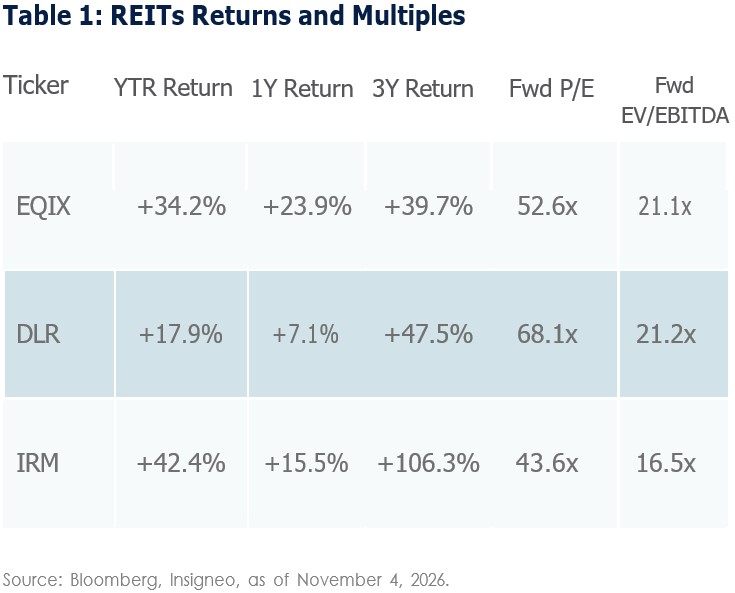
Equinix (EQIX) is the global colocation leader, with inter-connection-dense campuses in the world’s most liquid data center markets. Its forward P/E of 52.6x reflects the premium placed on its network-effect moat. Digital Realty (DLR) has more than 450 MW of gross unsold capacity under construction, plus 540 MW of shell assets that can be converted into turnkey facilities. Its forward P/E of 68.1x, the highest in this group, reflects the optionality in its development pipeline. Iron Mountain (IRM) is the strongest YTD performer among the listed REITs shown here, benefiting from its transition from document storage to data center operations. Its three-year return of approximately 106% reflects a re-rating as data center revenue has grown as a share of the business.
Private markets have become one of the most important sources of capital for the data center boom. Firms such as KKR and Blackstone are investing across the ecosystem, from data centers and power infrastructure to cooling systems and other supporting assets. KKR recently raised a record USD 19.2 billion infrastructure fund, while Blackstone has committed USD 8.7 billion to vehicles focused on digital infrastructure, renewables, and AI-related opportunities.
For investors, the appeal lies in the combination of long-term demand growth and relatively predictable cash flows. Infrastructure funds can invest in tangible assets such as buildings, power connections, and cooling systems, while private credit investors are underwriting some projects at 18%-20% target returns. Private markets also provide access to a broader opportunity set than public markets, where exposure is largely concentrated in a handful of REITs, equipment suppliers, and utilities. This allows investors to participate in development projects, power infra-structure, and specialized digital assets that are often unavailable through listed securities.
Private investments involve significant risks, including illiquidity, limited transparency, valuation uncertainty, leverage, concentration, credit/default risk and proįect-execution risk. Such investments may have lengthy holding periods and may not be suitable for all investors. Targeted or expected returns are not guaranteed and actual results may difFer materially.
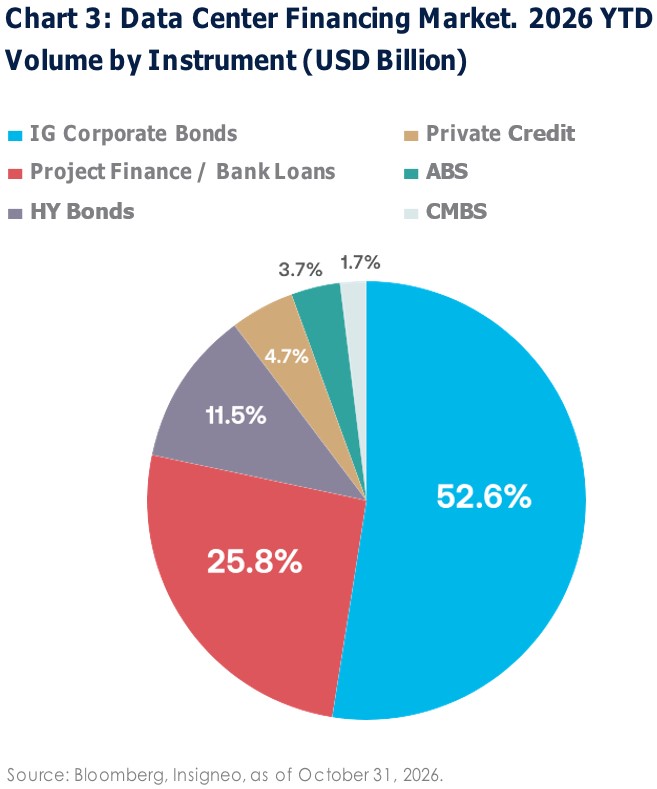
Investment-grade corporate bonds offer another route into the data center ecosystem. Debt issued by infra-structure owners such as American Tower and Digital Realty provides exposure to secular growth in digital infrastructure, typically with lower volatility and a higher position in the capital structure than equity.
Within the hyperscaler universe, Oracle’s investment-grade debt has become a barometer of AI-related financing risk. Its USD 25 billion bond issuance and subsequent spread widening highlighted concerns about the capital required to fund next-generation data center capacity. Beyond the hyperscalers, however, capital markets are beginning to fund AI infrastructure through new financing structures. Hut 8’s USD 3.25 billion River Bend financing, structured as the first investment-grade construction bond for a single-sponsor data center project, illustrates how the market is evolving to support increasingly large and specialized data center developments.
The high yield data center universe is concentrated in colocation and neocloud issuers, where credit quality and structural protections vary widely.
Iron Mountain (BB-) remains the sector’s largest and most liquid high yield issuer, with bonds maturing between 2027 and 2035 trading at yields of 5.7%–6.8%. Across monitored data center and neocloud issuers, weighted-average yields are approaching 8%, while some CoreWeave bonds trade at yields above 15%. This dispersion reflects differences in collateral quality, structural protections, customer concentration, and project execution risk. The asset class has undergone a meaningful repricing in 2026 as funding requirements have accelerated. Yields on the highest-quality data center high-yield bonds have risen from below 5% at the start of the year to nearly 7%. Much of the pressure is concentrated in neocloud financing, where concerns about excess capacity and weaker counterparties remain elevated. For example, a construction bridge loan for Applied Digital’s first site was assessed at approximately 300 bps wider than comparable data center construction financings, reflecting the absence of an anchor tenant and the risks of a less mature location.
Data center ABS is the fastest-growing and most structurally innovative segment of the fixed income market, with issuance nearly doubling year over year in 2025. The structure is straightforward: operators securitize contracted cash flows from long-term leases with creditworthy hyperscaler tenants, using the physical facilities as collateral. Financing is concentrated in portfolios of stabilized properties rather than new construction. Investment-grade, non-agency tranches offer yields ranging from the high-5% to low-7% area.
The data center buildout also creates opportunities in raw materials. Every gigawatt of compute capacity requires copper for power distribution, aluminum for transmission and heat dissipation, steel for structural frames, natural gas for generation, uranium for nuclear power, and water for cooling. Unlike the equity and credit strategies discussed above, the commodity thesis centers on expo-sure to physical scarcity rather than company-level technology obsolescence or counterparty credit risk.
Copper: A key input in data center construction, power infrastructure, and grid expansion, making it one of the commodities most directly linked to the growth of AI-related infrastructure.
Natural Gas: The primary source of incremental power generation for data centers in the near term, supported by growing electricity demand and increasing adoption of on-site generation solutions.
Uranium: A longer-term power infrastructure theme tied to nuclear generation, which is gaining relevance as operators seek reliable, carbon-free sources of baseload electricity.
Aluminum: A beneficiary of both data center construction and grid expansion through its use in transmission networks, structures, and electrical equipment, while also serving as a partial substitute for copper in some applications.
Steel: Closely linked to the physical buildout of data centers through its use in buildings, racks, and supporting infrastructure. Returns are likely to be more dependent on construction activity than on ongoing data center operations.
The 2026 midterm elections could prove a turning point for the data center industry. Democratic gains across Congress and several key states, fueled in part by concerns over rising energy costs and the growing foot-print of AI infrastructure, have increased regulatory uncertainty for developers and investors. New oversight proposals, potential moratoriums, and power-use restrictions, including in traditionally development-friendly states such as Texas, have raised concerns about project timelines and economics. Markets reacted negatively, with data center, neocloud, and semiconductor stocks coming under pressure as investors reassessed the pace of AI infrastructure expansion. While demand for data centers remains strong and investment commitments continue, the sector is likely to face a period of elevated volatility as policymakers reshape rules around permit-ting, energy consumption, and taxation.
Important Disclosures
Insigneo” and “Insigneo Wealth” are brand names used by Insigneo Financial Group, LLC and its affiliates. Brokerage products and services are offered through Insigneo Securities, LLC, a broker-dealer, registered with the U.S. Securities and Exchange Commission (“SEC”) and a member of FINRA and SIPC. Investment advisory products and services are offered through Insigneo Advisory Services, LLC, an SEC-registered investment adviser. Because we operate through various affiliates in different locations, please visit https:// insigneo.com/legalentities/ to understand which entity you are working with and what that means for you. This material should not be construed as an offer to sell or the solicitation of an offer to buy a security. It is for general information purposes only. To the extent that this material discusses general market activity, industry or sector trends or other broad-based economic or political conditions, it should not be construed as research investment advice. To the extent that it includes references to securities, those references do not constitute a recommendation to buy, sell or hold such security. It does not constitute a recommendation or a statement of opinion, or a report of either of those things and does not, and is not intended, to consider the particular investment objectives, financial conditions, or needs of the individual investors.
Not All Risks Are Disclosed – Past performance is not indicative of futures results. Investment involves significant risk, and it is possible to lose some or all of your principal investments and therefore may not be suitable for everyone. Always consider whether any investment is suitable for your particular circumstances and, if necessary, seek professional advice from your Investment Professional. This material may contain opinions, expressions an estimated that represent the analysis and perspective of Insigneo Securities, LLC’s Investment Strategy Department or its providers at the time of publication. These are subject to change at any time without notice.
FOR AFFILIATES LOCATED IN CHILE – PARA AFILIADAS LOCALIZADAS EN CHILE
Insigneo Asesorías Financieras SPA se encuentra inscrito en Chile, en el Registro de Prestadores de Servicios Financieros de la Comisión para el Mercado Financiero. Este informe fue efectuado por área de Research & Strategy de Insigneo Securities LLC. o sus proveedores, en base a la información disponible a la fecha de emisión de este. Para evitar cualquier conflicto de interés, Insigneo Securities LLC dispone que ningún integrante del equipo de Research & Strategy tenga su remuneración asociada directa o indirectamente con una recomendación o reporte específico o con el resultado de una cartera. Aunque los antecedentes sobre los cuales ha sido elaborado este informe fueron obtenidos de fuentes consideradas confiables, no podemos garantizar la completa exactitud e integridad de estos, no asumiendo responsabilidad alguna al respecto Insigneo Securities LLC, Insigneo Asesorías Financieras SPA ni ninguna de sus empresas relacionadas. Este material está destinado únicamente a facilitar el debate general y no pretende ser fuente de ninguna recomendación específica para una persona concreta. Por favor, consulte con su ejecutivo de cuentas o con su asesor financiero si alguna de las recomendaciones específicas que se hacen en este documento es adecuada para usted. Este documento no constituye una oferta o solicitud de compra o venta de ningún valor en ninguna jurisdicción en la que dicha oferta o solicitud no esté autorizada o a ninguna persona a la que sea ilegal hacer dicha oferta o solicitud. Las inversiones en cuentas de corretaje y de asesoramiento de inversiones están sujetas al riesgo de mercado, incluida la pérdida de capital. La información base del presente informe puede sufrir cambios, no teniendo Insigneo Securities LLC ni Insigneo Asesorías Financieras SPA la obligación de actualizar el presente informe ni de comunicar a sus destinatarios sobre la ocurrencia de tales cambios. Cualquier opinión, expresión, estimación y/o recomendación contenida en este informe constituyen el juicio o visión de área de Research & Strategy de Insigneo Securities LLC. o sus proveedores, a la fecha de su publicación y pueden ser modificadas sin previo aviso.
FOR AFFILIATES LOCATED IN URUGUAY- PARA AFILIADAS LOCALIZADAS EN URUGUAY
Insigneo Asesor Uruguay S.A. está inscripto en el Registro de Mercado de Valores del Banco Central del Uruguay como Asesor de Inversiones. En Uruguay, los valores están siendo ofrecidos en forma privada de acuerdo al artículo 2 de la ley 18.627 y sus modificaciones. Los valores no han sido ni serán registrados ante el Banco Central del Uruguay para oferta pública. Este material está destinado únicamente a facilitar el debate general y no pretende ser fuente de ninguna recomendación específica para una persona concreta. Por favor, consulte con su ejecutivo de cuentas o con su asesor financiero si alguna de las recomendaciones específicas que se hacen en este documento es adecuada para usted según su perfil y estrategia de inversión. Este documento no constituye un asesoramiento ni una recomendación u oferta o solicitud de compra o. Las inversiones en valores negociables están sujetas al riesgo de mercado, incluida la pérdida parcial o total del capital invertido. Cualquier opinión, expresión, estimación y/o recomendación contenida en este informe constituyen el juicio o visión de área de Research & Strategy de Insigneo Securities LLC. o sus proveedores, a la fecha de su publicación y pueden ser modificadas sin previo aviso. Rentabilidades históricas de los productos anunciados no aseguran rentabilidades futuras.
FOR AFFILIATES LOCATED IN ARGENTINA – PARA AFILIADAS LOCALIZADAS EN ARGENTINA
Insigneo Argentina S.A.U. Agente Asesor Global de Inversión se encuentra registrado bajo el N° 1053 de la Comisión Nacional de Valores (CNV) e inscripto ante la Inspección General de Justicia (IGJ) bajo el N° 12.278 del Libro 90, Tomo –, de Sociedades por Acciones. Este informe fue efectuado por área de Research & Strategy de Insigneo Securities LLC. o sus proveedores, en base a la información disponible a la fecha de su emisión. Para evitar cualquier conflicto de interés, Insigneo Securities LLC dispone que ningún integrante del equipo de Research & Strategy tenga su remuneración asociada directa o indirectamente con una recomendación o reporte específico o con el resultado de una cartera. Aunque los antecedentes sobre los cuales ha sido elaborado este informe fueron obtenidos de fuentes consideradas confiables, no podemos garantizar la completa exactitud e integridad de estos, no asumiendo responsabilidad alguna al respecto Insigneo Securities LLC, Insigneo Argentina S.A.U. ni ninguna de sus empresas relacionadas. La información base del presente informe puede sufrir cambios, no teniendo Insigneo Argentina S.A.U. la obligación de actualizar el presente informe ni de comunicar a sus destinatarios sobre la ocurrencia de tales cambios. Este material está destinado únicamente a facilitar el debate general y no pretende ser fuente de ninguna recomendación específica para una persona concreta. Por favor, consulte con su ejecutivo de cuentas o con su asesor financiero si alguna de las recomendaciones específicas que se hacen en este documento es adecuada para usted. Este documento no constituye una oferta, recomendación o solicitud de compra o venta de ningún valor negociable en ninguna jurisdicción en la que dicha oferta o solicitud no esté autorizada o a ninguna persona a la que sea ilegal hacer dicha oferta o solicitud. Las inversiones en valores negociables están sujetas al riesgo de mercado, incluida la pérdida parcial o total del capital invertido. Cualquier opinión, expresión, estimación y/o recomendación contenida en este informe constituyen el juicio o visión de área de Research & Strategy de Insigneo Securities LLC. o sus proveedores, a la fecha de su publicación y pueden ser modificadas sin previo aviso.
FOR AFFILIATES LOCATED IN COLOMBIA – PARA AFILIADAS LOCALIZADAS EN COLOMBIA
Oficina De Representación en Colombia
La Oficina de Representación fue autorizada por la Superintendencia Financiera de Colombia el 5 de febrero de 2021, para promover o publicitar en Colombia, o a sus residentes, los productos y servicios del mercado de valores ofrecidos por Insigneo Securities, LLC e Insigneo Advisory Services, LLC. La información contenida en este informe ha sido obtenida de fuentes consideradas confiables; no obstante, no se garantiza su exactitud ni integridad, no asumiendo responsabilidad alguna Insigneo Securities, LLC e Insigneo Advisory Services, LLC ni sus entidades relacionadas. Este material tiene fines exclusivamente informativos y no constituye una recomendación personalizada. Las inversiones están sujetas a riesgos de mercado, incluida la posible pérdida de capital, por lo que se recomienda consultar con su asesor financiero. La información, opiniones y estimaciones aquí contenidas corresponden a la fecha de publicación, pueden ser modificadas sin previo aviso y no existe obligación de actualización por parte de las entidades mencionadas.
DM Wealth Management Group is the “doing business as entity” through which Cristina Mendez, Zoraida Diaz, and Debra Tyler, investment professionals (“IP”) of Insigneo Securities, LLC (“ISEC”) and Insigneo Advisory Services, LLC (“IAS”) conducts securities and advisory activities DM Wealth Management Group is not itself a broker dealer or an investment advisor and is not under common ownership with ISEC or IAS. Insigneo Financial Group, LLC comprises a number of operating businesses engaged in the offering of brokerage and advisory products and services in various jurisdictions. Brokerage products and services are offered through Insigneo Securities, LLC, a broker-dealer registered with the U.S. Securities and Exchange Commission (“SEC”) and member of FINRA and SIPC. Investment advisory products and services are offered through Insigneo Advisory Services, LLC, an investment adviser registered with the SEC. Insigneo has affiliated companies in different locations, so it is important to understand which entity you are conducting business with. Please visit "https://insigneo.com/legalentities" for more information about the differences between these companies, their locations, and what that means for you.
Investing involves risk, including possible loss of principal. Past performance is not indicative of future results. Please consult your Investment Professional for any recommendation regarding your specific financial situation.
Click on the following links to view ISEC Reg BI Client Relationship Summary (“Form CRS”) and IAS Form ADV Part 3 CRS.
The following content is provided by Insigneo, the firm through which DM Wealth Management’s investment professionals offer brokerage and advisory services. Visit insigneo.com to learn more.