

November 20, 2026

Fixed income has been a volatile, challenging market in 2026. Beyond the daunting fiscal outlooks that have pressured sovereign yields, political developments have added yet another layer of uncertainty.

France’s fiscal challenges are the result of years of limited progress on addressing structural spending pressures, a dynamic that has become increasingly difficult to ignore as growth slows.
The deterioration in public finances has triggered a notable repricing in French sovereign bonds, exposing growing investor unease with the country’s fiscal tra-jectory.
Despite the sharp market reaction, current price ac-tion suggests investors view France’s fiscal deteriora-tion as a country-specific issue rather than the begin-ning of a broader European debt crisis.
Political uncertainty ahead of the 2027 presidential election and limited prospects for external support could keep French sovereign debt under pressure for longer than many investors expect.
Fixed income has been a volatile, challenging market in 2026. Beyond the daunting fiscal outlooks that have pressured sovereign yields, political developments have added yet another layer of uncertainty. One case making headlines lately is what is happening in France. We wanted to delve deeper into what is driving the debt crisis, how markets are digesting it, and what to expect going forward, given the upcoming elections and the currently frail government in charge.
The current French debt crisis has been building for longer than markets seem to remember. In 2023, President Macron presented a plan to phase in an increase of the retirement age from 62 to 64. The plan faced strong backlash, protests, and threats of no-confi-dence motions. In October 2025, French Prime Minister Sébastien Lecornu announced that the retirement age increase would be suspended until January 2028, after the 2027 presidential election. France has one of the lowest retirement ages in the OECD, with the government paying retirees a larger share of their past earnings than in most OECD countries.
Additionally, the French macroeconomic backdrop has deteriorated substantially in 2026, adding another layer of difficulty to the much-needed fiscal consolidation. GDP contracted in 3Q26, the first quarterly contraction of the year, after decelerating throughout 2026. This occurred on the back of a setback in gross fixed capital formation and exports, which more than offset the meager expan-sion in household consumption and public sector expen-diture. Bear in mind that a contraction in economic activity reduces the government’s capacity to achieve its deficit goals – a subject in which France has not been excelling. Even though France beat its 2025 deficit target, the budget shortfall still reached 5.1% of GDP. Unsurprisingly, France has not recorded a general government budget surplus since 1974, helping explain why the debt-to-GDP ratio has climbed from roughly 60% in the 2000s to 119.1% today, according to the latest Eurostat data.
Meanwhile, the French government has struggled to get its 2027 budget approved, after the 2026 budget was adopted only after Prime Minister Lecornu invoked Article
49.3. This article allowed the government to bypass a parliamentary vote, and it was invoked before the PM survived two no-confidence votes. The National Assembly rejected the 2027 draft budget on November 5, making parliamentary approval by the December 17 deadline increasingly unlikely, the government now faces two options: either use Article 49.3 again to approve the new budget without a vote, risking a no-confidence motion, or implement the budget by ordinance if parliament has not decided within 70 days of the draft’s presentation (December 10). According to Bloomberg Intelligence, this unprecedented route could preserve more of the original fiscal consolidation while ultimately delivering greater fiscal tightening if the government implements a fiscal package closer to its original proposal.
Further complicating the fiscal backdrop, in September the French government abandoned its plan to narrow its 2026 deficit. Finance Minister Roland Lescure affirmed that the previous 5% target was no longer an option, citing weak economic growth. The government also reduced its 2026 GDP forecast and now expects an
expansion of only 0.5%, down from a previous estimate of 0.7%.
Rating agencies have also begun responding to the deterioration in France’s fiscal outlook. Fitch Ratings downgraded the country’s outlook to ‘negative’, citing deteriorating public finances, weaker growth, higher borrowing costs, and a wider deficit. Moody’s kept France’s rating at ‘Aa3’ with a negative outlook in the latest revision, arguing that slower growth and a higher deficit have pushed France’s debt burden higher than previously expected. However, the rating agency assumes a baseline that 2027 will bring a deficit-reducing budget that will eventually be adopted, even by decree. Both S&P and Fitch downgraded France’s rating in 2025 after the first failed budget negotiations.
Even if the current administration succeeds in passing the 2027 budget, political risks are unlikely to fade. The presidential election, scheduled for April 2027, is the main development to monitor, with current polls suggesting that far-right candidate Marine Le Pen could face a run-off with far-left firebrand Jean-Luc Mélenchon. The latter’s suggestion that central banks should cancel their hold-ings of French debt was among the factors that propelled the recent sell-off in French government bonds, known as OATs.
The key question, then, is how markets have absorbed these developments.
Against this backdrop, the French sovereign market has exhibited significant stress. Yields across the French sovereign curve have widened significantly, and the 10-year OAT-Bund spread (the yield difference between French and German 10-year benchmarks) is currently higher than levels seen during the eurozone debt crisis of 2011–2012 (see graph 1).
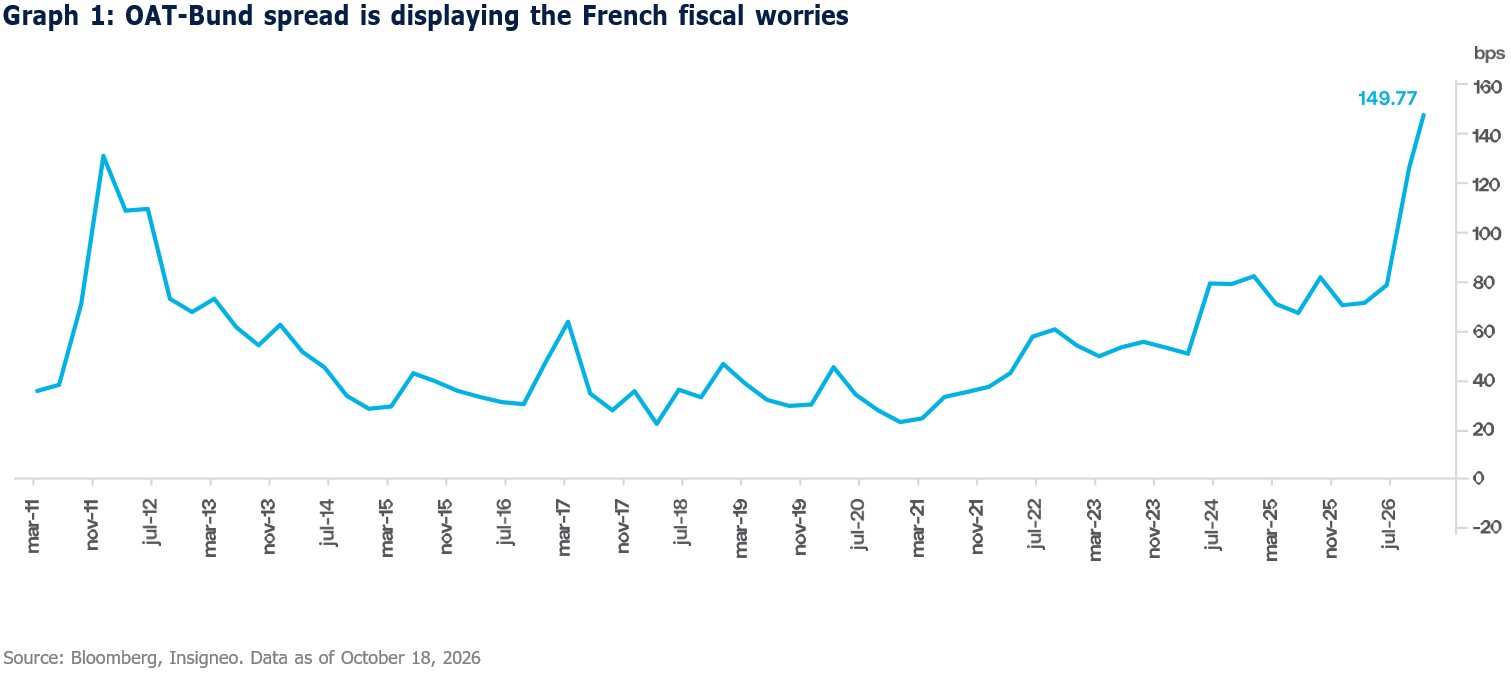
One thing that stands out in the current situation, aside from the yield overshoot in French debt, is the shift in the European spread hierarchy. The Italy-Germany (BTP-Bund) spread, which historically traded wider than the OAT-Bund spread, is currently 44bps narrower than the OAT-Bund spread at the time of this writing. This divergence widened further in October, with the BTP-Bund spread narrowing to
~106bps, whereas the OAT-Bund spread has continued to widen. That price action suggests the market is treating the episode more as a domestic French problem than a European worry.
One key risk investors are monitoring is whether stress in French sovereign debt could spill over into broader European markets and warrant ECB intervention. One mechanism the ECB could use to counter unwarranted and disorderly market dynamics that seriously threaten monetary policy transmission across the euro area is the Transmission Protection Instrument, better known as TPI. The framework was unanimously approved by the ECB Governing Council in 2022, and it requires two criteria to be satisfied before the ECB can act:
Even if these requirements are met, they do not guar-antee intervention; the Governing Council may reach a different conclusion even if the criteria are formally met. In more detail, the four cumulative criteria for eligibility are as follows:
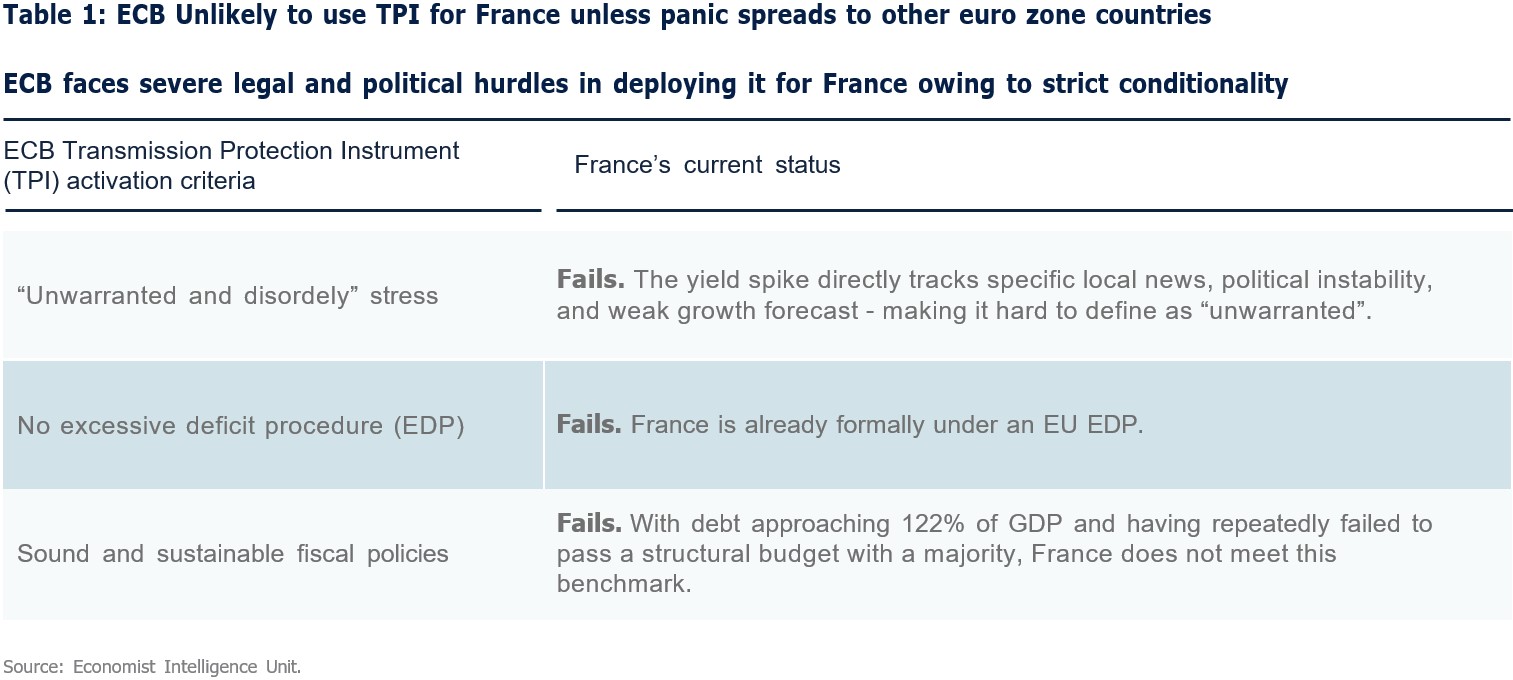
Given current market dynamics, even if some bet on a TPI activation, France does not appear to meet the criteria. Table 1 by the Economist Intelligence Unit summarizes why an activation of the TPI seems unlikely under the current circumstances.
Reinforcing this view, ECB Chief Economist Philip Lane stated that the bond market adjustment in French bonds signals uncertainty about the French fiscal outlook, and that the ECB should not adjust the run-off of its bond holdings or deploy its crisis tool to help the country with its budget problems.
Even if the 10-year OAT has shown signs of stabilization in recent trading sessions, the underlying fiscal concerns remain unresolved. The most likely outcome remains a continuation of the status quo, with meaningful fiscal adjustment postponed until market pressure becomes difficult to ignore. If investors continue to view the issue as a French rather than a eurozone problem, and the government can navigate toward the April 2027 presidential election, French yields are likely to remain biased higher.
Insigneo” and “Insigneo Wealth” are brand names used by Insigneo Financial Group, LLC and its affiliates. Brokerage products and services are offered through Insigneo Securities, LLC, a broker-dealer, registered with the U.S. Securities and Exchange Commission (“SEC”) and a member of FINRA and SIPC. Investment advisory products and services are offered through Insigneo Advisory Services, LLC, an SEC-registered investment adviser. Because we operate through various affiliates in different locations, please visit https:// insigneo.com/legalentities/ to understand which entity you are working with and what that means for you. This material should not be construed as an offer to sell or the solicitation of an offer to buy a security. It is for general information purposes only. To the extent that this material discusses general market activity, industry or sector trends or other broad-based economic or political conditions, it should not be construed as research investment advice. To the extent that it includes references to securities, those references do not constitute a recommendation to buy, sell or hold such security. It does not constitute a recommendation or a statement of opinion, or a report of either of those things and does not, and is not intended, to consider the particular investment objectives, financial conditions, or needs of the individual investors.
Not All Risks Are Disclosed – Past performance is not indicative of futures results. Investment involves significant risk, and it is possible to lose some or all of your principal investments and therefore may not be suitable for everyone. Always consider whether any investment is suitable for your particular circumstances and, if necessary, seek professional advice from your Investment Professional. This material may contain opinions, expressions an estimated that represent the analysis and perspective of Insigneo Securities, LLC’s Investment Strategy Department or its providers at the time of publication. These are subject to change at any time without notice.
Insigneo Asesorías Financieras SPA se encuentra inscrito en Chile, en el Registro de Prestadores de Servicios Financieros de la Comisión para el Mercado Financiero. Este informe fue efectuado por área de Research & Strategy de Insigneo Securities LLC. o sus proveedores, en base a la información disponible a la fecha de emisión de este. Para evitar cualquier conflicto de interés, Insigneo Securities LLC dispone que ningún integrante del equipo de Research & Strategy tenga su remuneración asociada directa o indirectamente con una recomendación o reporte específico o con el resultado de una cartera. Aunque los antecedentes sobre los cuales ha sido elaborado este informe fueron obtenidos de fuentes consideradas confiables, no podemos garantizar la completa exactitud e integridad de estos, no asumiendo responsabilidad alguna al respecto Insigneo Securities LLC, Insigneo Asesorías Financieras SPA ni ninguna de sus empresas relacionadas. Este material está destinado únicamente a facilitar el debate general y no pretende ser fuente de ninguna recomendación específica para una persona concreta. Por favor, consulte con su ejecutivo de cuentas o con su asesor financiero si alguna de las recomendaciones específicas que se hacen en este documento es adecuada para usted. Este documento no constituye una oferta o solicitud de compra o venta de ningún valor en ninguna jurisdicción en la que dicha oferta o solicitud no esté autorizada o a ninguna persona a la que sea ilegal hacer dicha oferta o solicitud. Las inversiones en cuentas de corretaje y de asesoramiento de inversiones están sujetas al riesgo de mercado, incluida la pérdida de capital. La información base del presente informe puede sufrir cambios, no teniendo Insigneo Securities LLC ni Insigneo Asesorías Financieras SPA la obligación de actualizar el presente informe ni de comunicar a sus destinatarios sobre la ocurrencia de tales cambios. Cualquier opinión, expresión, estimación y/o recomendación contenida en este informe constituyen el juicio o visión de área de Research & Strategy de Insigneo Securities LLC. o sus proveedores, a la fecha de su publicación y pueden ser modificadas sin previo aviso.
Insigneo Asesor Uruguay S.A. está inscripto en el Registro de Mercado de Valores del Banco Central del Uruguay como Asesor de Inversiones. En Uruguay, los valores están siendo ofrecidos en forma privada de acuerdo al artículo 2 de la ley 18.627 y sus modificaciones. Los valores no han sido ni serán registrados ante el Banco Central del Uruguay para oferta pública. Este material está destinado únicamente a facilitar el debate general y no pretende ser fuente de ninguna recomendación específica para una persona concreta. Por favor, consulte con su ejecutivo de cuentas o con su asesor financiero si alguna de las recomendaciones específicas que se hacen en este documento es adecuada para usted según su perfil y estrategia de inversión. Este documento no constituye un asesoramiento ni una recomendación u oferta o solicitud de compra o. Las inversiones en valores negociables están sujetas al riesgo de mercado, incluida la pérdida parcial o total del capital invertido. Cualquier opinión, expresión, estimación y/o recomendación contenida en este informe constituyen el juicio o visión de área de Research & Strategy de Insigneo Securities LLC. o sus proveedores, a la fecha de su publicación y pueden ser modificadas sin previo aviso. Rentabilidades históricas de los productos anunciados no aseguran rentabilidades futuras.
Insigneo Argentina S.A.U. Agente Asesor Global de Inversión se encuentra registrado bajo el N° 1053 de la Comisión Nacional de Valores (CNV) e inscripto ante la Inspección General de Justicia (IGJ) bajo el N° 12.278 del Libro 90, Tomo –, de Sociedades por Acciones. Este informe fue efectuado por área de Research & Strategy de Insigneo Securities LLC. o sus proveedores, en base a la información disponible a la fecha de su emisión. Para evitar cualquier conflicto de interés, Insigneo Securities LLC dispone que ningún integrante del equipo de Research & Strategy tenga su remuneración asociada directa o indirectamente con una recomendación o reporte específico o con el resultado de una cartera. Aunque los antecedentes sobre los cuales ha sido elaborado este informe fueron obtenidos de fuentes consideradas confiables, no podemos garantizar la completa exactitud e integridad de estos, no asumiendo responsabilidad alguna al respecto Insigneo Securities LLC, Insigneo Argentina S.A.U. ni ninguna de sus empresas relacionadas. La información base del presente informe puede sufrir cambios, no teniendo Insigneo Argentina S.A.U. la obligación de actualizar el presente informe ni de comunicar a sus destinatarios sobre la ocurrencia de tales cambios. Este material está destinado únicamente a facilitar el debate general y no pretende ser fuente de ninguna recomendación específica para una persona concreta. Por favor, consulte con su ejecutivo de cuentas o con su asesor financiero si alguna de las recomendaciones específicas que se hacen en este documento es adecuada para usted. Este documento no constituye una oferta, recomendación o solicitud de compra o venta de ningún valor negociable en ninguna jurisdicción en la que dicha oferta o solicitud no esté autorizada o a ninguna persona a la que sea ilegal hacer dicha oferta o solicitud. Las inversiones en valores negociables están sujetas al riesgo de mercado, incluida la pérdida parcial o total del capital invertido. Cualquier opinión, expresión, estimación y/o recomendación contenida en este informe constituyen el juicio o visión de área de Research & Strategy de Insigneo Securities LLC. o sus proveedores, a la fecha de su publicación y pueden ser modificadas sin previo aviso.
Oficina De Representación en Colombia
La Oficina de Representación fue autorizada por la Superintendencia Financiera de Colombia el 5 de febrero de 2021, para promover o publicitar en Colombia, o a sus residentes, los productos y servicios del mercado de valores ofrecidos por Insigneo Securities, LLC e Insigneo Advisory Services, LLC. La información contenida en este informe ha sido obtenida de fuentes consideradas confiables; no obstante, no se garantiza su exactitud ni integridad, no asumiendo responsabilidad alguna Insigneo Securities, LLC e Insigneo Advisory Services, LLC ni sus entidades relacionadas. Este material tiene fines exclusivamente informativos y no constituye una recomendación personalizada. Las inversiones están sujetas a riesgos de mercado, incluida la posible pérdida de capital, por lo que se recomienda consultar con su asesor financiero. La información, opiniones y estimaciones aquí contenidas corresponden a la fecha de publicación, pueden ser modificadas sin previo aviso y no existe obligación de actualización por parte de las entidades mencionadas.
DM Wealth Management Group is the “doing business as entity” through which Cristina Mendez, Zoraida Diaz, and Debra Tyler, investment professionals (“IP”) of Insigneo Securities, LLC (“ISEC”) and Insigneo Advisory Services, LLC (“IAS”) conducts securities and advisory activities DM Wealth Management Group is not itself a broker dealer or an investment advisor and is not under common ownership with ISEC or IAS. Insigneo Financial Group, LLC comprises a number of operating businesses engaged in the offering of brokerage and advisory products and services in various jurisdictions. Brokerage products and services are offered through Insigneo Securities, LLC, a broker-dealer registered with the U.S. Securities and Exchange Commission (“SEC”) and member of FINRA and SIPC. Investment advisory products and services are offered through Insigneo Advisory Services, LLC, an investment adviser registered with the SEC. Insigneo has affiliated companies in different locations, so it is important to understand which entity you are conducting business with. Please visit "https://insigneo.com/legalentities" for more information about the differences between these companies, their locations, and what that means for you.
Investing involves risk, including possible loss of principal. Past performance is not indicative of future results. Please consult your Investment Professional for any recommendation regarding your specific financial situation.
Click on the following links to view ISEC Reg BI Client Relationship Summary (“Form CRS”) and IAS Form ADV Part 3 CRS.
The following content is provided by Insigneo, the firm through which DM Wealth Management’s investment professionals offer brokerage and advisory services. Visit insigneo.com to learn more.