

August 14, 2026

Hedge Funds: Are We Situationally Aware?
Hedge funds are among the financial market’s most mythologized institutions, shaped by the reputations of legendary investors such as Ken Griffin, Ray Dalio, and George Soros.

The hedge fund industry has repeatedly been shaped by episodes in which compelling narratives attract enormous amounts of capital, turning investment themes into crowded trades that can unwind violently when expectations change.
The collapse of Situational Awareness underscores how quickly extraordinary capital inflows can trans-form a promising investment theme into a fragile port-folio when growth outpaces risk management, governance, and portfolio discipline.
Despite recent underperformance, the current market environment of tighter liquidity and greater earnings dispersion may create a more favorable backdrop for hedge funds, where stock selection and fundamental analysis can once again become meaningful sources of alpha.
To understand the significance of that event, it is useful to start at the beginning. Hedge funds are a relatively young investment strategy. They were created in New York in 1949 by Alfred Winslow Jones, a sociologist and financial journalist who wanted to profit from stock selection rather than market direction. The industry expanded rapidly during the 1970s and 1980s as new approaches emerged, including global macro, arbitrage, and event-driven investing. Since then, hedge funds have stood at the center of some of the most important financial episodes of modern history. These episodes range from George Soros’s famous 1992 bet against the British pound, to the collapse of Long-Term Capital Management during the 1998 Russian bond crisis, and more recently to the downfall of Melvin Capital during the 2022 meme-stock frenzy. Despite their differences, all of these stories share a common element: leverage.
Leverage is central to the hedge fund business model. As stock selection alone often does not generate the returns demanded by investors, many hedge funds amplify their positions through borrowed capital. On average, hedge funds operate with roughly 2.5x to 3.0x the capital entrusted to them by investors, with some funds operating well above those levels. According to JPMorgan, by the end of 2025, quantitative funds that rely on high-frequency and algorithmic trading strategies employed an average gross leverage of around 6.0x investor capital. In that context, the recent collapse of a USD 45 billion hedge fund has become less surprising.
So, what happened? In late July, the hedge fund Situational Awareness managed by Leopold Aschenbrenner, a 24-year-old former OpenAI employee, was forced to liquidate its public equity portfolio because of liquidity constraints. The fund was heavily concentrated on AI infrastructure companies, including SK Hynix, CoreWeave, Micron, SanDisk, and Bloom Energy, among other beneficiaries of the global data-center and computing buildout. When several of these stocks corrected sharply during July, the fund reportedly faced substantial margin calls from brokers including Goldman Sachs, JPMorgan, and Bank of America. Aschenbrenner, once described by some as an “AI Nostradamus,” ultimately had to sell the fund’s liquid portfolio to Citadel, Ken Griffin’s investment firm.
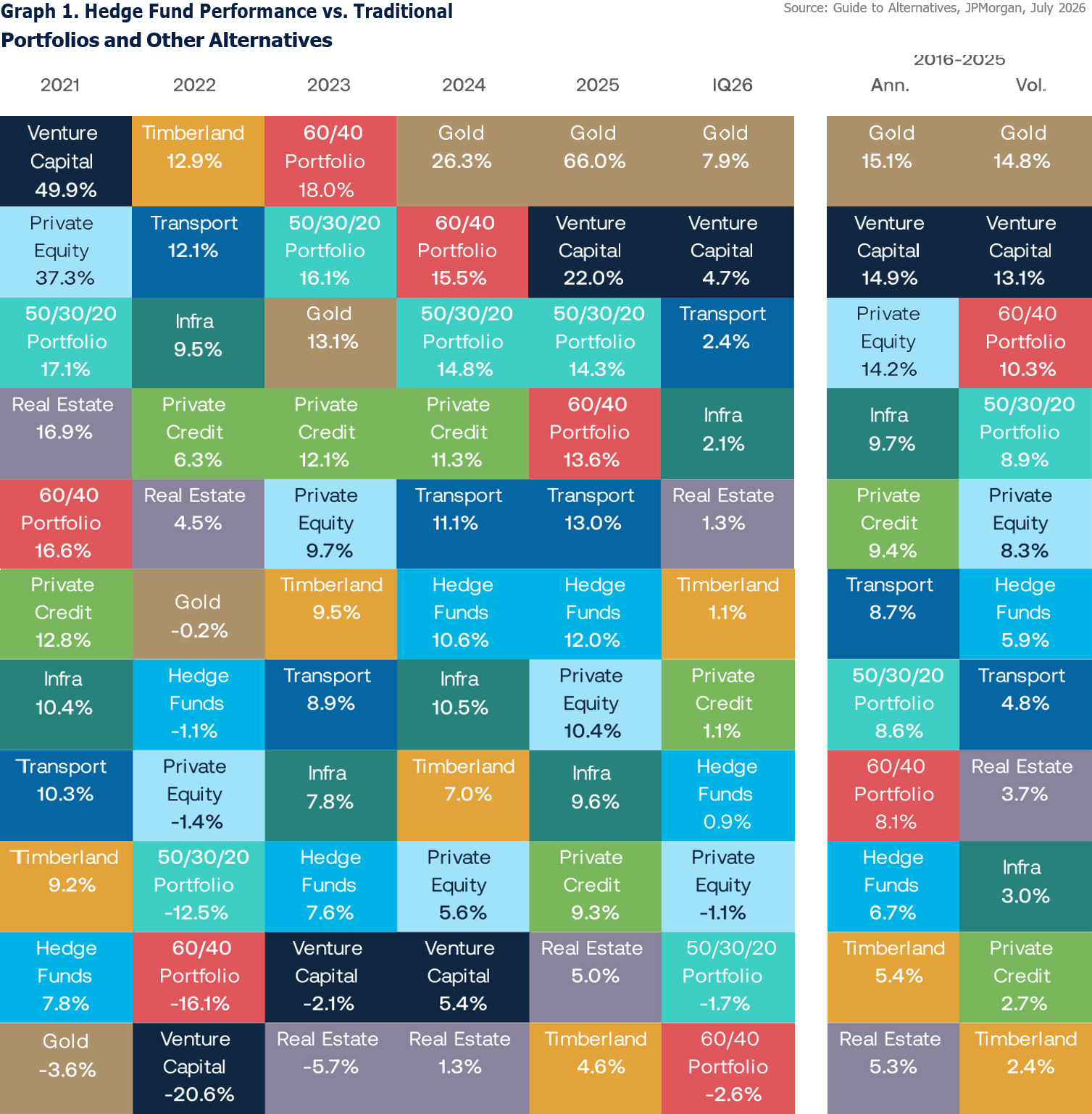
We would think that such high levels of leverage would consistently produce superior returns; however, during the last ten years, evidence suggests otherwise. Using the PivotalPath Composite Index, which tracks more than 3,000 institutional hedge funds representing over USD 3 trillion in assets and comparing it with a traditional 60/40 portfolio (60% S&P 500 and 40% Bloomberg U.S. Aggregate Total Return Index), hedge funds have generally underperformed traditional balanced portfolios over the past decade. Relative to other alternative asset classes, they have only outperformed real estate and timberland.
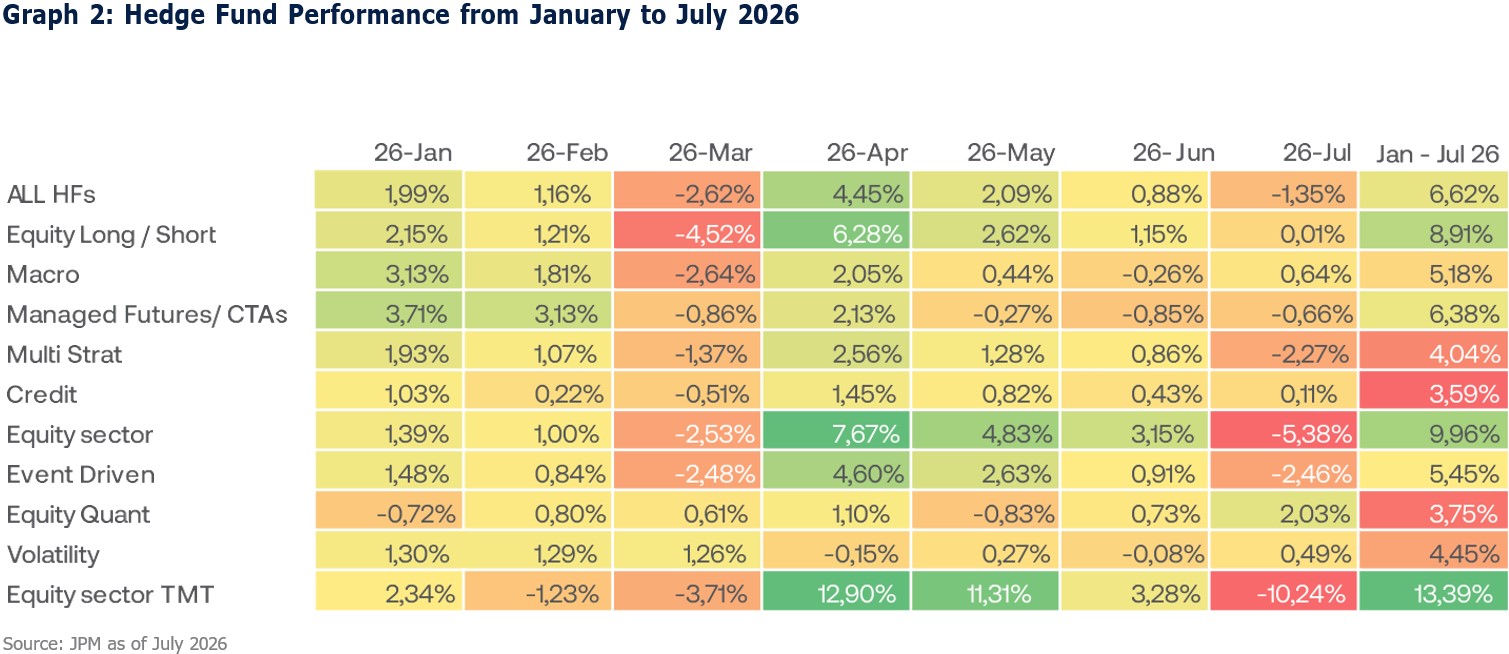
July also served as a powerful reminder of the risks embedded in leveraged portfolios. Preliminary data indicate that TMT Equity Sector hedge funds (Technology, Media, and Telecom) lost approximately 10.2% during July’s technology selloff, while multi-strategy hedge funds declined roughly 2.3%. The TMT figure excludes the full impact of the Situational Awareness collapse, yet it still represents the worst month on record for that strategy. For multi-strategy funds, we must look back to the pandemic or the 2008 Global Financial Crisis to find worse monthly performances.
Ordinarily, persistent underperformance combined with a high-profile collapse would suggest a difficult fund-raising environment. Yet the industry has been moving in the opposite direction. During 1Q26, hedge fund assets under management reached a record USD 5.22 trillion. During the first half of 2026, assets increased by approximately USD 473 billion, with investment gains accounting for roughly 81% of that growth.
Paradoxically, July’s turmoil may prove to be the catalyst the industry needed to regain relevance. For much of the 2010–2021 period, abundant liquidity and near-zero interest rates allowed many stocks to rise simultaneously through multiple expansion, meaning investors were willing to pay higher price-to-earnings or price-to-sales multiples even when underlying fundamentals did not improve proportionally. Today, that regime appears to have changed. Expectations are exceptionally high, particularly for AI-related companies, and stock prices are reacting far more sharply to earnings surprises and guidance revisions. Meta (META) provides a clear example. Despite reporting strong revenue growth, the stock fell roughly 10% after earnings as investors focused on rising AI capital expenditures and weaker free-cash-flow trends. Alphabet (GOOGL) also delivered solid top-line growth, yet its shares declined about 3% after management raised its capital expenditure outlook. In contrast, Microsoft (MSFT) rallied roughly 8% after earnings following stronger-than-expected Azure growth and a more convincing AI monetization story. These sharply different reactions among companies operating within the same technology ecosystem illustrate that stock selection matters far more today than it did during the era of broad multiple expansion.
This shift in market behavior becomes even more important if the Federal Reserve maintains a relatively restrictive policy stance. In such an environment, companies with strong near-term cash generation are likely to be rewarded more than long-duration growth companies
whose valuations depend heavily on distant future earnings. As a result, earnings dispersion should continue to widen, creating the type of market backdrop in which many long/short and event-driven hedge fund strategies have historically performed best. In other words, after years in which abundant liquidity made it difficult for active managers to differentiate themselves, hedge funds may finally be operating in an environment where fundamental analysis, relative-value investing, and stock selection can once again become meaningful sources of alpha.
Ironically, Situational Awareness gave the industry genuine situational awareness. The episode exposed the vulnerabilities of managers with weak risk frameworks and insufficient portfolio oversight. Over time, the market is likely to depurate some of those managers, potentially leaving behind a stronger group of firms better positioned to benefit from the more selective environment now emerging. Ultimately, the story of Leopold Aschenbrenner captures both the risk and the opportunity embedded in today’s hedge fund landscape. After publishing a 165-page manifesto on artificial intelligence, Leopold grew his hedge fund from roughly USD 225 million to USD 45 billion in just two years, only to lose nearly everything within a single month. That extraordinary rise and collapse may become part of the hedge fund industry’s enduring mythology, where bold ideas, rapid capital inflows, leverage, and market euphoria can create fortunes and destroy them just as quickly.
While writing this piece, I attended a lecture by Aswath Damodaran, who remarked that he could understand the mistakes of a 24-year-old entrepreneur as a matter of inexperience, but not the mistakes of major Wall Street institutions that chose to finance the strategy. More than an AI story, this episode is a reminder that manager due diligence and risk discipline matter far more than compelling narratives or fear of missing out.
Insigneo Financial Group, LLC comprises a number of operating businesses engaged in the offering of brokerage and advisory products and services in various jurisdictions. Brokerage products and services are offered through Insigneo Securities, LLC, a broker-dealer registered with the U.S. Securities and Exchange Commission (“SEC”) and member of FINRA and SIPC. Investment advisory products and services are offered through Insigneo Advisory Services, LLC, an investment adviser registered with the SEC. Insigneo has affiliated companies in different locations, so it is important to understand which entity you are conducting business with. Please visit https://insigneo.com/legalentities/ for more information about the differences between these companies, their locations, and what that means for you.
This material should not be construed as an offer to sell or the solicitation of an offer to buy any security. It is for general information purposes only. To the extent that this material discusses general market activity, industry or sector trends or other broad-based economic or political conditions, it should not be construed as research or investment advice. To the extent that it includes references to securities, those references do not constitute a recommendation to buy, sell or hold such security. It does not constitute a recommendation or a statement of opinion, or a report of either of those things and does not, and is not intended, to consider the particular investment objectives, financial conditions, or needs of individual investors. Any target prices provide reflect our current expectations, are subject to change and may not be achieved due to a variety of risks, including changes in economic conditions, interest rates, geopolitical developments, and issuer-specific factors. The target price does not guarantee future results and should not be relied upon as a sole basis for investment decisions.
Not All Risks Are Disclosed – Past performance is not indicative of futures results. Investments involve significant risks, and it is possible to lose some or all of your principal investments and therefore may not be suitable for everyone. Always consider whether any investment is suitable for your particular circumstances and, if necessary, seek professional advice from your Investment Professional. This material may contain opinions, expressions, and estimates that represent the analysis and perspective of Insigneo Securities, LLC’s Investment Strategy department or its providers at the time of publication. These are subject to change at any time, without notice.
FOR AFFILIATES LOCATED IN CHILE
Insigneo Asesorías Financieras SPA se encuentra inscrito en Chile, en el Registro de Prestadores de Servicios Financieros de la Comisión para el Mercado Financiero. Este informe fue efectuado por área de Research & Strategy de Insigneo Securities LLC. o sus proveedores, en base a la información disponible a la fecha de emisión de este. Para evitar cualquier conflicto de interés, Insigneo Securities LLC dispone que ningún integrante del equipo de Research & Strategy tenga su remuneración asociada directa o indirectamente con una recomendación o reporte específico o con el resultado de una cartera.
Aunque los antecedentes sobre los cuales ha sido elaborado este informe fueron obtenidos de fuentes consideradas confiables, no podemos garantizar la completa exactitud e integridad de estos, no asumiendo responsabilidad alguna al respecto Insigneo Securities LLC, Insigneo Asesorías Financieras SPA ni ninguna de sus empresas relacionadas.
Este material está destinado únicamente a facilitar el debate general y no pretende ser fuente de ninguna recomendación específica para una persona concreta. Por favor, consulte con su ejecutivo de cuentas o con su asesor financiero si alguna de las recomendaciones específicas que se hacen en este documento es adecuada para usted. Este documento no constituye una oferta o solicitud de compra o venta de ningún valor en ninguna jurisdicción en la que dicha oferta o solicitud no esté autorizada o a ninguna persona a la que sea ilegal hacer dicha oferta o solicitud. Las inversiones en cuentas de corretaje y de asesoramiento de inversiones están sujetas al riesgo de mercado, incluida la pérdida de capital.
La información base del presente informe puede sufrir cambios, no teniendo Insigneo Securities LLC ni Insigneo Asesorías Financieras SPA la obligación de actualizar el presente informe ni de comunicar a sus destinatarios sobre la ocurrencia de tales cambios. Cualquier opinión, expresión, estimación y/o recomendación contenida en este informe constituyen el juicio o visión de área de Research & Strategy de Insigneo Securities LLC. o sus proveedores, a la fecha de su publicación y pueden ser modificadas sin previo aviso.
FOR AFFILIATES LOCATED IN URUGUAY
Insigneo Asesor Uruguay S.A. está inscripto en el Registro de Mercado de Valores del Banco Central del Uruguay como Asesor de Inversiones. En Uruguay, los valores están siendo ofrecidos en forma privada de acuerdo al artículo 2 de la ley 18.627 y sus modificaciones. Los valores no han sido ni serán registrados ante el Banco Central del Uruguay para oferta pública. Este material está destinado únicamente a facilitar el debate general y no pretende ser fuente de ninguna recomendación específica para una persona concreta. Por favor, consulte con su ejecutivo de cuentas o con su asesor financiero si alguna de las recomendaciones específicas que se hacen en este documento es adecuada para usted según su perfil y estrategia de inversión. Este documento no constituye un asesoramiento ni una recomendación u oferta o solicitud de compra o. Las inversiones en valores negociables están sujetas al riesgo de mercado, incluida la pérdida parcial o total del capital invertido. Cualquier opinión, expresión, estimación y/o recomendación contenida en este informe constituyen el juicio o visión de área de Research & Strategy de Insigneo Securities LLC. o sus proveedores, a la fecha de su publicación y pueden ser modificadas sin previo aviso. Rentabilidades históricas de los productos anunciados no aseguran rentabilidades futuras..
FOR AFFILIATES LOCATED IN ARGENTINA
Insigneo Argentina S.A.U. Agente Asesor Global de Inversión se encuentra registrado bajo el N° 1053 de la Comisión Nacional de Valores (CNV) e inscripto ante la Inspección General de Justicia (IGJ) bajo el N° 12.278 del Libro 90, Tomo –, de Sociedades por Acciones. Este informe fue efectuado por área de Research & Strategy de Insigneo Securities LLC. o sus proveedores, en base a la información disponible a la fecha de su emisión. Para evitar cualquier conflicto de interés, Insigneo Securities LLC dispone que ningún integrante del equipo de Research & Strategy tenga su remuneración asociada directa o indirectamente con una recomendación o reporte específico o con el resultado de una cartera. Aunque los antecedentes sobre los cuales ha sido elaborado este informe fueron obtenidos de fuentes consideradas confiables, no podemos garantizar la completa exactitud e integridad de estos, no asumiendo responsabilidad alguna al respecto Insigneo Securities LLC, Insigneo Argentina S.A.U. ni ninguna de sus empresas relacionadas. La información base del presente informe puede sufrir cambios, no teniendo Insigneo Argentina S.A.U. la obligación de actualizar el presente informe ni de comunicar a sus destinatarios sobre la ocurrencia de tales cambios.
Este material está destinado únicamente a facilitar el debate general y no pretende ser fuente de ninguna recomendación específica para una persona concreta. Por favor, consulte con su ejecutivo de cuentas o con su asesor financiero si alguna de las recomendaciones específicas que se hacen en este documento es adecuada para usted. Este documento no constituye una oferta, recomendación o solicitud de compra o venta de ningún valor negociable en ninguna jurisdicción en la que dicha oferta o solicitud no esté autorizada o a ninguna persona a la que sea ilegal hacer dicha oferta o solicitud. Las inversiones en valores negociables están sujetas al riesgo de mercado, incluida la pérdida parcial o total del capital invertido. Cualquier opinión, expresión, estimación y/o recomendación contenida en este informe constituyen el juicio o visión de área de Research & Strategy de Insigneo Securities LLC. o sus proveedores, a la fecha de su publicación y pueden ser modificadas sin previo aviso.
DM Wealth Management Group is the “doing business as entity” through which Cristina Mendez, Zoraida Diaz, and Debra Tyler, investment professionals (“IP”) of Insigneo Securities, LLC (“ISEC”) and Insigneo Advisory Services, LLC (“IAS”) conducts securities and advisory activities DM Wealth Management Group is not itself a broker dealer or an investment advisor and is not under common ownership with ISEC or IAS. Insigneo Financial Group, LLC comprises a number of operating businesses engaged in the offering of brokerage and advisory products and services in various jurisdictions. Brokerage products and services are offered through Insigneo Securities, LLC, a broker-dealer registered with the U.S. Securities and Exchange Commission (“SEC”) and member of FINRA and SIPC. Investment advisory products and services are offered through Insigneo Advisory Services, LLC, an investment adviser registered with the SEC. Insigneo has affiliated companies in different locations, so it is important to understand which entity you are conducting business with. Please visit "https://insigneo.com/legalentities" for more information about the differences between these companies, their locations, and what that means for you.
Investing involves risk, including possible loss of principal. Past performance is not indicative of future results. Please consult your Investment Professional for any recommendation regarding your specific financial situation.
Click on the following links to view ISEC Reg BI Client Relationship Summary (“Form CRS”) and IAS Form ADV Part 3 CRS.
The following content is provided by Insigneo, the firm through which DM Wealth Management’s investment professionals offer brokerage and advisory services. Visit insigneo.com to learn more.