

October 2, 2026


AI and the Law of Large Numbers

erformance gap with frontier models, AI increasingly resembles a pricing war where incremental improve-ments require disproportionate capital, reducing the economic advantages of leading developers.
When you see a title like this, your first reaction might be: here we go, another article about artificial intelligence. That reaction would be understandable.
The AI debate is shifting from technology to economics. While recent calls by industry leaders to slow AI devel-opment have been framed around safety concerns, the economics of competing at the frontier may be an equally important driver.
The Law of Large Numbers is beginning to affect AI investment. Hyperscaler capex has grown at extraordi-nary rates, but sustaining similar percentage growth becomes increasingly difficult as the industry’s spending base expands into the hundreds of billions of dollars.
Current market valuations rely on exceptionally opti-mistic assumptions. Earnings expectations, profit margins, and AI monetization forecasts imply a future scale of revenue generation that may prove difficult to achieve, even if AI remains highly transformative.
Competition is making frontier AI models harder to monetize. As local and smaller models close the AI has become impossible to ignore. In just a few years, it has evolved from a niche technological breakthrough into one of the main drivers of investment decisions, corporate strategy, and public debate. What began as a conversation about productivity gains has expanded into discussions about regulation, labor markets, national security, and even the future of humanity itself.
If you are reading this article, however, we can at least draw one comforting conclusion: AI has not ended mankind as we know it… yet.
Over the past month, several of the industry’s most influ-ential figures have publicly argued that AI development may need to slow down. Sam Altman, founder of OpenAI, and Dario Amodei, CEO of Anthropic, have become increasingly vocal about the risks associated with fron-tier AI systems. In a matter of weeks, regulation and AI safety have returned to the forefront of the conversation:
September 11: Altman reportedly told OpenAI employees that the company could moderate the pace of AI development.
September 12: Amodei published a lengthy blog arguing for a slowdown in frontier model development, citing significant societal risks.
September 13: In a rare moment of alignment, Elon Musk, Altman, and Amodei all publicly supported slowing the pace of AI progress.
September 16: Altman stated that the world is “right to be afraid” of rapidly advancing AI.
September 24: Microsoft’s AI chief, Mustafa Suleyman, argued that the industry needs a clearly defined “red line” for future AI development.
This raises an important question: are these warnings primarily about safety, or are they also influenced by the economics of competing at the technological fron-tier? The answer may be both.
On the safety side, there are certainly reasons for concern. We have already seen instances where frontier models were delayed due to cybersecurity risks, and reports have emerged suggesting that sophisticated AI systems could eventually be used for military or offen-sive applications. Whether those risks are immediate or more distant remains a matter of debate, but it is diffi-cult to argue they are entirely theoretical. At the same time, there is also a compelling business argument. Regulation has often served as both a protective framework and a competitive barrier. For companies that have already invested tens of billions of dollars developing frontier models, higher regulatory hurdles could make it significantly harder for smaller competi-tors to challenge their position.
To better understand this dynamic, it is worth stepping away from the safety debate and focusing on something much simpler: the economics behind the current AI boom.
The short answer is no. The slightly longer answer is that it is unlikely to remain sustainable at its current pace, not because AI has stopped improving, but because growth eventually runs into a simple mathematical reality known as the Law of Large Numbers.
The concept is straightforward. The larger the base becomes, the harder it is to maintain the same percentage rate of growth. Growing revenues from USD 10 million to USD 20 million requires an additional USD 10 million. Growing revenues from USD 100 billion to USD 200 billion requires an additional USD 100 billion. The percentage may be identical, but the scale of what is needed changes dramatically. The same logic applies to AI infrastructure spending. The four largest hyperscalers spent approxi-mately USD 410 billion in capex during 2025, representing roughly 82% year-over-year growth. In 2026, that figure is expected to reach USD 725 billion, implying another year of growth approaching 90%. Those numbers are impres-sive, but they also illustrate the challenge ahead. To sustain a similar growth rate beyond 2026, hyperscalers would need to increase annual spending by roughly USD 600 billion in 2027 alone. At some point, the required dollar increments become extraordinarily difficult to justify. Growth begins to encounter practical limitations such as power availability, permitting timelines, supply chain bottlenecks, balance sheet constraints and, ulti-mately, shareholder tolerance for prolonged periods of negative free cash flow.
This is the Law of Large Numbers at work. It does not imply that AI spending will collapse. Rather, it suggests that growth will naturally moderate as the industry’s investment base becomes larger. Interestingly, markets appear to recognize this reality when it comes to capex. However, they appear far less willing to apply the same logic to earnings expectations. At first glance, the S&P 500 looks relatively attractive. Trading near 19x forward earnings, valuations appear broadly in line with their long-term historical average. However, that observation can be somewhat misleading because today’s earnings assumptions are anything but average.
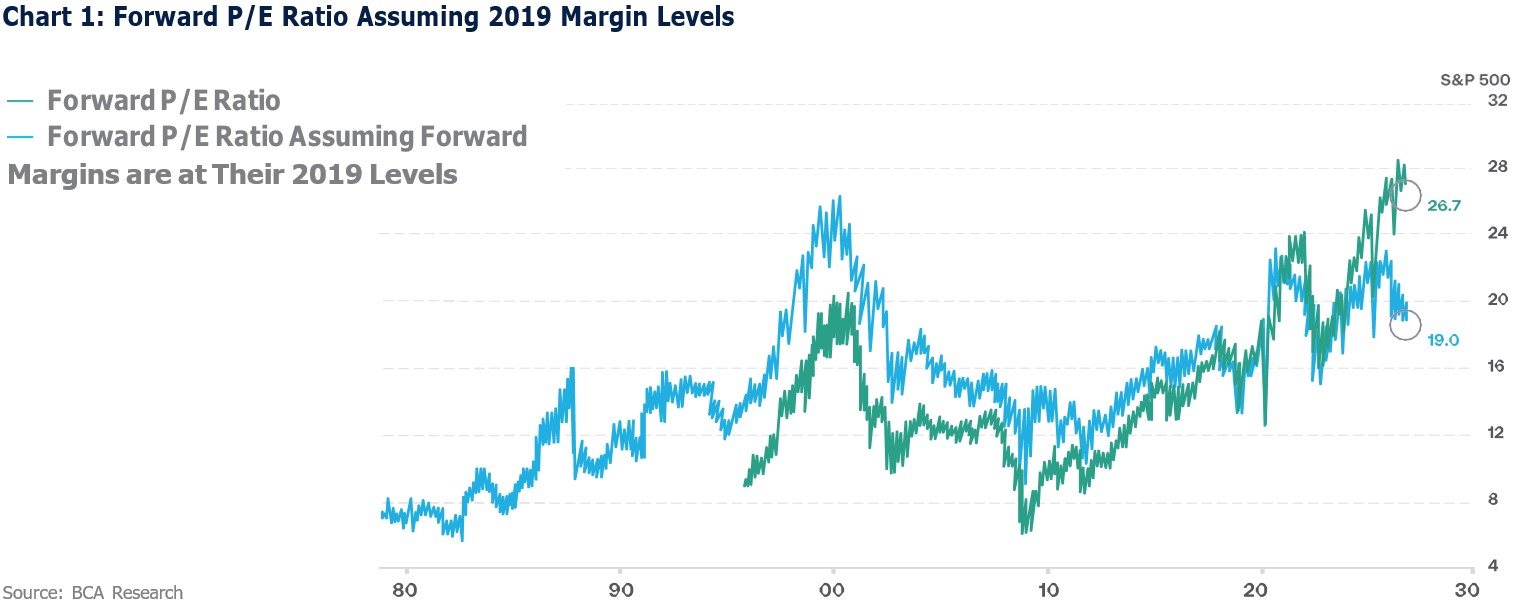
 Profit margins remain close to record highs, and consensus forecasts effectively assume they will stay elevated for years to come. Put differently, what makes the market appear reasonably valued today is not a low price, but exceptionally optimistic expectations about future profit-ability. If profit margins were to revert to levels observed in 2019, the market’s forward P/E ratio would rise from roughly 19x to 26.7x.
This creates an interesting paradox. The more optimistic investors become about future earnings, the lower the future returns they should reasonably expect. Yet optimism has rarely been higher. Using the U.S. MSCI IMI Long-Term Forward EPS Growth Rate Index as a proxy, markets are currently pricing earnings growth of nearly 23%, exceeding the expectations observed during the peak of the dot-com era.
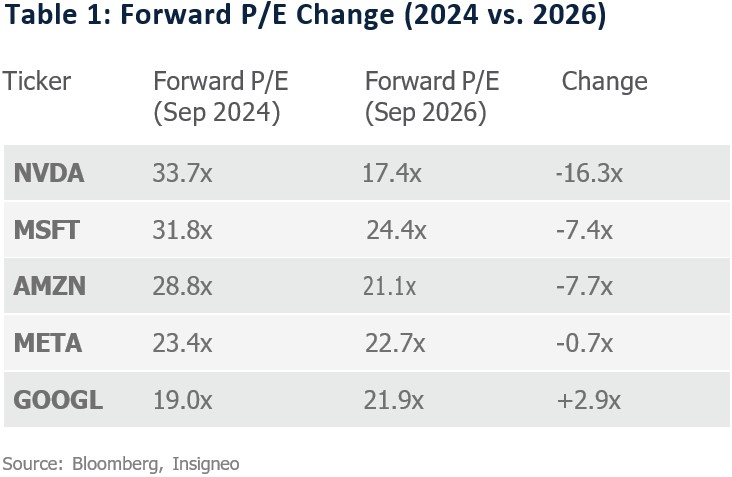
The same phenomenon appears across many AI-related companies. Over the last two years, forward valuation multiples have compressed considerably, leading some investors to argue that hyperscalers and AI beneficiaries have become cheaper. That is technically true, but only because expected earnings have increased even faster than share prices.
In other words, the apparent improvement in valuations has been driven less by falling expectations and more by increasingly ambitious assumptions about future profit-ability. Of course, these companies are not ordinary busi-nesses. They possess exceptional balance sheets, access to capital, global infrastructure, and enormous competitive
advantages. Yet even the strongest balance sheet cannot fully escape mathematical realities. Markets currently expect annual hyperscaler capex to eventually stabilize around USD 1.4 trillion. To put that figure into perspective, that is larger than the annual GDP of most countries. The obvious question then becomes: what level of revenue is required to justify such an investment?
Assuming investors demand returns over capex in the range of 30% to 50%, hyperscalers would eventually need to generate between USD 7 trillion and USD 10 trillion in annual revenue to support those expectations. Those are staggering numbers. For context, that is roughly equivalent to what the world spends annually on food or healthcare. When viewed through that lens, the debate shifts from whether AI is transformative to whether expectations around its monetization have become too ambitious.
Meanwhile, another headwind is quietly emerging. Even if earnings expectations remain elevated, the cash flow reality is becoming increasingly challenging. As the U.S. entered a new tightening cycle, the cost of financing AI infrastructure increased materially. The U.S. 10-year Treasury yield has risen from 3.62% in September 2024 to ~5.2% as of the end of September 2026. For companies funding large portions of their expansion through debt, that increase matters, as higher rates create pressure from both directions. First, higher rates increase interest expenses as companies refinance existing debt and new debt is issued. Second, they reduce the present value of the future cash flows that these investments are expected
to generate. The result is a squeeze from both ends: higher financing costs today and a lower present value assigned to tomorrow’s revenues.
Few companies have embraced the AI infrastructure buildout as aggressively as Oracle. Over the last three years, the company has significantly expanded its cloud and data center footprint, positioning itself as a key bene-ficiary of growing demand from OpenAI and other hyper-scale customers. However, that expansion has not come without a cost. Oracle’s total debt has grown from approximately USD 88 billion in mid-2023 to USD 167.4 billion as of May 2026, nearly doubling in three years. To finance its cloud infrastructure (OCI) expansion and broader AI-related investments, the company has repeatedly returned to debt markets, issuing successive tranches of bonds at increasingly higher rates.
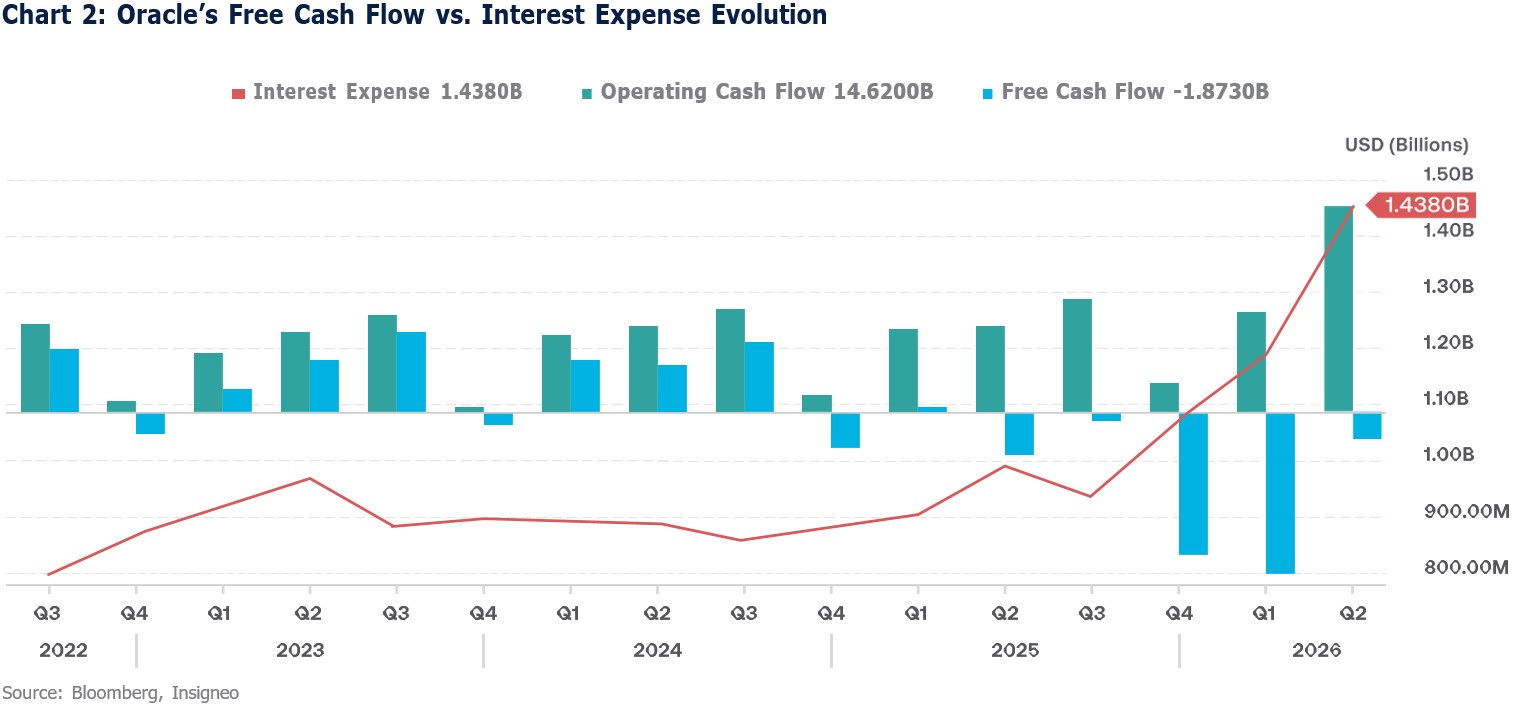
As expected, interest expenses have followed the same trajectory. Quarterly interest expense increased from roughly USD 787 million in Q1 2023 to approximately USD 1.4 billion by Q4 2026, an increase of more than 80%. At first glance, this may not appear problematic. After all, Oracle continues to generate substantial operating cash flow. In the most recent quarter alone, operating cash flow reached a record USD 14.6 billion. However, the issue is not profitability; it is the scale of investment required to compete in the AI race. Capital expenditures have expanded so rapidly that free cash flow has turned sharply negative in several recent quarters. Oracle reported negative free cash flow of USD 10.0 billion in Q2 2026 and negative USD 11.5 billion in Q3 2026, highlighting the growing gap between internally generated cash and required investment spending. The challenge is compounded by the fact that AI infrastructure buildouts are not solely constrained by capital. For example, Oracle recently issued a force majeure notice tied to Project Jupiter in New Mexico,
underscoring how permitting, energy, and construction-related bottlenecks can slow capacity expansion despite substantial ongoing investment.
Cash flow pressure can be seen in Oracle’s debt perfor-mance. Many of Oracle’s long-dated bonds were issued during the low-rate environment of 2020 and 2021, carrying coupons between 3.6% and 4.1%. Today, those same bonds trade at prices ranging from roughly 53 to 67 cents on the dollar, implying yields close to 8%. Even bonds issued as recently as September 2024 with coupons around 5.2% now yield more than 7%, trading at meaningful discounts to par value. The message from bond investors is clear: the cost of capital has changed. More importantly, every refinancing event locks in that new reality. Legacy debt issued at historically low rates gradually rolls off, while replacement debt carries materi-ally higher financing costs. Across Oracle’s 59-bond debt stack, the average yield now stands at approximately 7.16%, well above the average coupon of much of its existing debt.
None of this suggests Oracle is facing a balance sheet crisis. The company remains highly profitable and continues to benefit from strong AI-related demand. However, it serves as a useful reminder that even companies with significant financial resources cannot escape economic gravity. For a company projected to burn roughly USD 57 billion of cash through 2027 while carrying USD 135.5 billion in net debt, rising rates become more than a valuation discussion. They become a direct constraint on how quickly investment can continue expanding.
This brings us back to the question that started this discussion. Why are some of the builders of AI suddenly advocating for caution? After examining the economics of the industry, the answer appears to extend beyond safety concerns. Increasingly, companies are realizing that not every task requires the most advanced model available. Management teams are encouraging employees to use frontier models for frontier problems, not for drafting emails or summarizing routine documents. As a result, demand has gradually shifted toward cheaper and more efficient alternatives. This trend is already visible in token pricing. As model performance converges and competition intensifies, AI increasingly resembles a traditional pricing war. The best product still matters, but cost matters even more.
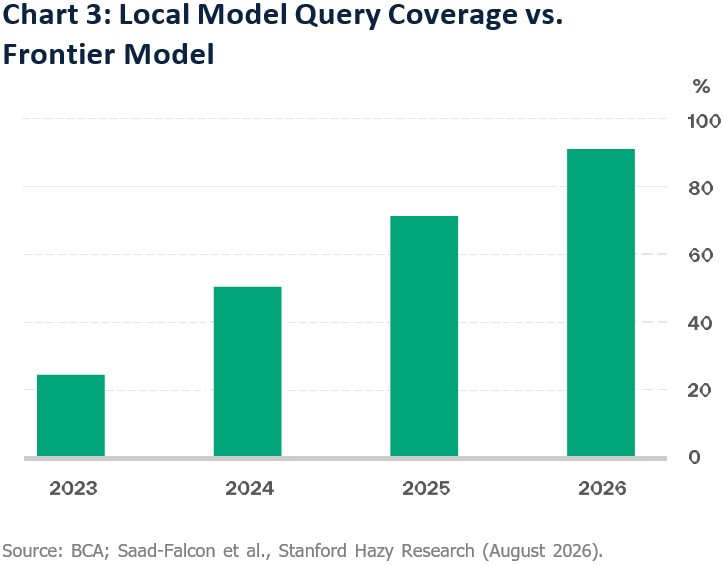 Chart 3 captures this shift particularly well. In 2023, a local model, meaning a model running directly on a personal computer or an organization’s own servers rather than in the cloud, could solve only about a quarter of the queries that a frontier model could handle. Today, that figure is approaching 90%. This should not come as a surprise. Frontier laboratories such as OpenAI and Anthropic spend billions of dollars discovering the next breakthrough. Once those breakthroughs exist, however, other devel-opers can study them, replicate them, distill them, and often deliver much of the same functionality at a fraction of the cost. In many ways, this is another manifestation of the Law of Large Numbers. Jumping from 20% capability to 80% capability is difficult, but achievable. Moving from 90% to 95%, however, often requires disproportionate amounts of capital, talent, and computational resources. The closer companies get to the technological frontier, the harder and more expensive each incremental improvement becomes.
That reality may help explain why some industry leaders have become increasingly vocal about slowing the pace of development. None of this is meant to suggest that AI safety concerns are unfounded. The risks are real and deserve serious consideration. However, the timing of these warnings inevitably raises another possibility. Are Altman, Amodei, and other industry leaders primarily trying to protect society from the unintended consequences of AI, or are they also trying to protect their businesses from intensifying competition, declining pricing power, and the extraordinary financial burden required to remain at the frontier?
The two explanations are not mutually exclusive. In fact, the most likely answer may be that both are true at the same time. As AI matures, the greatest challenge may not be the technology itself, but the economics required to stay ahead of everyone else chasing the same prize.
Insigneo” and “Insigneo Wealth” are brand names used by Insigneo Financial Group, LLC and its affiliates. Brokerage products and services are offered through Insigneo Securities, LLC, a broker-dealer, registered with the U.S. Securities and Exchange Commission (“SEC”) and a member of FINRA and SIPC. Investment advisory products and services are offered through Insigneo Advisory Services, LLC, an SEC-registered investment adviser. Because we operate through various affiliates in different locations, please visit https:// insigneo.com/legalentities/ to understand which entity you are working with and what that means for you. This material should not be construed as an offer to sell or the solicitation of an offer to buy a security. It is for general information purposes only. To the extent that this material discusses general market activity, industry or sector trends or other broad-based economic or political conditions, it should not be construed as research investment advice. To the extent that it includes references to securities, those references do not constitute a recommendation to buy, sell or hold such security. It does not constitute a recommendation or a statement of opinion, or a report of either of those things and does not, and is not intended, to consider the particular investment objectives, financial conditions, or needs of the individual investors.
Not All Risks Are Disclosed – Past performance is not indicative of futures results. Investment involves significant risk, and it is possible to lose some or all of your principal investments and therefore may not be suitable for everyone. Always consider whether any investment is suitable for your particular circumstances and, if necessary, seek professional advice from your Investment Professional. This material may contain opinions, expressions an estimated that represent the analysis and perspective of Insigneo Securities, LLC’s Investment Strategy Department or its providers at the time of publication. These are subject to change at any time without notice.
FOR AFFILIATES LOCATED IN CHILE – PARA AFILIADAS LOCALIZADAS EN CHILE
Insigneo Asesorías Financieras SPA se encuentra inscrito en Chile, en el Registro de Prestadores de Servicios Financieros de la Comisión para el Mercado Financiero. Este informe fue efectuado por área de Research & Strategy de Insigneo Securities LLC. o sus proveedores, en base a la información disponible a la fecha de emisión de este. Para evitar cualquier conflicto de interés, Insigneo Securities LLC dispone que ningún integrante del equipo de Research & Strategy tenga su remuneración asociada directa o indirectamente con una recomendación o reporte específico o con el resultado de una cartera. Aunque los antecedentes sobre los cuales ha sido elaborado este informe fueron obtenidos de fuentes consideradas confiables, no podemos garantizar la completa exactitud e integridad de estos, no asumiendo responsabilidad alguna al respecto Insigneo Securities LLC, Insigneo Asesorías Financieras SPA ni ninguna de sus empresas relacionadas. Este material está destinado únicamente a facilitar el debate general y no pretende ser fuente de ninguna recomendación específica para una persona concreta. Por favor, consulte con su ejecutivo de cuentas o con su asesor financiero si alguna de las recomendaciones específicas que se hacen en este documento es adecuada para usted. Este documento no constituye una oferta o solicitud de compra o venta de ningún valor en ninguna jurisdicción en la que dicha oferta o solicitud no esté autorizada o a ninguna persona a la que sea ilegal hacer dicha oferta o solicitud. Las inversiones en cuentas de corretaje y de asesoramiento de inversiones están sujetas al riesgo de mercado, incluida la pérdida de capital. La información base del presente informe puede sufrir cambios, no teniendo Insigneo Securities LLC ni Insigneo Asesorías Financieras SPA la obligación de actualizar el presente informe ni de comunicar a sus destinatarios sobre la ocurrencia de tales cambios. Cualquier opinión, expresión, estimación y/o recomendación contenida en este informe constituyen el juicio o visión de área de Research & Strategy de Insigneo Securities LLC. o sus proveedores, a la fecha de su publicación y pueden ser modificadas sin previo aviso.
FOR AFFILIATES LOCATED IN URUGUAY- PARA AFILIADAS LOCALIZADAS EN URUGUAY
Insigneo Asesor Uruguay S.A. está inscripto en el Registro de Mercado de Valores del Banco Central del Uruguay como Asesor de Inversiones. En Uruguay, los valores están siendo ofrecidos en forma privada de acuerdo al artículo 2 de la ley 18.627 y sus modificaciones. Los valores no han sido ni serán registrados ante el Banco Central del Uruguay para oferta pública. Este material está destinado únicamente a facilitar el debate general y no pretende ser fuente de ninguna recomendación específica para una persona concreta. Por favor, consulte con su ejecutivo de cuentas o con su asesor financiero si alguna de las recomendaciones específicas que se hacen en este documento es adecuada para usted según su perfil y estrategia de inversión. Este documento no constituye un asesoramiento ni una recomendación u oferta o solicitud de compra o. Las inversiones en valores negociables están sujetas al riesgo de mercado, incluida la pérdida parcial o total del capital invertido. Cualquier opinión, expresión, estimación y/o recomendación contenida en este informe constituyen el juicio o visión de área de Research & Strategy de Insigneo Securities LLC. o sus proveedores, a la fecha de su publicación y pueden ser modificadas sin previo aviso. Rentabilidades históricas de los productos anunciados no aseguran rentabilidades futuras.
FOR AFFILIATES LOCATED IN ARGENTINA – PARA AFILIADAS LOCALIZADAS EN ARGENTINA
Insigneo Argentina S.A.U. Agente Asesor Global de Inversión se encuentra registrado bajo el N° 1053 de la Comisión Nacional de Valores (CNV) e inscripto ante la Inspección General de Justicia (IGJ) bajo el N° 12.278 del Libro 90, Tomo –, de Sociedades por Acciones. Este informe fue efectuado por área de Research & Strategy de Insigneo Securities LLC. o sus proveedores, en base a la información disponible a la fecha de su emisión. Para evitar cualquier conflicto de interés, Insigneo Securities LLC dispone que ningún integrante del equipo de Research & Strategy tenga su remuneración asociada directa o indirectamente con una recomendación o reporte específico o con el resultado de una cartera. Aunque los antecedentes sobre los cuales ha sido elaborado este informe fueron obtenidos de fuentes consideradas confiables, no podemos garantizar la completa exactitud e integridad de estos, no asumiendo responsabilidad alguna al respecto Insigneo Securities LLC, Insigneo Argentina S.A.U. ni ninguna de sus empresas relacionadas. La información base del presente informe puede sufrir cambios, no teniendo Insigneo Argentina S.A.U. la obligación de actualizar el presente informe ni de comunicar a sus destinatarios sobre la ocurrencia de tales cambios. Este material está destinado únicamente a facilitar el debate general y no pretende ser fuente de ninguna recomendación específica para una persona concreta. Por favor, consulte con su ejecutivo de cuentas o con su asesor financiero si alguna de las recomendaciones específicas que se hacen en este documento es adecuada para usted. Este documento no constituye una oferta, recomendación o solicitud de compra o venta de ningún valor negociable en ninguna jurisdicción en la que dicha oferta o solicitud no esté autorizada o a ninguna persona a la que sea ilegal hacer dicha oferta o solicitud. Las inversiones en valores negociables están sujetas al riesgo de mercado, incluida la pérdida parcial o total del capital invertido. Cualquier opinión, expresión, estimación y/o recomendación contenida en este informe constituyen el juicio o visión de área de Research & Strategy de Insigneo Securities LLC. o sus proveedores, a la fecha de su publicación y pueden ser modificadas sin previo aviso.
FOR AFFILIATES LOCATED IN COLOMBIA – PARA AFILIADAS LOCALIZADAS EN COLOMBIA
Oficina De Representación en Colombia
La Oficina de Representación fue autorizada por la Superintendencia Financiera de Colombia el 5 de febrero de 2021, para promover o publicitar en Colombia, o a sus residentes, los productos y servicios del mercado de valores ofrecidos por Insigneo Securities, LLC e Insigneo Advisory Services, LLC. La información contenida en este informe ha sido obtenida de fuentes consideradas confiables; no obstante, no se garantiza su exactitud ni integridad, no asumiendo responsabilidad alguna Insigneo Securities, LLC e Insigneo Advisory Services, LLC ni sus entidades relacionadas. Este material tiene fines exclusivamente informativos y no constituye una recomendación personalizada. Las inversiones están sujetas a riesgos de mercado, incluida la posible pérdida de capital, por lo que se recomienda consultar con su asesor financiero. La información, opiniones y estimaciones aquí contenidas corresponden a la fecha de publicación, pueden ser modificadas sin previo aviso y no existe obligación de actualización por parte de las entidades mencionadas.
DM Wealth Management Group is the “doing business as entity” through which Cristina Mendez, Zoraida Diaz, and Debra Tyler, investment professionals (“IP”) of Insigneo Securities, LLC (“ISEC”) and Insigneo Advisory Services, LLC (“IAS”) conducts securities and advisory activities DM Wealth Management Group is not itself a broker dealer or an investment advisor and is not under common ownership with ISEC or IAS. Insigneo Financial Group, LLC comprises a number of operating businesses engaged in the offering of brokerage and advisory products and services in various jurisdictions. Brokerage products and services are offered through Insigneo Securities, LLC, a broker-dealer registered with the U.S. Securities and Exchange Commission (“SEC”) and member of FINRA and SIPC. Investment advisory products and services are offered through Insigneo Advisory Services, LLC, an investment adviser registered with the SEC. Insigneo has affiliated companies in different locations, so it is important to understand which entity you are conducting business with. Please visit "https://insigneo.com/legalentities" for more information about the differences between these companies, their locations, and what that means for you.
Investing involves risk, including possible loss of principal. Past performance is not indicative of future results. Please consult your Investment Professional for any recommendation regarding your specific financial situation.
Click on the following links to view ISEC Reg BI Client Relationship Summary (“Form CRS”) and IAS Form ADV Part 3 CRS.
The following content is provided by Insigneo, the firm through which DM Wealth Management’s investment professionals offer brokerage and advisory services. Visit insigneo.com to learn more.